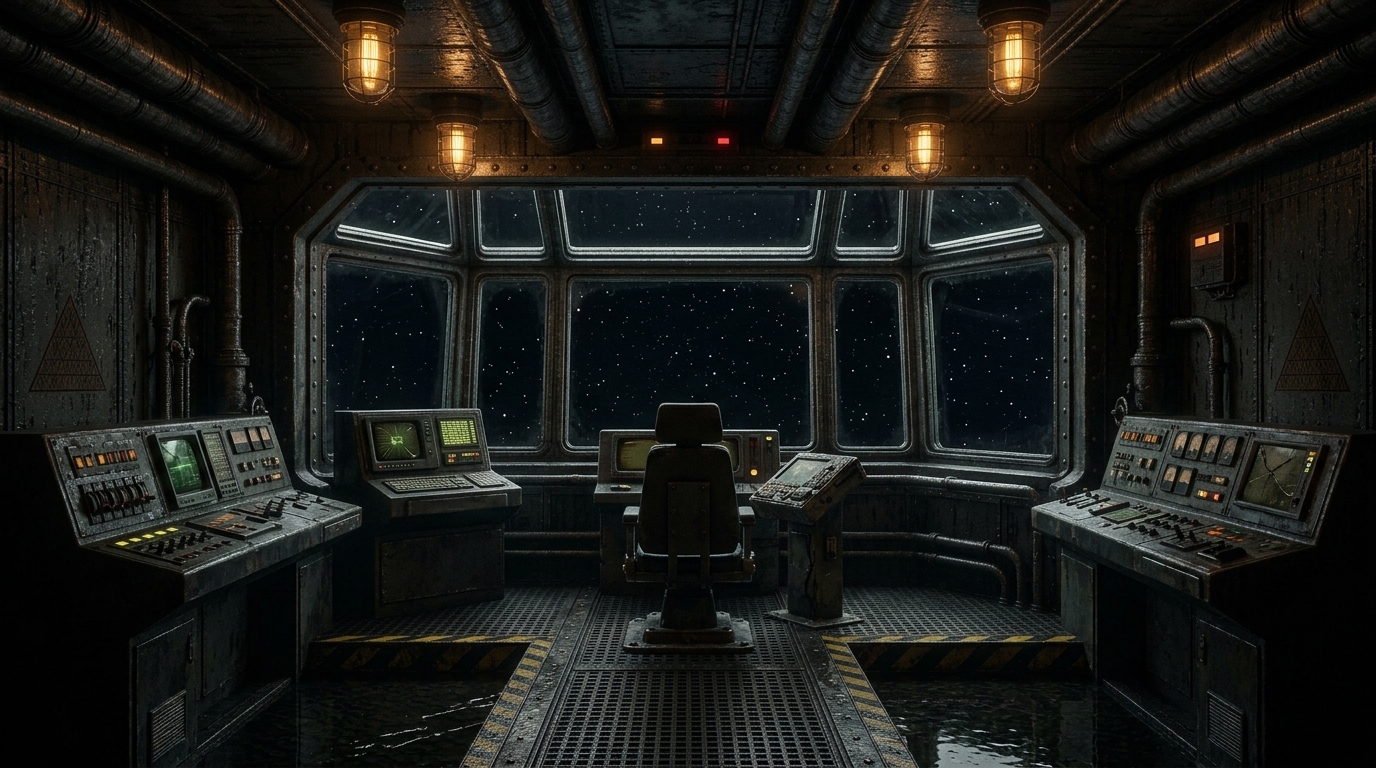
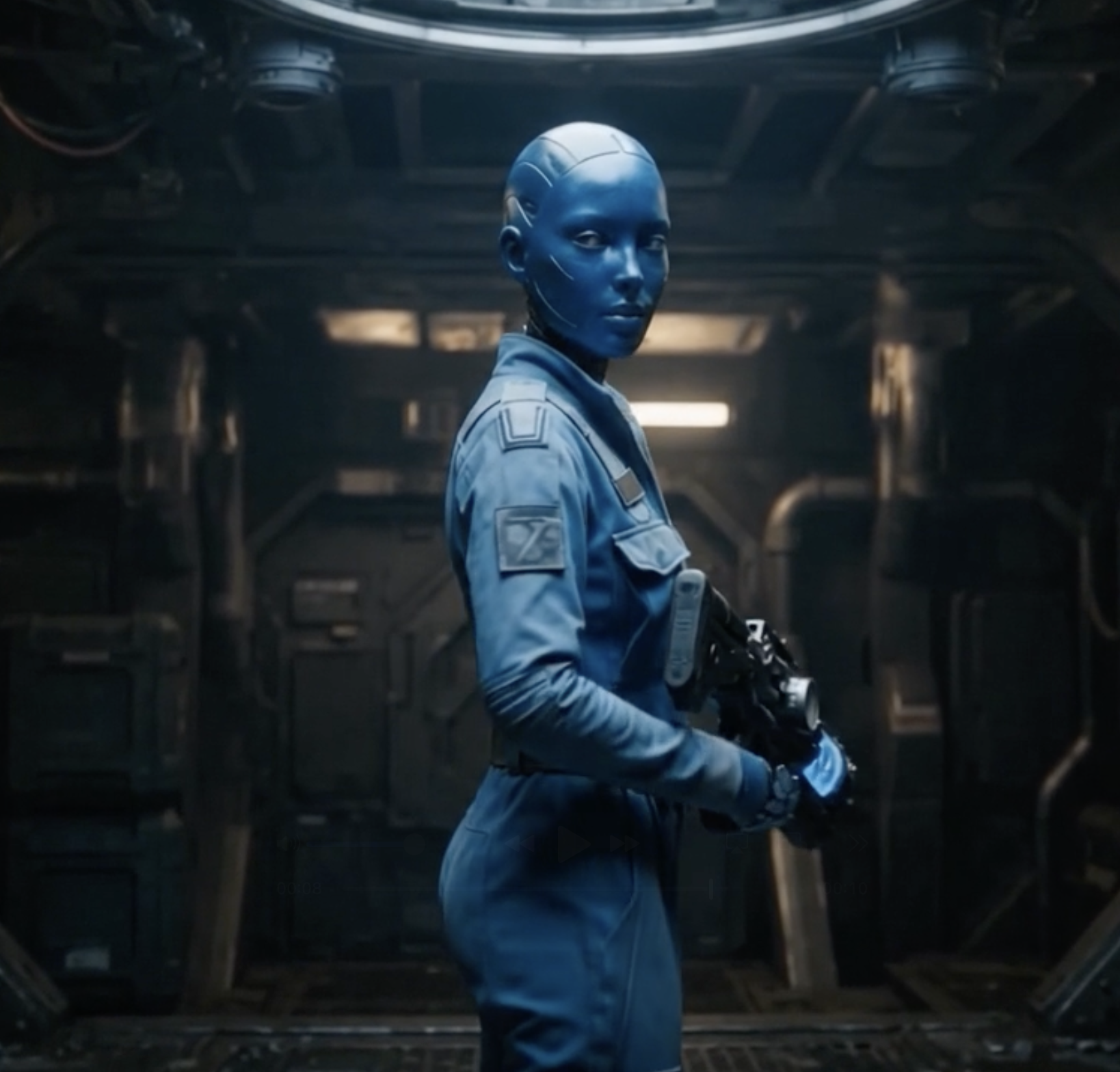
[An away team made up of Colonel Jack O’Neill, Dr. Daniel Jackson, the android/AI Rommie, and Dr. Rodney McKay has been dispatched to investigate a seemingly derelict freighter. On board, they discover a service android named Maia who offers to accompany them to the bridge – but first they must make a detour to avoid a compromised section of the ship.]
The away team waits as Rommie checks the forward compartment. Moments later she returns and confirms Maia was telling the truth. Had they unsealed it, they’d have been hit with a wave of hard radiation that would have shut her down, fried their comms and sensors, and slightly irradiated their testes.
Maia says nothing. She merely turns and continues on her way.
You follow, taking the detour around the compromised section, and finally reach the bridge. Its doors slide open on Maia’s neural command, giving the team full access. Maia and Rommie immediately get to work, isolating the damaged decks, restoring life support, and killing the emergency beacon before it draws any unwanted company.
Rommie notes that the ship’s database has been corrupted by whatever it encountered out there, but she has turned up something very interesting. When the atemporal entity entered this reality, knocking the Waldorf Astoria out of FTL, the freighter’s sensors recorded and analyzed the event as it happened. According to this analysis, the rift it passed through carries the same harmonics as the residual traces of their own crossings into this universe. This could well be their key to getting home. But the data is fragmentary and corrupted, and it will take some time to decipher.
Daniel, at that point, reminds them of the lone life sign a few sections over, still flickering but now growing fainter. He wants it made the priority. Maia informs them that the Waldorf Astoria was on an unmanned long haul run, and warns this life sign is likely the entity she warned them about. She wants to accompany them but there is a much more pressing issue that demands her attention.
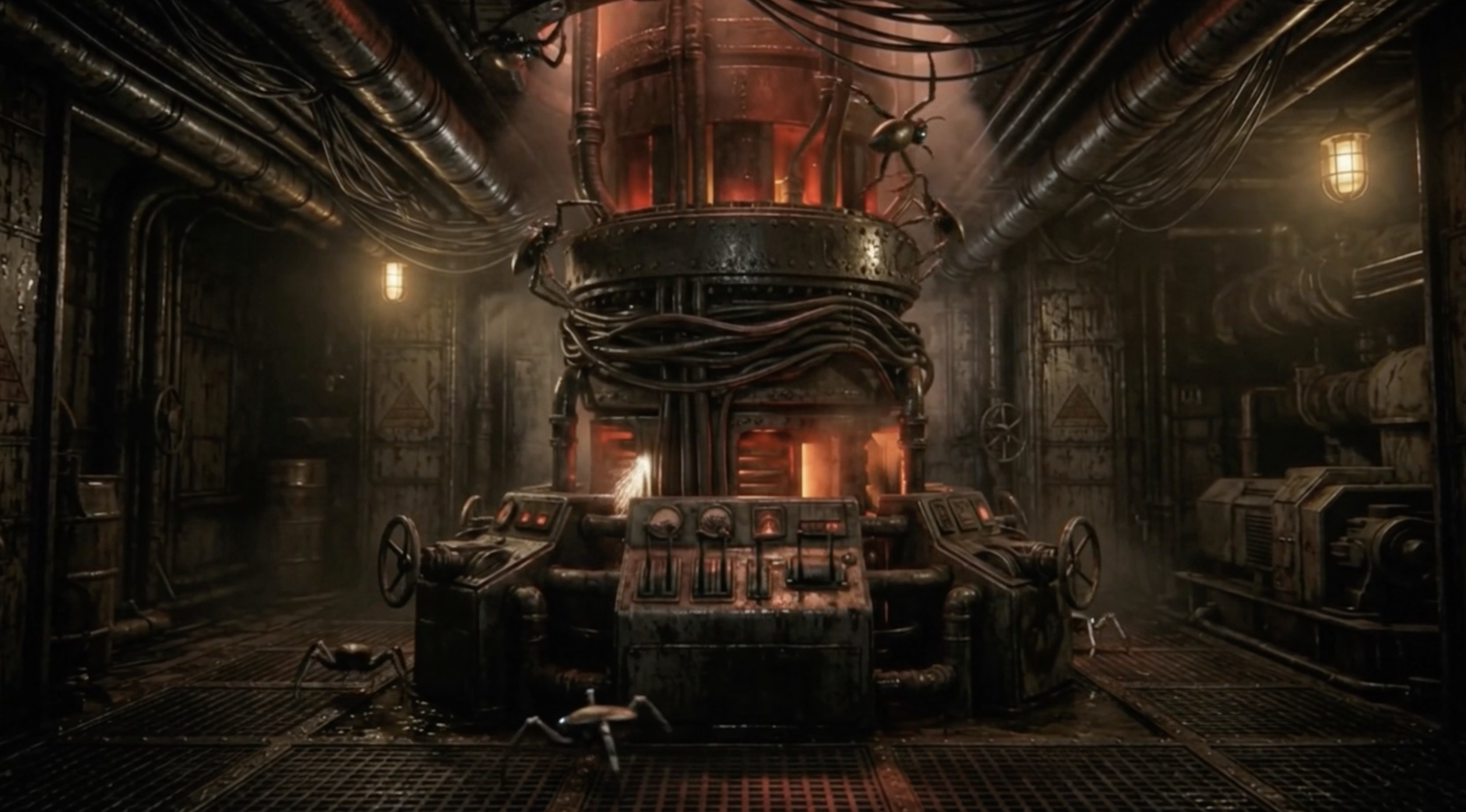
One of the consoles reveals the anomaly’s pulses have fried the core’s automated containment and regulation, and the reactor is climbing towards a breach, maybe less than an hour from critical. It can’t be stopped from the bridge. Someone has to head to engineering and vent the drive by hand.
What do you do?
A) Wait for Rommie to decipher the corrupted database and retrieve a potential clue to the way home.
B) Investigate the life sign. Reach it before it fades, whatever it turns out to be.
C) Go to engineering and vent the drive. Save the ship.
D) Split the team. O’Neill’s call. He and Daniel will investigate the life sign, McKay accompanies Maia to engineering, while Rommie stays on the bridge to decipher the corrupted data. Everything gets done, but it does spread them thin.
CHOOSE!
Previously On Amalgaverse…
You and 19 others have been stranded in an amalgam universe of myriad SF realities. All 19 are sci-fi’s Best of the Best. And then there’s you, uniquely qualified given your encyclopedic knowledge garnered from your world where these characters, their technologies, and their stories are fiction, beloved TV shows you have watched time and again. Together, all 20 of you have set off on the Enterprise-D, tasked with finding a way home.
For your first mission, you’ve decided to investigate a seemingly derelict freighter broadcasting an emergency beacon. An away team and puddle jumper have been dispatched to the ghost ship, anomalous energy pulses making beaming and communications a challenge.
After parking and cloaking the puddle jumper in the freighter’s hangar, the team crosses the airless bay into the ship proper. There, they make the decision to check out the waning energy signature of a containment field en route to the bridge. But they immediately encounter a utility unit that advances on them menacingly. Rommie connects to it and relays a shut down command that causes the robot to collapse.
Further along, they encounter a sealed door and Rommie informs them that the compartment beyond is exposed to space. She suggests locking down their current section and then unsealing the door since it’s the most direct route to the bridge – and that ebbing containment field. They do so. The door slides open to reveal an immense hull breach complicating their progress. Rommie leaps over the chasm and secures a tether to the other side, allowing the rest of the team to pull themselves over. But when they attempt to open the door to the next section, they hit an impasse. The door remains locked and will not respond to their commands.
O’Neill blows the lock with C4, allowing them entry into the adjoining compartment where they discover an android in a containment field, completing its regenerative cycle. When the android awakens, it informs them it is the caretaker of this freighter, the Waldorf Astoria, and warns them off pillaging its contents. Daniel assures the android, Maia, that they harbor no ill intent and ask for her assistance in accessing the bridge and restoring ship’s systems. But Maia remains suspicious. She requests a peer-to-peer interface with Rommie to confirm that your presence on the freighter is, in fact, benign. Rommie agrees, satisfying Maia’s request. Maia explains that her memory stores and parts of the ship were damaged after the freighter encountered an atemporal force during FTL transit. She offers to help the team access the ship’s systems in exchange for their assistance in tracking down and eradicating a mysterious entity that has boarded the freighter.
On your way to the bridge, Maia takes a detour, explaining that the forward compartment has been compromised by a radiation leak. The team considers whether to believe her or not.
***

Barry N. Malzberg
A writer known for his bleak, distinctive, and darkly funny body of work.
Beyond Apollo (1972): This critique of the space program follows the sole survivor of a doomed mission to Venus and his contradictory accounts of exactly what happened.
Herovit’s World (1973): A burned-out sci-fi writer loses his grip on reality as his fictional characters intrude on his life in this metafictional novel.
Galaxies (1975): A metafictional deconstruction of the space opera in which a writer continuously intrudes on his narrative to explain why it is fundamentally unwritable.
“Understanding Entropy” (1994): A dying man who abandoned his family is questioned across time about whether he would do it all over again in this Hugo and Nebula Award-nominated short story that explores freedom, regret, and human relationships.

Paul Preuss
Whose hard SF blended rigorous science with human drama and intrigue.
Secret Passages (1997): An aged Cretan quantum physicist uses a cache of Minoan treasure to lure a theoretician and a photographer to his home island, where he stages a radical experiment premised on the notion that the past can be recovered from the present.
Broken Symmetries (1983): Espionage, political intrigue, and particle physics collide when scientists at a massive particle accelerator in Hawaii discover a new subatomic particle with potentially devastating military applications.
Human Error (1985): This novel explores the ethical fallout after a bio-tech firm turns genetically engineered viruses into living biochips.
Starfire (1988): Preuss’s understanding of orbital mechanics and space technology is on full display in this novel about a NASA mission to an asteroid on a perilously close orbit around the sun.

Lloyd Biggle Jr.
Who was known for his humanistic SF that championed art, music, and cultural exchange over conflict.
The Tunesmith (1957): In a dystopian future where music has been reduced to commercial jingles, a composer discovers the transformative effects truly creative music can have on society.
The Still, Small Voice of Trumpets (1968): An interplanetary relations agent attempts to introduce democracy to a totalitarian world through art and music.
Monument (1974): Expanded from his 1961 novelette, and a 1962 Hugo nominee, this ecological SF novel follows a marooned spacer who prepares the inhabitants of an isolated planet for the coming wave of outside developers.
The Metallic Muse (1972): This stories in this collection gathers seven of Biggle’s strongest stories, several of which explore his recurring themes art, music, and their power to transform society.



Leave a Reply