The team elects to let Rommie lead.
She clips one end of the tether to the near wall, then backs down the corridor, paying out the line behind her. At the far end, she stops, sets herself, and runs. Boots pounding the plating, she hits the lip of the breach and launches herself.
For a moment, she’s airborne over the chasm, the sea of stars beneath her, arms wheeling. Then the far grating comes up fast and – WHAM – she lands in a crouch, mag boots snapping tight to the deck. She rises, tugs the line taut and anchors it to the far side, establishing a bridge of sorts.
One by one, the others follow, hand over hand along the tether. O’Neill goes first. Then McKay, hauling himself with his eyes fixed ahead and absolutely not on the bottomless dark beneath him. Daniel brings up the rear.
Safe on the far side, they try the door.
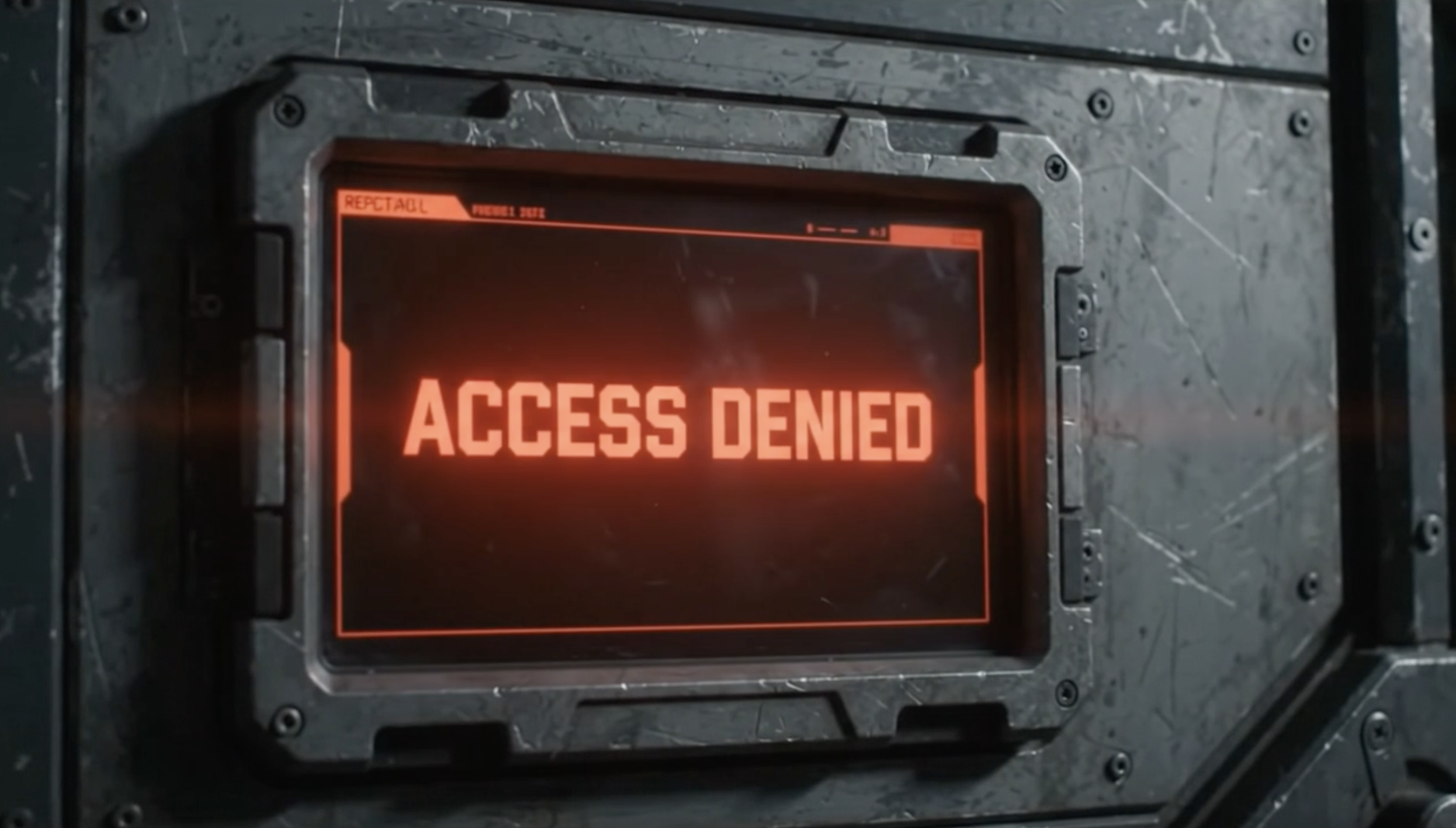
Nothing. A red ACCESS DENIED flashes back at them.
Rommie reaches into the lock, feeling for a way in, but the door refuses her. McKay elbows his way in, confident that it is finally his turn to shine. He works the manual panel, cross-wiring the override by hand. Still nothing. The door holds.
“We have to go back,”says McKay, throwing his hands up in frustration.
“Not necessarily,”says Daniel. Everyone follows his gaze down to the breach. “We could, uh…go for a stroll with a view?”
“You’re…not serious,”says McKay.
Rommie backs Daniel. She reviewed the freighter’s layout before they boarded and there’s an airlock topside that should put them down outside the compartment housing the containment field. Out through the breach, a short walk across the hull, and in through the airlock. Simple. But she adds one caveat: out on the exposed hull, those anomalous pulses hit hardest, and if one catches her mid-crossing, it could scramble her systems at the worst possible time. In which case they would have to unlock her mag boots and carry her the rest of the way. Fortunately for them, she would be weightless.
McKay points out, again, they could simply turn around. That’s the other option.
But O’Neill brings up a third. They could always blow the door with C4. Then, off the look McKay throws him: “Not a lot of C4. Just enough to blow the door.”
“And exactly how much C4 would that require?”asks McKay.
“Just a smidge,”says Jack.
“Just a SMIDGE of C4?”asks an incredulous McKay.
“Give or take,”concedes O’Neill.
So what do you do?
A. Take a stroll
B. Blow the door
C. Turn back and find another way around
CHOOSE!
PREVIOUSLY ON…
You and 19 others have been stranded in an amalgam universe of myriad SF realities. All 19 are sci-fi’s Best of the Best. And then there’s you, uniquely qualified given your encyclopedic knowledge garnered from your world where these characters, their technologies, and their stories are fiction, beloved TV shows you have watched time and again. Together, all 20 of you have set off on the Enterprise-D, tasked with finding a way home.
For your first mission, you’ve decided to investigate a seemingly derelict freighter broadcasting an emergency beacon. An away team and puddle jumper have been dispatched to the ghost ship, anomalous energy pulses making beaming and communications a challenge. After parking and cloaking the puddle jumper in the freighter’s hangar, the team crosses the airless bay into the ship proper. There, they make the decision to check out the waning energy signature of a containment field en route to the bridge. But they immediately encounter a utility unit that advances on them menacingly. Rommie connects to it and relays a shut down command that causes the robot to collapse. Further along, they encounter a sealed door and Rommie informs them that the compartment beyond is exposed to space. She suggests locking down their current section and then unsealing the door since it’s the most direct route to the bridge – and that ebbing containment field. They do so. The door slide open to reveal an immense hull breach complicating their progress. A plan is formulated. One of them will jump the chasm with a tether they will secure to the other side which will allow the rest of the team to cross over.
***

L. Sprague de Camp
A giant of the field celebrated for his social satire, alternate histories, and time-travel stories.
Lest Darkness Fall (1939/1941): Archaeologist Martin Padway is transported to sixth-century Italy, where he uses modern engineering, double-entry bookkeeping, and the printing press in his bid to avert the coming Dark Ages.
A Gun for Dinosaur (1956): Over drinks, a time-safari guide explains exactly why he won’t take an underweight client back to the Cretaceous to hunt a ceratopsian.
The Wheels of If (1940): A New York district attorney finds himself shifting between alternate versions of North America, each shaped by different historical outcomes.
Aristotle and the Gun (1958): A modern physicist tries to accelerate scientific progress by influencing Aristotle – with ironic consequences.

Fritz Leiber
SFWA Grand Master
The Big Time (1958): This Hugo Award-winning novel plays out like a stage play, set entirely inside a lounge beyond space and time where soldiers from every era take a breather from a cosmic war.
The Wanderer (1964): Global chaos ensues when a rogue planet suddenly appears beside Earth in this Hugo-winning disaster novel.
“A Pail of Air” (1951): This unforgettable post-apocalyptic short story follows a family’s struggle to survive after the Earth is pulled out of its orbit around the Sun.
Gather, Darkness! (1943): This sharp satire of religion and authority explores a world where an advanced theocracy rules through science disguised as divine power, while rebels fight back using science masquerading as witchcraft.

George Turner
Who published his first SF novel at the age of 61.
The Sea and Summer (1987): Titled Drowning Towers in the U.S., this Arthur C. Clarke Award-winner is set in a near future where climate change and economic collapse have divided society between the privileged Sweet elite and the impoverished Swill underclass.
Brain Child (1991): A genetic experiment produces humans with enhanced intelligence in this thriller exploring the ethics of genetic and social engineering.
Beloved Son (1978): An interstellar crew returns to a transformed, post-apocalyptic Earth, where the rebuilt society regards them as dangerous throwbacks to the violence that nearly wiped out humanity. Turner’s first SF novel, it is also the opening book of his loosely connected Ethical Culture sequence.
The Destiny Makers (1993): Set in a bleak, overpopulated Australia, this political thriller follows a police detective who uncovers a high-level government conspiracy involving forbidden medical technology and state-controlled population management.






Leave a Reply