
FRED SABERHAGEN
Best known for his Berserker series, a foundational machine-war saga.
Berserker (1967): A collection of eleven linked stories that launched the mythos of the Berserkers, ancient self-replicating war machines programmed to extinguish all life. Sharp and chilling in its exploration of humanity’s relationship with technology.
Brother Assassin (1969): This tight and inventive entry in the Berserker series sees the machines attacking humanity’s past through time travel, forcing a human protagonist to take temporal counter-measures.
The Veils of Azlaroc (1978): The wildly imaginative standalone novel takes place on a planet where, at yearly intervals, a veil of energy falls and seals everyone present into a frozen pocket of time, leaving generations of settlers stacked together yet out of phase with one another.
Berserker Man (1979): The most character-driven book in the series explores an endgame where humanity’s last hope against the killer machines is an eleven-year-old boy – the one mind in a hundred billion who can meld with Lancelot, an experimental weapon that fuses pilot and machine into one.

JACK VANCE
Another giant of speculative fiction.
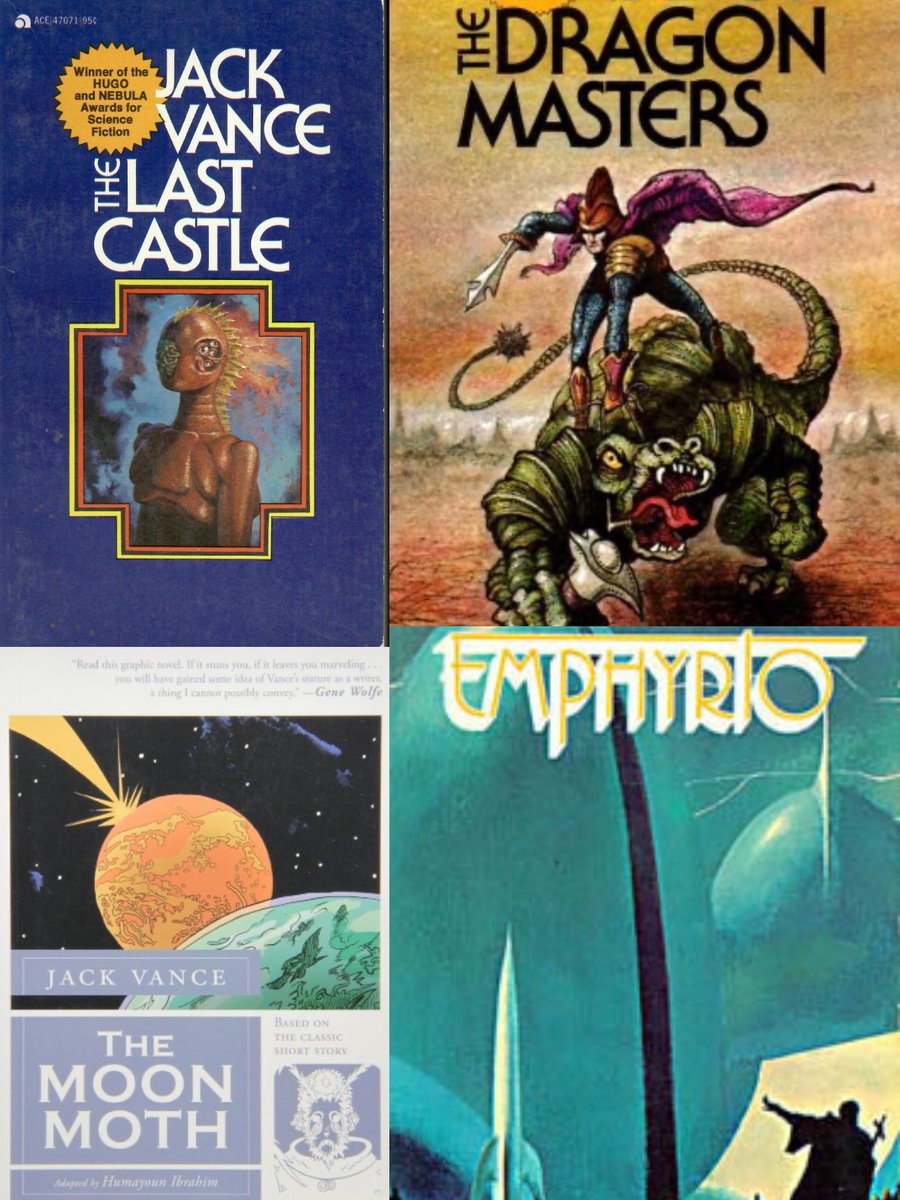
The Last Castle (1966): Decadent future humans in a castle fortress must confront their rebellious alien servants in this Hugo and Nebula Award-winning novella.
Emphyrio (1969): Arguably his most emotionally resonant novel, this one tells the story of a young artisan who uncovers the exploitative foundations of a beautiful but deeply stratified society.
The Moon Moth (1961): In this masterpiece novelette, a Terran diplomat must hunt down a disguised assassin on an alien world. To do so, he must navigate an anthropological nightmare where communication is sung through musical instruments and social status is dictated by elaborate masks.
The Dragon Masters (1962): This Hugo winner is set on an isolated world where humans have bred captured alien invaders into specialized bio-weapons for warfare— a grim mirror of what the invaders have done to the humans they have captured.

LEIGH BRACKETT
The Queen of Space Opera, Brackett was an accomplished screenwriter. Her contributions to the field included – among other notable works – the classic noir The Big Sleep and an early draft of The Empire Strikes Back.
The Long Tomorrow (1955): Set in a technophobic, agrarian post-nuclear America, it follows two cousins seeking the legendary hidden enclave of Bartorstown where science is secretly preserved. Compassionate, thoughtful, and profoundly human, it earned a well-deserved Hugo nomination for Best Novel.
The Sword of Rhiannon (1953): A high-water mark for the sword-and-planet subgenre. It tells the breakneck tale of an archaeological thief hurled into Mars’s ancient, oceanic past, where he is caught up in a mythic, planet-spanning conflict.
The Last Days of Shandakor (1952): A gorgeous, elegiac novelette that follows an Earthman’s discovery of a doomed, legendary Martian city – and the ancient elder race quietly suffocating under the illusion of their own vanished glory.
The Moon That Vanished (1948): A masterclass in atmosphere set on an oppressive, misty Venus. It tracks a man’s obsessive quest for the Moonfire – the godlike, life-wasting remnant of the planet’s long-vanished moon.



Leave a Reply