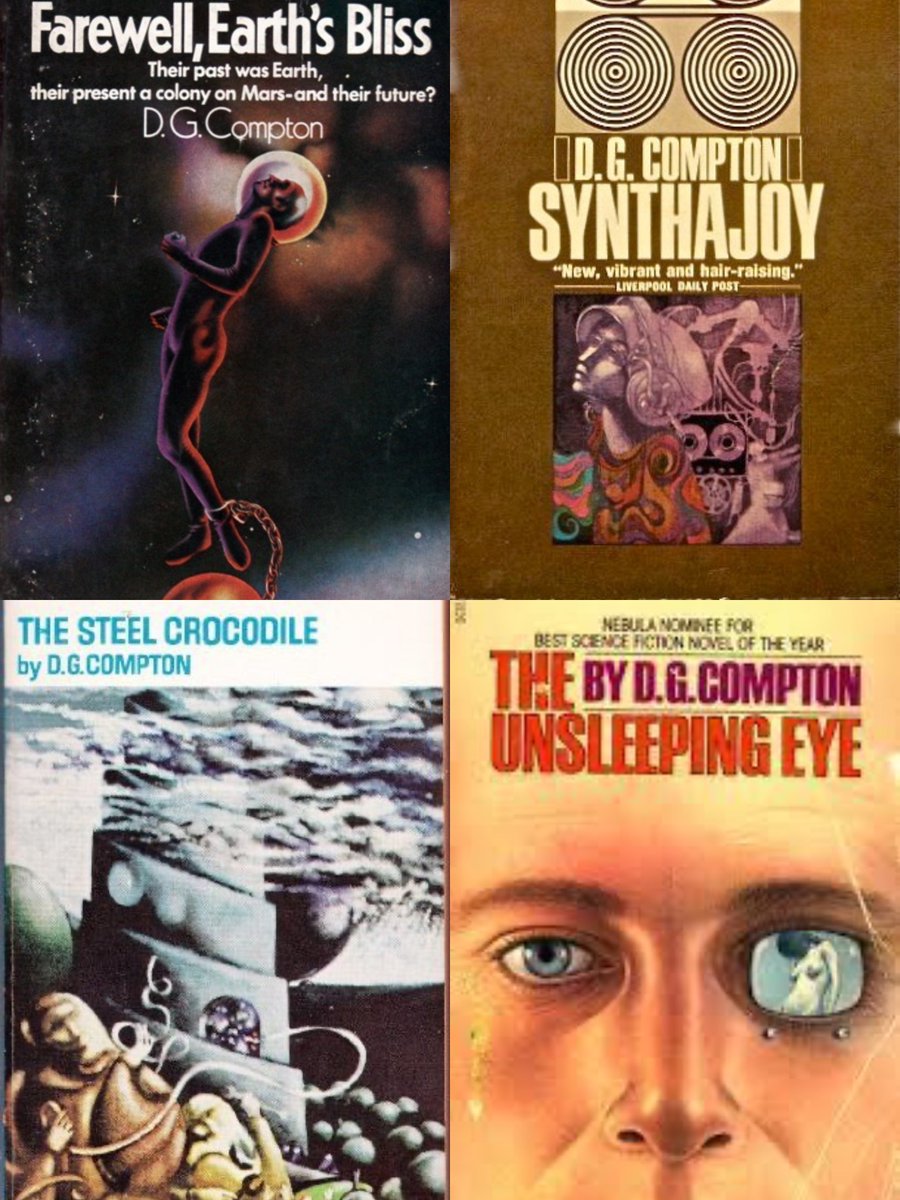

D.G. Compton
D.G. Compton was an author of SF’s New Wave era whose works explored the psychological and ethical realities in the face of technological creep.
The Continuous Katherine Mortenhoe, aka The Unsleeping Eye (1974): A reporter has a camera surgically implanted in his eye in order to film the decline of a terminally ill woman. Written decades before the advent of reality television, this novel proved prophetic in its exploration of media sensationalism and the death of privacy.
Synthajoy (1968): A neuro-technology allows users to experience the recorded emotions and memories of others. The story unfolds in a unique fragmented style, told from the POV of a woman undergoing psychological treatment as she pieces together her past.
The Steel Crocodile (1970): A super computer guides humanity’s progress via controlled targeting of technological advancements, but some individuals begin to question who, exactly, should decide the Greater Good.
Farewell, Earth’s Bliss (1966): This bleak, claustrophobic novel set on a Mars penal colony follows a group of convicts who must struggle to survive in their harsh new environment.

Thomas M. Disch
A New Wave era powerhouse.
Camp Concentration (1968): Set in a near-future military prison, inmates are injected with a mutated strain of syphilis that enhances their intellect before eventually killing them. Told through journal entries, this devastating Faustian critique of the military-industrial complex overflows with theological and philosophical allusions.
334 (1972): This mosaic novel follows the lives of the residents of 334 East 11th Street in dystopian New York City. Its focus is ordinary people struggling to survive in a bureaucratic welfare state.
The Genocides (1965): Disch’s debut novel is a response to the human-centric works of SF’s Golden Age. Here, Earth is invaded by fast-grown alien vegetation. The unseen alien cultivating them view humanity as vermin to be exterminated.
On Wings of Song (1979): Considered to be one of his saddest works, this novel explores spiritual freedom through protagonist Daniel Weinreb’s pursuit of “flight”, astral projection achieved via song.

Alice Bradley Sheldon
Author Alice Bradley Sheldon published under the pseudonym James Tiptree, Jr.
The Screwfly Solution (1977): Published under her other pseudonym, Raccoona Sheldon, this Nebula Award winning novelette is a chilling sci-fi horror story. It chronicles an alien-engineered agent that drives men to kill women and adolescent girls.
Houston, Houston, Do You Read? (1976): Winning both the Hugo and Nebula Awards for Best Novella, this one follows a crew of 20th century astronauts who are flung forward in time to an Earth where men have been wiped out by a pandemic and cloned women rule the planet.
The Girl Who Was Plugged In (1973): A pre-Cyberpunk Cyberpunk tale of a deformed woman who pilots a beautiful celebrity body to market products in a future where advertising has been banned. This Hugo Winning novella is shockingly prescient about influencer culture and virtual identities.
Love Is the Plan the Plan Is Death (1973): This tragic Nebula Award-winning short story is told from the POV of an alien insect-like entity doomed to its inevitable biological programming.

Stargate fans, take note! Fans will be flying a banner of Amazon/MGM Headquarters tomorrow!


Leave a Reply