
Zenna Henderson
A writer whose gentle, character-driven science fiction explored themes of belonging, compassion, and what it means to be an outsider.
“Pottage” (1955): Adapted into the 1972 TV movie The People starring William Shatner, this novelette follows a schoolteacher who arrives in a small, isolated mining town and discovers that its grim, fearful community is hiding extraordinary psychic abilities – gifts its members have suppressed out of terror, and which surface despite themselves in her schoolchildren.
“Captivity” (1958): One of Henderson’s most emotionally affecting works, and a 1959 Hugo finalist, this powerful novella centers on a paralyzed schoolteacher and her struggle to reach the “Francher kid”, a rebellious, alienated boy whose remarkable gifts have left him ready to turn his back on humanity altogether.
“Ararat” (1952): The historic first story in Henderson’s acclaimed People series introduces an isolated community of extraterrestrial refugees forced to conceal their remarkable abilities while living quietly among humans who would fear and reject them if the truth were known.
“The Anything Box” (1956): A deceptively simple and quietly devastating story about a troubled little girl who finds comfort in an invisible box. When her teacher begins to understand what the box truly represents, the narrative moves toward a haunting conclusion that balances beautifully between madness and miracle.

Pauline Ashwell
The Lost Kafoozalum (1960): Highlighted in Richard A. Lupoff’s What If? Stories That Should Have Won the Hugo, this Hugo-nominated novella follows a daring cultural-engineering project designed to avert an impending nuclear holocaust on an isolated colony world.
Unwillingly to Earth (1992): This fix-up novel collects all four of her Lizzie Lee stories (including her Hugo-nominated debut). It’s a joyous coming-of-age adventure across the galaxy, featuring one of SF’s most engaging and capable heroines.
Unwillingly to School (1958): The story that started it all. This opening movement introduces Lizzie Lee, a tough, resourceful girl from a rough mining planet, setting off a journey that traces her evolution from a reluctant student to a master of cultural engineering. A fun, beloved adventure.
Project FarCry (1995): Ashwell’s characteristic warmth and problem-solving focus are on full display in this fix-up novel, which expands and unifies her 1958 novelette Big Sword and her 1993 short novel The Man Who Stayed Behind. It follows a hidden young telepath navigating the complex puzzles of alien biology, first contact, and telepathic communication.
Frederik Pohl
An SF Grand Master whose career spanned more than seven decades and helped define modern science fiction.
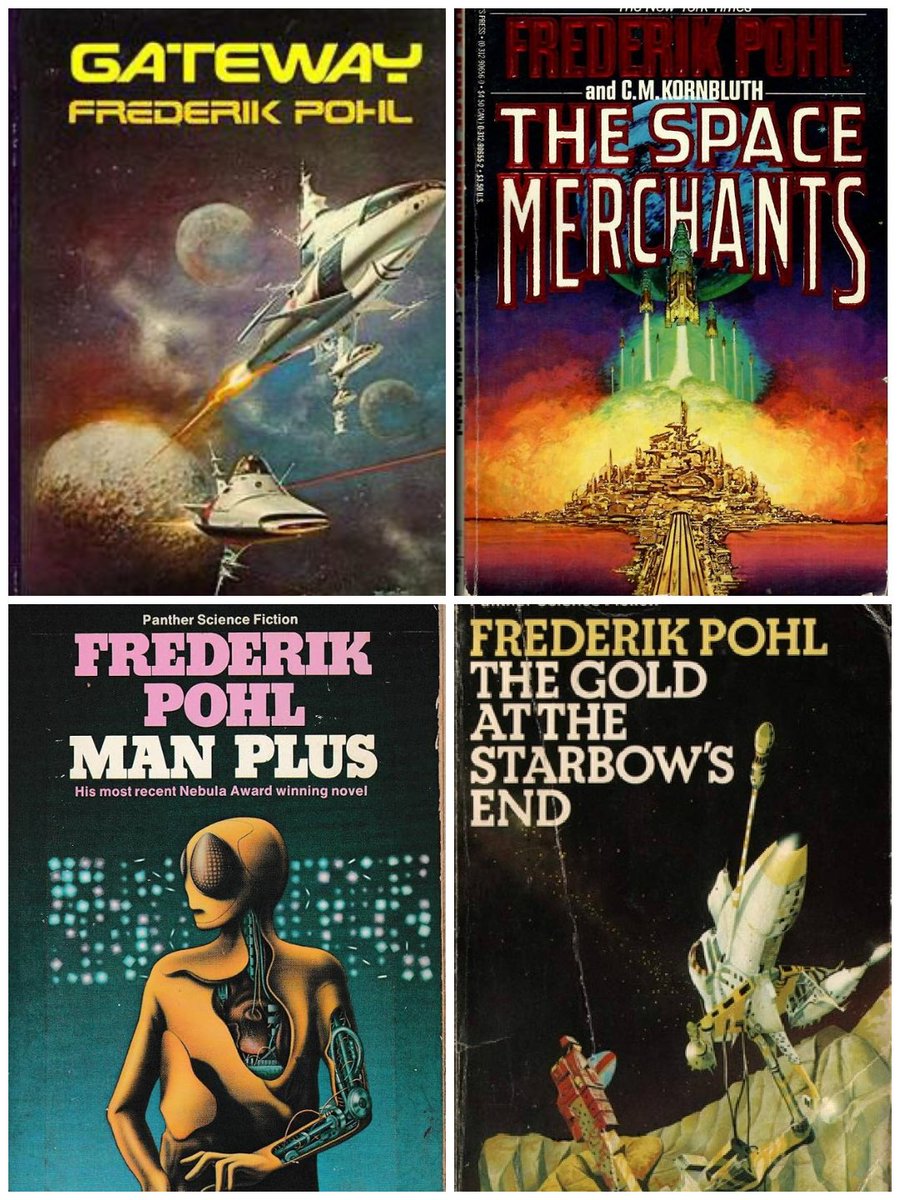
Gateway (1977): Winner of the Hugo, Nebula, Locus, and John W. Campbell Memorial awards, this is widely regarded as one of the greatest science fiction novels of the 1970s. The first book in the Heechee Saga follows a down-on-his-luck prospector who travels to Gateway, a hollowed-out alien asteroid serving as a spaceport filled with mysterious, automated ships that can take humans to unknown – and often deadly – destinations. Blending high-stakes exploration, psychological depth, and existential dread, it remains one of the genre’s defining masterpieces.
The Space Merchants (1953): Co-written with C.M. Kornbluth, this razor-sharp satire skewers advertising, consumerism, and unchecked corporate power. In a dystopian future dominated by Madison Avenue, a top advertising executive is assigned the ultimate account: selling the colonization of a brutally hostile Venus. When corporate rivals betray him, he’s thrust into the underclass and forced to fight his way back.
Man Plus (1976): A chilling and powerful novel about an astronaut who is surgically and cybernetically transformed into a grotesque cyborg so he can survive on Mars. Winner of the Nebula Award for Best Novel, it explores identity, alienation, and what it means to be human in a cynical yet deeply moving way.
“The Gold at the Starbow’s End” (1972): This acclaimed novella follows a hand-picked crew launched on a decades-long interstellar mission to a planet that doesn’t exist. The voyage is a government hoax designed to isolate the crew and force rapid intellectual evolution under extreme conditions. As the crew transcends the experiment – fundamentally altering their own minds and perceptions – Earth descends into chaos. It’s a profound meditation on knowledge, language, consciousness, and humanity’s evolutionary potential.



Leave a Reply