
Clifford D. Simak
City (1952): Eight inter-connected stories spanning thousands of years frame humanity’s long farewell – preserved and pondered by the dogs and robots who inherit the Earth.
Way Station (1963): Winner of the Hugo Award for Best Novel, it tells the story of a Civil War veteran who manages an interstellar transit point in rural Wisconsin.
Time and Again (1951): A space explorer’s unexpected return with a heretical text that could unite all conscious life sparks a multi-century temporal war.
All Flesh is Grass (1965): A small town finds itself isolated by a mysterious space-borne barrier in this entry in the cozy apocalypse sub-genre.

Algis Budrys
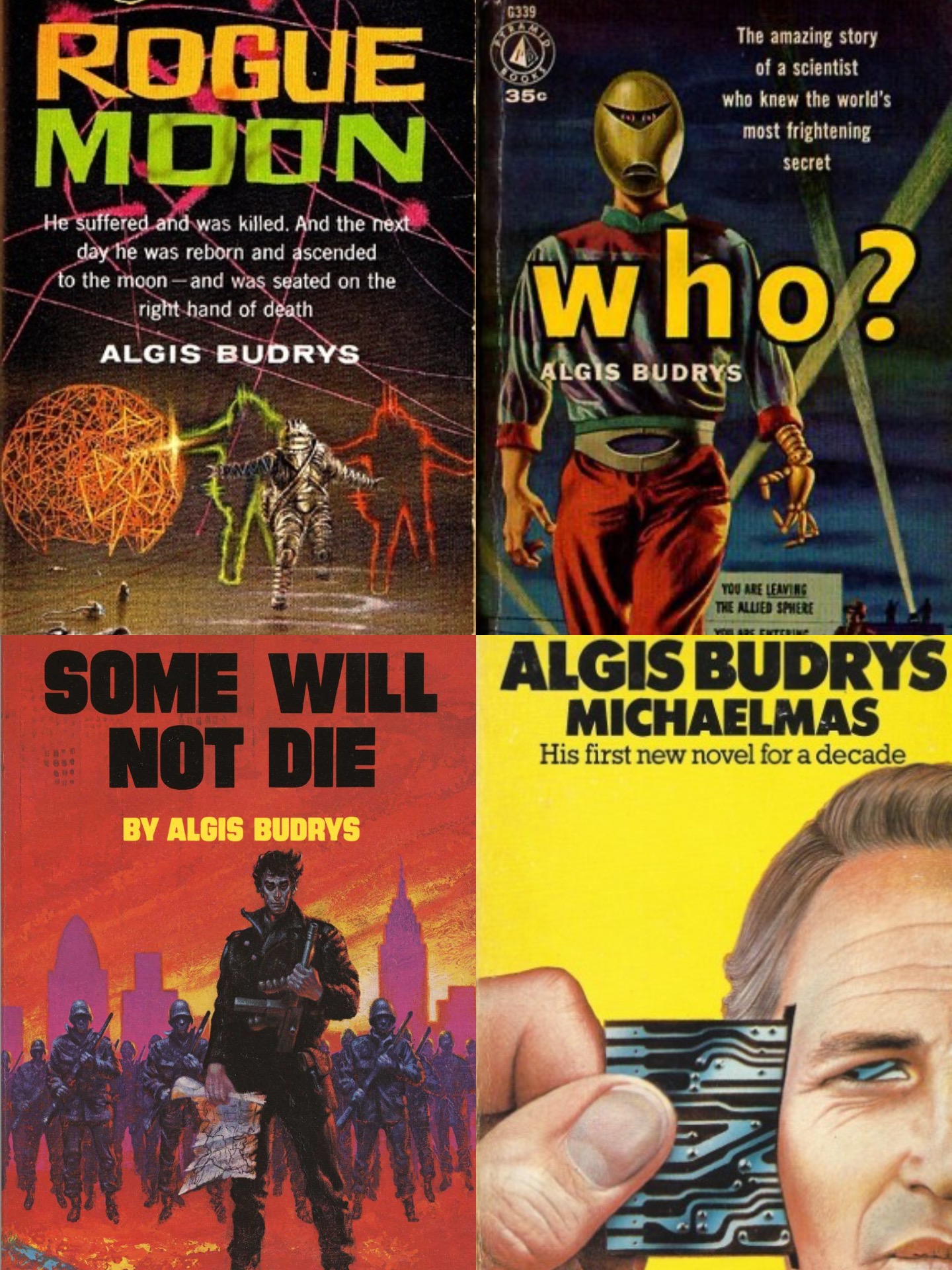
Rogue Moon (1960): In this deeply influential Hugo-nominated Cold War thriller, when attempts to explore an alien labyrinth on the moon result in instant death, scientists use a matter transmitter to create duplicates of a volunteer. Every death gets them one step closer to mapping the artifact in this exploration of identity, obsession, and existential dread.
Who? (1958): After being disfigured in an explosion, an American scientist’s life is saved by the Soviets who replace his face and arm with cybernetic implants. Returned to the West, he is met with deep suspicion: is he still the American scientist, or a perfect Soviet sleeper agent?
Michaelmas (1977): A journalist secretly rules the world with the help of an artificial intelligence that has quietly infiltrated every digital communications network on Earth. The status quo is shattered when a dead astronaut miraculously revives, forcing our journalist to protect his secret global stability against an alien threat. A prescient exploration of media, surveillance, and information control.
Some Will Not Die (1961): Following a devastating plague that wipes out 90% of the world’s population, the survivors attempt to rebuild society. Grittier and more grounded than typical SF of the era.

A.E. Van Vogt
Slan (1940): This novel introduced the mutant-persecuted-by-humanity premise that would inspire the likes of the X-Men. It follows Jommy Cross, a young Slan, a race of telepaths who are hunted by humanity.
The World of Null-A (1948): Van Vogt at his most baffling best. When our hero, Gilbert Gosseyn, discovers his memories don’t match reality, he is pulled into a vast conspiracy centered on the Games Machine – a supercomputer that governs Earth by testing citizens in non-Aristotelian logic. Identity shifts, resurrection, and interplanetary intrigue follow in a narrative that reads like a lucid dream you can’t quite hold onto..
The Weapon Shops of Isher (1951): A fan favorite built around one of SF’s great political ideas: “The right to buy weapons is the right to be free.” The story follows ordinary citizens caught between a sprawling imperial government and a network of mysterious, technologically advanced weapon shops that exist outside the empire’s reach – and refuse to be absorbed by it. Pulpy in the best sense, with a libertarian backbone that still provokes debate.
The Voyage of the Space Beagle (1950): A “fix-up” novel made up of previously published short stories, this book details the adventures of a massive scientific exploration spaceship. Direct inspiration for Alien and The Thing.




Leave a Reply