
Today, it gives me great pleasure to turn this blog over to premiere SF author Kristine Kathryn Rusch. If you read Diving into the Wreck, the following Q&A offers some wonderful insight into the creative driving the novel as well as Kristine’s fascinating approach to the writing process. If you haven’t reading Diving into the Wreck yet – what the hell are you waiting for?
Over to Kristine…
Gordon writes: “My question: Do you dive?”
KKR: No, Gordon, I don’t dive. My husband does. In fact, he used to do search and rescue dives in Idaho. He was my best source for the material
I do swim, however, and have since I was little. So I do have a sense of it.
Wahlyn writes: “What was your inspiration for setting deep sea divers in space? Also, thank you for an excellent story!”
KKR: You’re welcome, Wahlyn. I’m glad you enjoyed the story. My inspiration came while reading an Esquire article which was an excerpt from Robert Kurson’s The Shadow Divers. As I was reading, I realized that there would be wrecks floating in space, and someone (some crazy someone) would probably dive them. After all, going without atmosphere is similar to going underwater. And then I had my idea.
Cat4444 writes: “A. Are you a diver? If so, are you certified as a wreck diver? If not, did you research the subject or speak to people that are certified wreck divers in order to be as true to the requirements as possible? Some combination of the two?”
KKR: I answered part of that above. I talked to my husband a lot about diving. I’ve done a lot of research about environmental suits and space because of my job writing science fiction. I read a bit about wreck diving, but mostly I made things up. 🙂 That’s the fun part of my job.
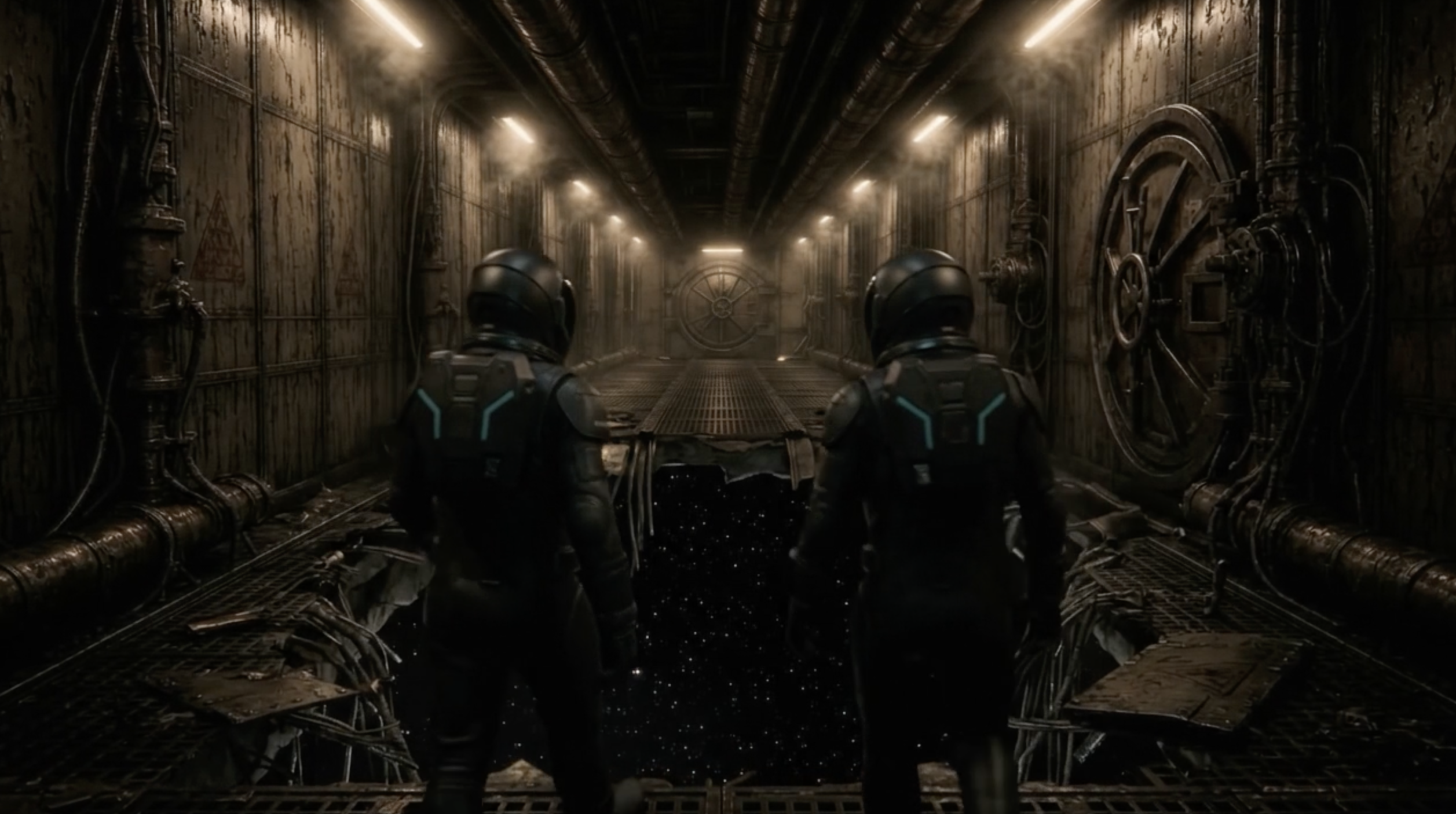
“B. Regarding the “Room of Lost Souls”, I found it kind of odd that the Room would reveal more of the station outward from the central core as the stealth field collapsed. I would expect a collapse to, by definition, fall inward. Is this an effect of the “dimensional rift” created by the stealth technology (i.e., does the Room expand in Boss’ reality as it is drawn through the rift from its “original” reality)?”
KKR: The Room is slowly drifting into our time and revealing itself. It’s doing so from the stealth mechanism outward, which is why it’s appearing the way it is.
“C. I was reading a book the other day on character naming in stories, and there was a section dealing with using a “title” of some kind for a character rather than actually assigning a name. Did you consciously decide not to give your character a name and simply refer to her as “Boss” or did that aspect develop as the story was being written?”
KKR: I’m a very intuitive writer, so I don’t plan ahead in the first draft. Boss never revealed her name to me. Not once. Even now, as I’m working on another piece about her—and she tells a character her name—do I know her name. (Dammit.) I never called her Boss. Everyone else on the crew did. So it wasn’t until my book editor needed to write back cover copy that he started calling her Boss. Which seemed strange to me. But it’s sticking in reviews and among fans of the book. So I guess her name is Boss.
“D. Not a question, simply a comment: I quite enjoyed this book and look forward to reading more of your stories. Thank you for taking the time to answer our questions.”
KKR: You’re very welcome. Thank you—all of you—for participating.
Rich G. writes: “Boss undergoes a change in motive towards the end of the book that’s kinda odd given her actions throughout. I wonder if the author will comment on that. It kind of came out of left field.”
KKR: I’m sorry you thought it came out of left field, Rich. People, including characters, do change. And Boss had a realization over the course of the novel as to how dangerous the stealth tech is. She’s lost friends. And through Squishy, she has learned that the government experiments have killed many, many others. Boss isn’t willing to let that tech fall into the wrong hands, people that would use it to continue killing—even if it means destroying a piece of history.
Tammy Dixon writes: “I enjoyed reading Diving Into The Wreck. I found it intriguing you segregated people into what kind of gravities they were exposed to as children. I liked the way these low/zero gravity children could be differentiated based on appearances. I suppose medical advances kept these individuals bones from losing too many minerals? So that when they switched to a normal earth gravity, they didn’t have the problems with broken bones? Have you done any cave diving? Sleath technology, fascinating! Thank you, for participating in this Q & A!”
KKR: Great point, Tammy. I think some medical advances would take that into account. But if you’re going to live your life on a ship in low or no gravity, why have strong bones? There’s no threat to them. The tech in this culture is varied and patchwork, and not available to everyone, so here it’s not a surprise that people would have different levels of medical availability. If this were a strong dictatorship or a more unified government that heavily regulates everything, then we’d see more unification among the people, I think.
As for cave diving. No. Never have. Sounds scary to me. But I have gone through caves a lot, which is both fascinating and terrifying.
DP writes: “There was a violation of the laws of motion. After the science ship explosion, the science ship started rolling, then stopped. I figured, if the hull delaminated and gas escaped tangentially, the ship could roll from an internal explosion, but that wasn’t consistent with the damage described. (Hah, “wasn’t consistent with the damage”, can you tell I used to do Failure Analysis?) Boss should have been surprised when the ship stopped rolling without anything to stop it.”
KKR: Ooops. Should have added that. Didn’t. Too late now. <sigh>
DP also writes: “The empire acted with impunity in big matters, but governed competently and fairly in small ones. On the small scale, they enforced rights about discoveries without evidence their enforcement “services” were available to interest groups who could buy favor to help them “compete”with someone as independent- minded as Boss. There was no evidence of corporatism on a smaller scale so was Boss’s father’s massive influence an exception or an inconsistency?”
KKR: Um…wow. You extrapolated quite far from my novel here, so I can’t answer the question except to say that Boss’s father doesn’t have massive influence within the government. He just has control on one aspect of the stealth tech program because he believes he can produce results—and he convinced someone in charge that he could. Rather like our government, really. Just because someone has a lock on some kind of research doesn’t mean they have power in other areas.
DP also writes: “Why didn’t anyone worry the Empire’s security would hulk out on them?
KKR: I’m afraid I don’t understand “hulk out.”
“Are there any aliens in the universe of Diving into the Wreck?”
KKR: Nope. I do a series that’s all about aliens, which is my Retrieval Artist series. I don’t want any crossover at all. The Diving universe has no aliens whatsoever.
“How do you describe the story’s structure?”
KKR: I see it as a standard plot.
“What do your novel outlines look like?”
KKR: I don’t outline. Ever. Takes the fun out of writing for me.
“Why did you decide on the present tense? Why did you decide on the first person?”
KKR: As I mentioned above, I’m an intuitive writer. I don’t decide. My subconscious does. I think the reason Boss uses present tense is that because she has no idea how the story will end either. That’s the weird construct of first person. First person past tense narratives usually begin with the narrator acknowledging that things didn’t go well or there was a good ending. Boss didn’t know. So the reader doesn’t know. The only way that works logically is in first person, present tense.
Artdogspot writes: “I really enjoyed this story and hope there is a sequel that answers some questions left unanswered at the end of the book.
A. You seem to combine adventure, mystery and scifi in a natural way. I have read that you write romance and mystery novels as well. How do you approach each of these genres differently or do you approach them the same way?”
KKR: I approach them all the same way. I didn’t know that genres existed until I was in college. I read in all genres and thought everyone did. So genres are mixed together in my mind as “story” and I tell the story I need to tell, using whatever tools are available. Sometimes I use mystery tools or romance tools. In this case, I used sf & adventure fiction.
“B. I read in a couple of interviews that you write stories out of order. How did this story evolve?”
KKR: I wrote the wreck first. Then I showed the diving sequences to my husband and he helped with some of the details. I wrote a somewhat different version of the first section as a novella for Asimov’s, and thought I was done.
Then I started a story about this mysterious room, and wrote the room first. Midway through, I realized Boss would be connected to the room, but I didn’t know how. So I figured that out, and wrote the second section pretty much as is. I got to the end and realized it didn’t end, so I waved my hands a lot and sold the second section as a stand-alone novella, but realized I had to write the rest, which all tied to the initial novella.
When it came time to write the novel, I changed the opening, made things flow in a novel fashion instead of a novella fashion, cut off the handwaving ending of Room, and wrote to the end. Convoluted, I know, but I write most of my novels like this. My very first novel, The White Mists of Power, came in sections like that, and I printed them out, sat on the floor and organized and reorganized the sections like a jigsaw puzzle until they made sense.
“C. I liked the first person, present tense and compact writing style you chose for this story. Is this a general approach you use for many of your pieces or was this a very specific choice for this story?”
KKR: It was a deliberate choice. That’s Boss’s voice. She doesn’t talk much and when she does, she’s a woman of few words. Compare that to my Kristine Grayson novels, which are all voice and style and words, and you’ll see that I pretty much pick the narration that the story demands.
“D. Boss is a great character who prizes her freedom and self reliance above everything else. It seems that events in her past gave her no choice but to become completely self reliant. I also like the fact that she is interested in historic ship wrecks and values their historic importance. She is fearless when it comes to diving these wrecks but is haunted by and reticent to deal with her own personal history. Is this ironic interest in the history of these ships a way to avoid her own personal history?”
KKR: I wish I had that much foresight. Since I write intuitively, a lot of the metaphor/thematic level comes out of the subconscious. I never consciously think about it—not even after it’s done. That sounds like a cop out, but it’s not, really. I prefer to leave the English teacher stuff to, well, the English teachers.
“E. I liked the fact that the story worked on a couple of levels. As Boss starts the Room of the Lost Souls job, she is also unwittingly set on a collision course with her own past involving her father. So, is the story also a metaphor for her reluctance to deal with her own troubled past? If so, is she in fact also a “wreck”?”
KKR: Um…interesting point. I don’t think Boss would see herself as a wreck—except in the opening of the Rooms section. So…I dunno. I guess. Maybe? Again, subconscious stuff.
“F. I didn’t like seeing Karl killed off. Did you have second thoughts about “offing” such a great character?”
KKR: I always hate killing off characters. But the story demands what it demands. And you wouldn’t believe things were dangerous if the good characters lived and the bad ones didn’t.
“G. I’ve read that you sold another novella in this series to Asimov’s – do you answer the questions left at the end of this story in that one?”
KKR: A few. But there are more questions to be asked, and much more to be learned. I suspect I’ll be exploring this universe for quite a while.
Airelle writes: “What was the significance of the sounds associated with the stealth tech only a few could hear?”
KKR: Honestly, that gets revealed in a future story. But those with the gene can hear the sound of the tech working, partly because they’re designed to work within the tech. I can’t answer much more without spoiling future stories.
———–
Thanks, everyone, for the great questions. I appreciate the interest in the novel.


Leave a Reply