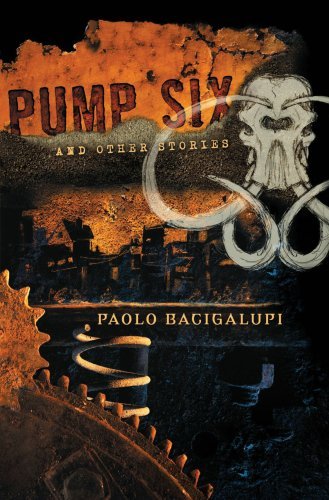


Pump Six and Other Stories, Paolo Bacigalupi
I’ve been a big fan of Paulo Bacigalupi’s work for quite some time and have been sitting on this book for a while now, hoping a paperback edition would be released so that I could make it a Book of the Month Club selection. Well, I finally broke down and read it, and what a treat it was. Comprised of ten stories, Pump Six and Other Stories offers up a thought-provoking combination of powerful social commentary and provocative future visions that bleed through various genres: SF, fantasy, and horror. Many of the tales that make up the collection touch on a similar theme, the dehumanizing nature of social and technological progress, challenging the reader with unsettling ideas and images – the surgically altered human/musical instrument hybrids of “The Flute Girl”, the infant-eradicating authority of “Pop Squad”, the casually indifferent judgment passed on a living relic of the past in “The People of Sand and Slag”. Although at times it makes for admittedly difficult reading, Pump Six and Other Stories is engaging and intellectually satisfying.
The Illustrated Man, Ray Bradbury
I read this collection of short stories way back in high school. I enjoyed it then and, despite the fact that some of the elements feel a bit dated, I enjoyed it that much more when I read it earlier this year. One of the things I appreciate about Bradbury’s writing style is the economy of his language. We are spared the endless, meandering descriptions of local fauna and decrepit architecture in favor of a narrative that is concise yet no less informative or entertaining. The Illustrated Man is chock full of memorable tales, from the horrific response of two young children to their parents’ attempts to reign in their playtime (“The Veldt”) to the poignant efforts of an impoverished junkyard owner to treat his family to an outerspace adventure (“The Rocket”). Other stories that leave a lasting impression include “Kaleidoscope” (in which a group of astronauts, separated from their ship following a massive malfunction, converse over radios as they float and free fall to their inevitable deaths), “The Rocket Man” (in which an astronaut’s commitment to his job puts incredible pressure on his family life – with tragic results), and “Zero Hour” (in which aliens make use of a most unlikely ally in their bid to invade the planet). Granted, some of the stories feel somewhat forced by contemporary standards (“The Other Foot” and “The Man”), but the “hits” far outweigh the “misses” here.
In the Country of Last Things, Paul Auster
When done well, nothing resonates stronger with me than dystopian fiction. At its best, it elicits a dual emotional response, touching on the primal fears associated with mass extinction and the basic struggle for survival while, at the same time, stirring hope for us, as individuals, in the face of global catastrophe. And, in this book, author Paul Auster crafts a breathtaking tale that delivers on both. The narrative is delivered in the form of a letter written by a woman in search of her missing brother as she navigates a region decimated by some never-fully-explained calamity. Whereas once she enjoyed a comfortable existence, she now spends her days foraging the streets for tiny treasures, discarded items that will fetch a price no matter how meager. And yet, amidst the overwhelming tragedy there are triumphs as our heroine perseveres and, through her experience, impresses upon us the value of the many things we take for granted – a warm meal, a comfortable bed, the company of a loved one. In the Country of Last Things is bleak and haunting and frighteningly plausible, yet evokes an appreciation for life’s smaller gifts. And it resonates strongly.
Earth Abides, George R. Stewart
Even though this book was first published in 1949, it is hands-down the greatest work of dystopian fiction I’ve ever read. After a plague wipes out most of the human population, the few remaining survivors attempt to remake their lives in the face of unimaginable odds. Whereas many works in this post-apocalyptic sub-genre of SF tend to focus on the dark and tragic, Earth Abides is surprisingly positive. Stewart’s emphasis is less on the horrors of the disorder and more on the potential devolutionary aspects of the event – the fall of society, transformation of the natural order, and the gradual yet inevitable resurrection of both. We follow Ish, our protagonist, as he journeys through dead and decaying communities. At first, his sole concern is mere survival but, eventually, he begins to rebuild, seeking out companionship and community. Ish’s efforts to re-establish some semblance of societal order are dealt recurring setbacks in the form of unforeseen complications: an alarming rise in the city’s rat population, the loss of running water, the deterioration of basic education. And yet, time and again, Ish finds a way to, if not overcome these setbacks, then, at the very least, to readjust to them. And, throughout, Stewart intersperses the narrative with accounts of the disaster’s far-reaching effects: dogs become both hunter and hunted, cats fare far better, cattle seek out greener lands while horses take to dry open plains, sheep perish, boars survive, only the human louse – of half a million insect species – are threatened with extinction. A brilliant book.





Leave a Reply