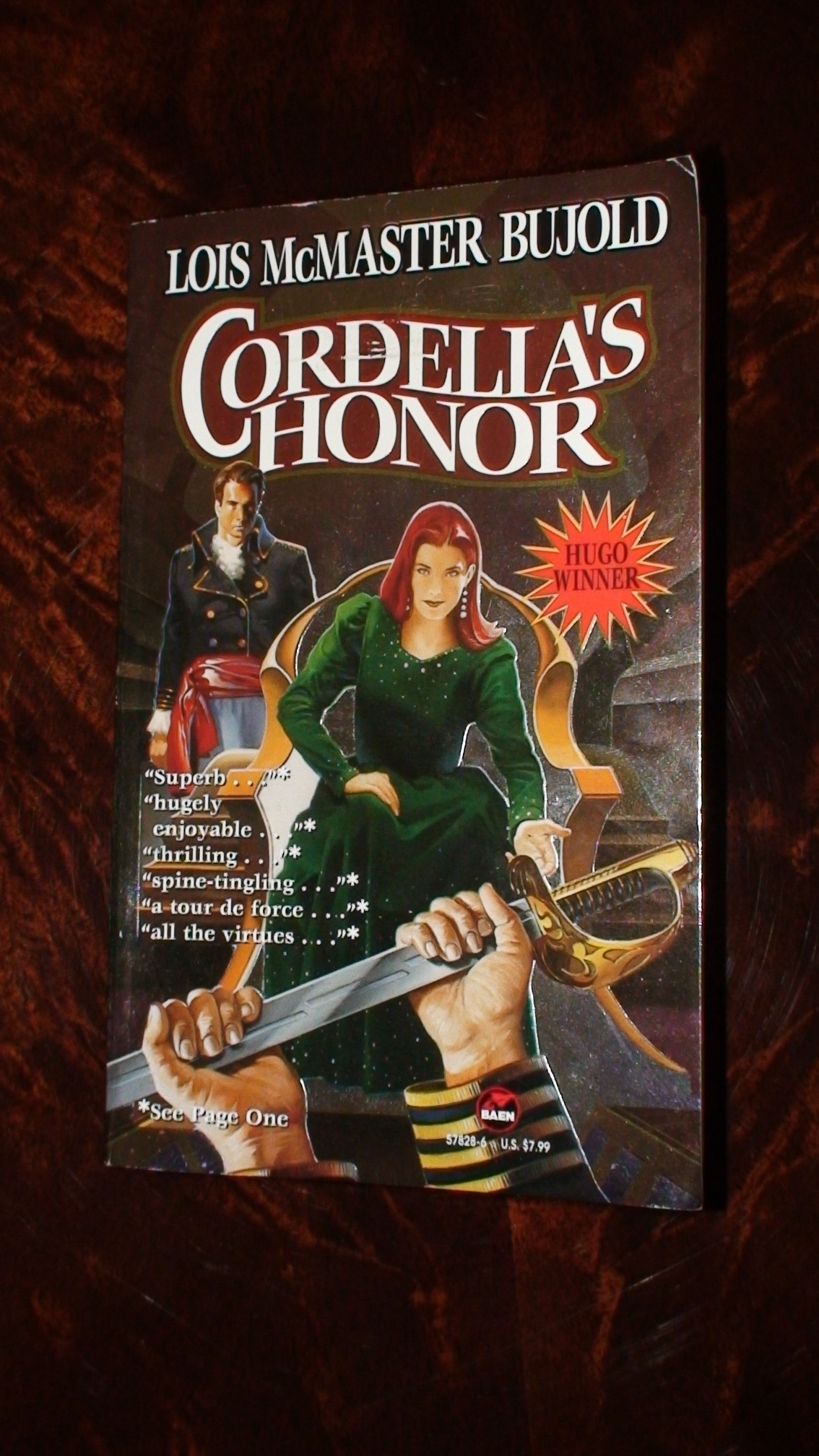
Finally, a Space Opera that lives up to the title! Ages ago, when I first heard of the sub-genre, I was intrigued by the idea of mixing SF with soap operatic convention. Okay, while I wasn’t exactly expecting Love’s Laser’s Lost, I was looking forward to reading science fiction that focused on real people dealing with real problems against the backdrop of a potentially surreal environment. Presumably, in the far distant future, amidst the space battles, alien invasions, and recreational virtual reality generators run amok, such quaint concepts as love, marriage, and relationships would still prove of some significance. I certainly assumed as much, but the authors of most of the Space Opera I read felt otherwise. My initial enthusiasm for the sub-genre was immediately deflated by works that were heavy on the hard SF and light on plot and character. “What the hell were you expecting?”a fellow scifi buff once asked me. “Dallas in space?” Well…no. Not exactly. Although, in truth, I’d sooner read about J.R. 3000’s intergalactic machinations than re-read some of the technically accomplished but emotionally devoid novels I’d experienced to date.
The two books that make up Cordelia’s Honor, however, turned out to be a much more satisfying representation of what I’d imagined Space Opera could be. Grand, yes. Futuristic, of course. But at its heart, it‘s the personal interrelations of the various characters that drive the narrative. The SF is there (wormhole nexus, neural disruptors, uterine replicators) to serve the plot but doesn’t overwhelm. Bujold elects to focus on social and political aspects instead of excruciatingly detailed accounts of technological marvels, appealing to a reader’s sense of the familiar over fathomless narrative minutiae. In so doing, she fashions a future world that is as engaging and believable as the characters who people it.
Shards of Honor introduces us to Captain Cordelia Naismith, the seasoned commander of a survey team for the Betan Expeditionary Force who ends up stranded on planet with Captain Aral Vorkosigan, the legendary “Butcher of Komarr” (who, for some reason, I pictured as a young Robert Davi). Despite their differences, the two come together in order to survive a treacherous alien environment. As mutual suspicions thaw, the two former enemies develop a grudging respect for one another that, in turn, evolves into much, much more. The progression from distrust to love struck me as all too quick at first but, upon further reflection, I realized that I knew plenty of people who had “fallen in love” within weeks, hell, even days, of meeting their significant others. Also, I suppose being beholden to someone for saving your life would certainly go a long way toward cementing those affections.
From events on the planet, we head shipboard where Cordelia helps Vorkosigan head off a mutiny before escaping back to Beta Colony where she receives is welcomed back with a certain amount of suspicion. The story hits the ground running, delivering a thoroughly engaging narrative that never slackens its pace through its 250+ page run.
The second book, Barrayar, finds Cordelia on Vorkosigan’s home planet, married and expecting her first child. Whereas the first book centers on our protagonist as she is swept up in a galactic war, the second book shifts focus to the political machinations within the Barrayaran court. Crosses and double-crosses are the order of the day and, despite her pregnancy and struggles to adjust to her new life, Cordelia continues to display the spirit of fierce independence that made her such a fascinating character in her early adventures. The rules may have changed, but she proves that she can play the game with the best of them, leading a rescue op to head off a political coup.
While I enjoyed both books, I found the first structurally diffuse, hopping from events on the planet to the mutiny aboard the Barrayaran ship and back to Beta Colony before returning to Barrayaran clutches. It wasn’t so much the change in locations as the sense that the different scenarios were separate pieces brought together to create a greater whole. Barrayar, on the other hand, proved a more unified narrative and more satisfying in the intricacy of its plotting and the depth of its characterization particularly among the secondary players like Koudelka, Drou, Piotr Vorgasigan and, my favorite, Bothari.
Well, those are my initial thoughts to get the discussion started. I’d be interested to hear what others have to say, especially if they found the time to read both books.
Also, if you have any questions or comments for author Lois McMaster Bujold, now would be the time to post them.


Leave a Reply