

Daniel F. Galouye
His fiction pioneered virtual reality, simulated consciousness, and altered perceptions of reality long before they became SF staples.
Simulacron-3 (1964): Decades before The Matrix, Galouye published this groundbreaking virtual-reality thriller about a computer scientist who realizes the simulated city he helps oversee is just one layer in a terrifying nesting doll of artificial realities.
Dark Universe (1961): This Hugo-nominated novel follows humanity generations after a nuclear war, surviving in total darkness deep underground, negotiating their world through touch and sound.
The Last Leap and Other Stories of the Super-Mind (1964): This UK-only collection gathers Galouye’s strongest short fiction from the 1950s and ’60s, exploring telepathy, psychic evolution, and the next stage of human consciousness.
Lords of the Psychon (1963): Sixteen years after Earth is conquered by mysterious floating alien “Spheres,” whose bizarre geometric cities have forced humanity back to steam-age technology, a ragtag resistance fights back.

Sydney J. Van Scyoc
Her fiction explored alien cultures, biological adaptation, and coming-of-age journeys.
Darkchild (1982): The opening book of her Sunstone Scrolls trilogy is set on the cold matriarchal world of Brakrath, where sun-channeling queens rule. A barohna’s daughter, Khira, befriends a strange amnesiac boy, unaware he’s a programmed agent sent to gather the knowledge that could destroy her people.
Drowntide (1987): On an ocean world, young Keiris, heir to a telepathic bloodline but seemingly without the gift himself, sets out to find his long-lost father and a twin sister he’s never met, and to claim a heritage that binds his people to the sea’s sentient depths.
Starsilk (1984): The third and final book in the Sunstone Scrolls trilogy carries the saga off-world, expanding its mythology through a new symbiosis of human and alien life while delivering an emotionally satisfying conclusion.
Saltflower (1971): Van Scyoc’s debut novel. A dying alien race seeds Earth with crystal spores that breed silver-eyed, salt-hungry hybrid children, forcing a reckoning over what “improving” humanity actually costs.
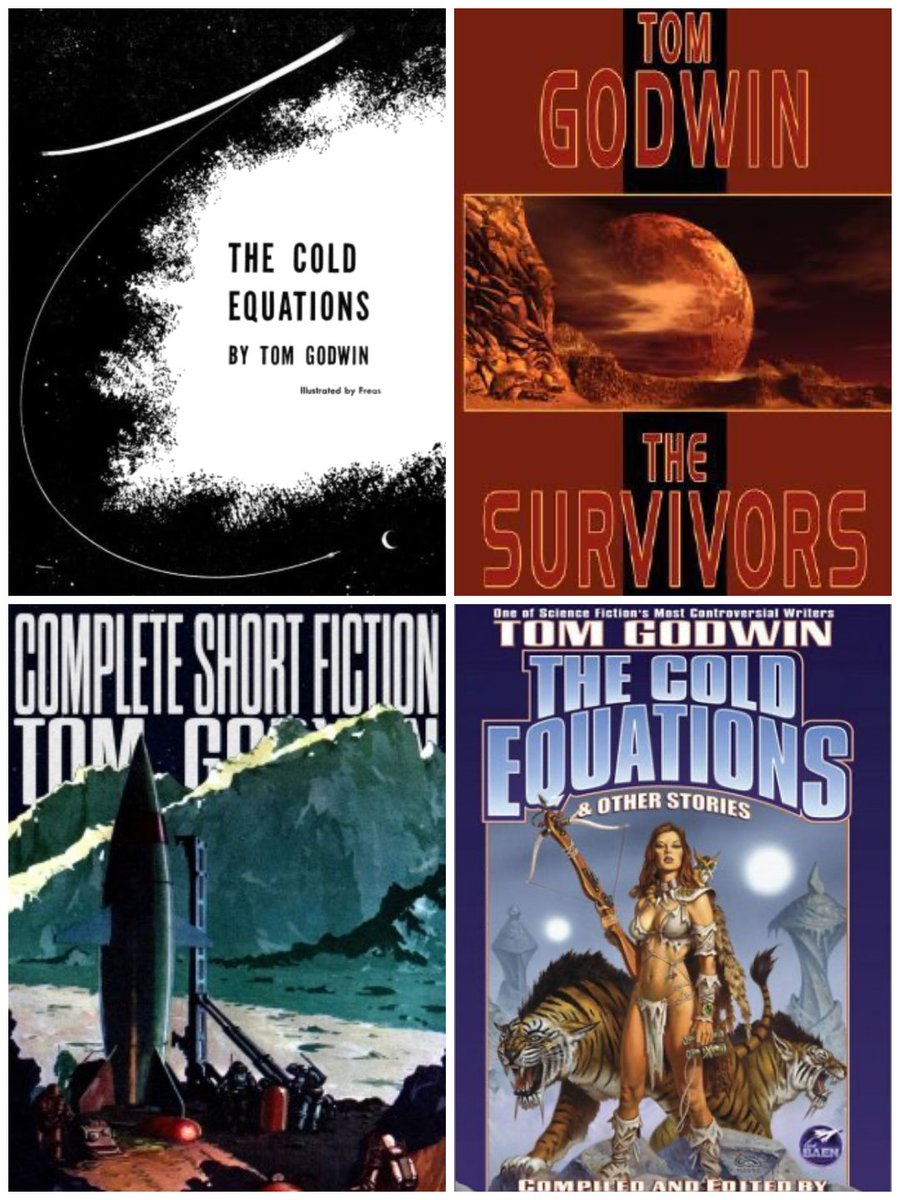
Tom Godwin
An author who, while never especially prolific, produced stories and novels that became enduring classics of hard SF.
The Cold Equations (1954): One of the most debated stories in SF history sees a pilot face a dire dilemma: his ship has just enough fuel to deliver life-saving medical supplies to a colony – but only if he sheds the extra mass of a young female stowaway.
The Survivors (1958): Human colonists are stranded on a lethally hostile alien world. They struggle to survive its brutal conditions and lay the foundations for their descendants to eventually exact revenge.
Mother of Invention (1953): Five fortune hunters are marooned on a diamond-rich world that offers no uranium to power a conventional drive. With their ship crippled and the planet doomed by an impending nova, they must invent an antigravity drive before time runs out. A classic of clever, problem-solving hard SF.
The Cold Equations & Other Stories (2003): The definitive Tom Godwin collection gathers “The Cold Equations,” the full novel The Survivors, and many of his other essential stories under a single cover.


Leave a Reply