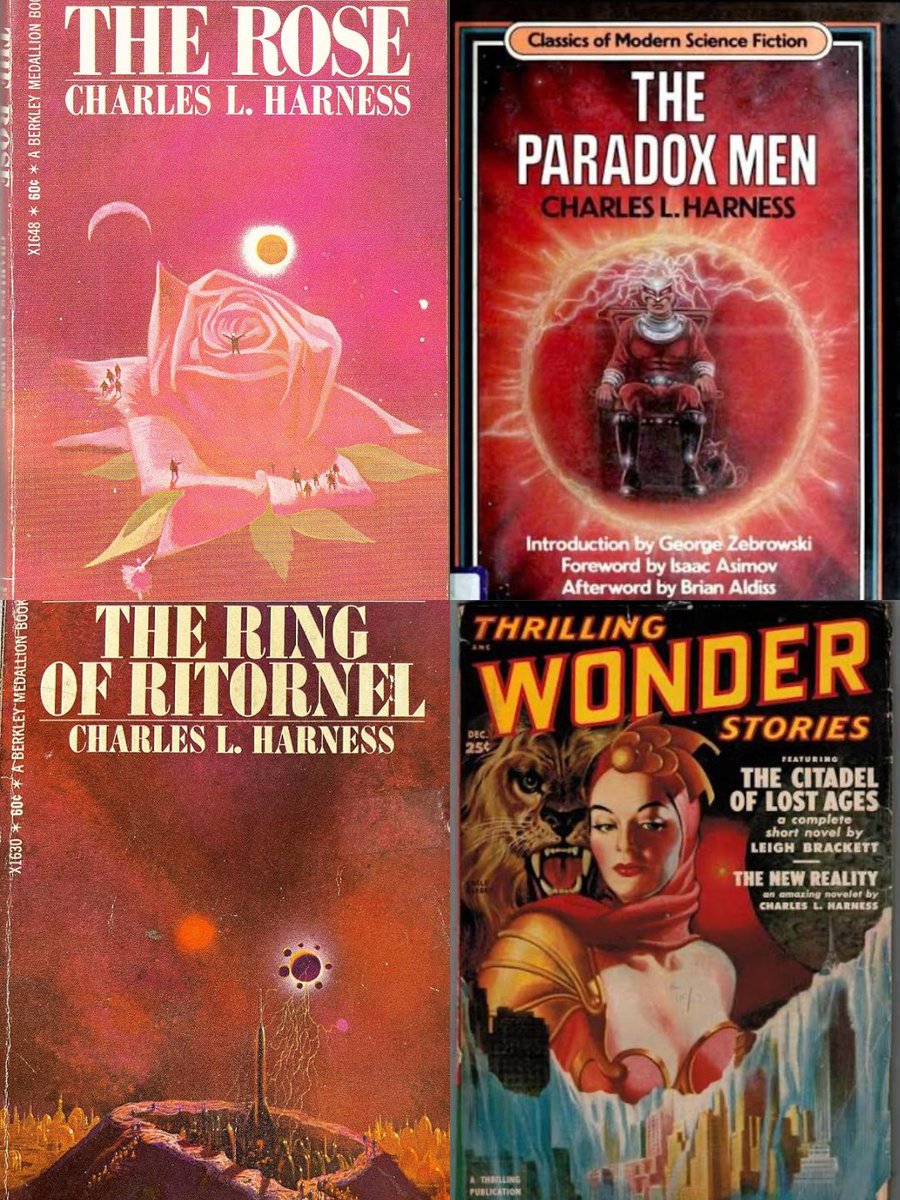

Charles L. Harness
A writer unfamiliar to most readers yet admired by some of SF’s greatest authors including Brian Aldiss who described his work as “widescreen baroque”.
The Rose (1953): This novella, a richly symbolic exploration of the tension between art vs science, was deemed too eccentric by North American editors who rejected it, forcing Harness to go overseas where it was published in the British magazine Authentic Science Fiction and championed by none other than Michael Moorcock. The story, about a ballerina with physical mutations and her attempts to complete an opera score, is noted for its haunting, transcendent ending.
The Paradox Men (1953): An amnesiac master thief navigates a class-divided future and a cosmic time-loop to save humanity from historical collapse. Expanded from his novella Flight into Yesterday, it’s a wild mix of space opera, time paradoxes, and cosmic adventure. It’s also credited for one of the first uses of the personal force shield in science fiction.
Ring of Ritornel (1968): Harness’s most ambitious novel explores free will vs determinism in a universe locked in a cyclical time-loop.
The New Reality (1950): The SF Encyclopedia’s pick for the genre’s “best Adam and Eve story” sees a scientist unmake and remake the fabric of an unstable reality shaped by human perception and consensus.

Harold Waldrop
A master of meticulously researched alternate history.
The Ugly Chickens (1980): Winner of both the Nebula and World Fantasy Awards, this novelette follows a researcher investigating reports that the supposedly extinct dodo survived into the twentieth-century Deep South, where one family has quietly raised them as “ugly chickens.” A melancholy, tragicomic masterpiece.
“Night of the Cooters” (1987): A Hugo Award-nominated short story that reimagines H.G. Wells’ The War of the Worlds through the eyes of a small-town sheriff.
Them Bones (1984): Waldrop’s premier solo novel is an ambitious blend of time travel, archaeology, and alternate history. A military expedition from a devastated future is scattered across pre-Columbian North America and divergent timelines on a mission to avert catastrophe.
A Dozen Tough Jobs (1989): This inventive novella transplants the Twelve Labors of Hercules to Depression-era Mississippi, recasting Greek myth as Southern folklore with wit and grit.

George Rosel Brown
A writer admired for her grounded, character-driven fiction.
Sibyl Sue Blue (1966): A wisecracking female police sergeant investigates an alien drug that is killing teenagers in this clever subversion of the hardboiled detective archetype.
A Handful of Time (1963): This essential collection of Brown’s finest short fiction showcases her wit, social commentary, and satirical bite.
“Car Pool” (1959): This slice of suburban sci-fi explores cultural differences and acceptance in a tale about car pooling – with an alien twist.
Earthblood (1966): Co-written with Keith Laumer, this sweeping space opera follows a human boy, raised on an alien planet, who fights his way across the galaxy in search of his distant home world of Earth.



Leave a Reply