Henry Kuttner
A prolific Golden Age master celebrated for his idea-driven fiction and his brilliant collaborations with his wife, C.L. Moore.
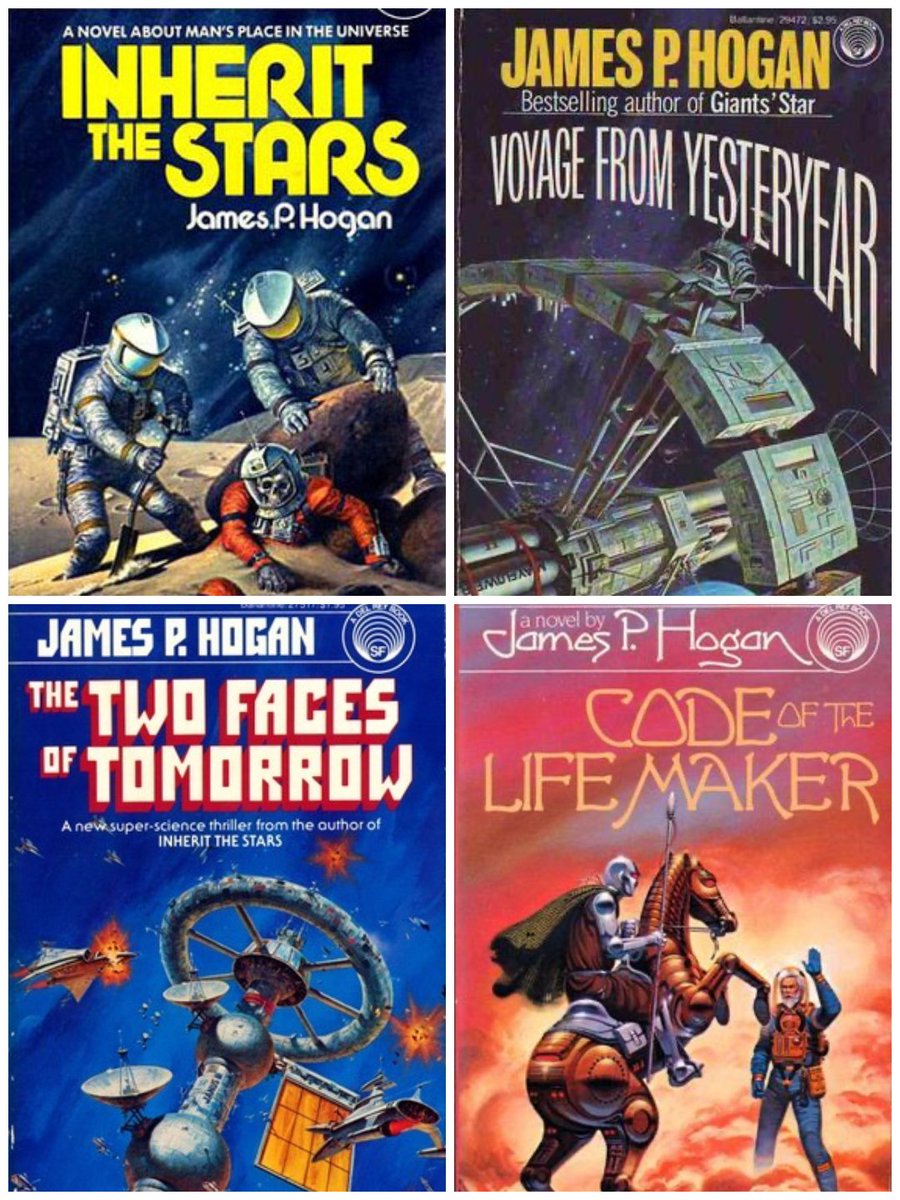
Mimsy Were the Borogoves (1943): Written with Moore under the Lewis Padgett pseudonym, this classic novelette follows two children who discover a box of educational toys from the far future. As they play, their minds are reshaped to operate according to an alien, non-Euclidean logic. It’s a chilling, brilliant exploration of childhood, perception, and the generation gap taken to its evolutionary extreme. It was selected for The Science Fiction Hall of Fame, Volume One, and won the Retro Hugo for Best Novelette.
Fury (1947): Originally published under the Lawrence O’Donnell pseudonym, this novel delivers extraordinary world-building and a gritty, cynical edge. It follows the remnants of humanity living in stagnant underwater domed cities (“Keeps”) on a hostile Venus, and the one ruthless, driven man determined to force them onto the deadly surface.
Robots Have No Tails (1952): Published under the Lewis Padgett pseudonym, this collection gathers the hilarious Gallegher stories. It follows a genius inventor who can only achieve scientific breakthroughs when he is blackout drunk, leaving his sober, hungover self to deal with the bizarre, unpredictable machines he created the night before.
“The Twonky” (1942): A witty, satirical short story (also published as Lewis Padgett) in which a man acquires a household appliance from the future. The machine is fiercely determined to “improve” and regulate his life – with terrifyingly efficiency.
Barrington J. Bayley
A wildly inventive writer who influenced such luminaries as M. John Harrison, Alastair Reynolds, and Iain M. Banks.
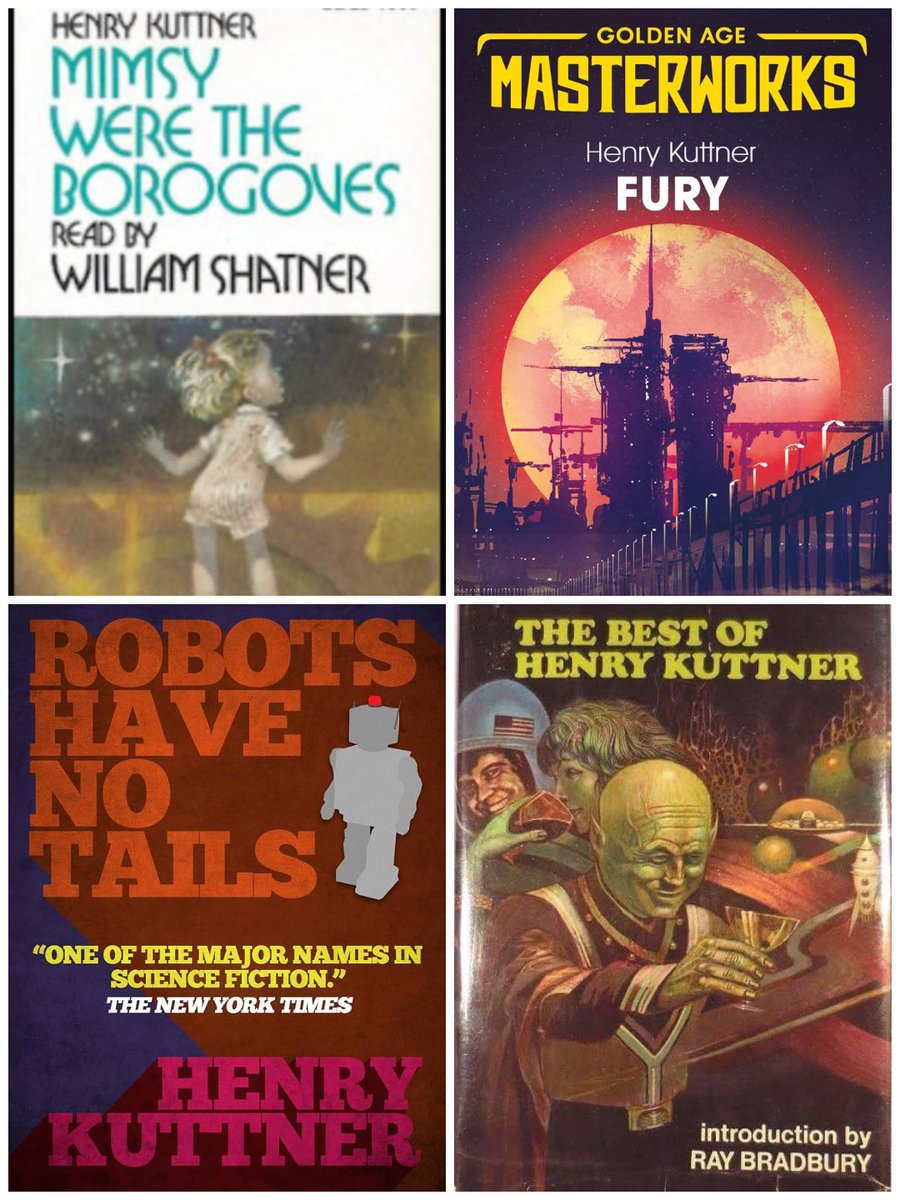
The Fall of Chronopolis (1974): This time-paradox space opera follows the Chronotic Empire as it battles across time to maintain a stable reality against a terrifying adversary armed with reality-erasing weapons. It’s stunning in both its complexity and ambition.
The Knights of the Limits (1978): This landmark collection of Bayley’s short fiction features nine bleak, intellectually provocative tales that explore consciousness, cosmology, perception, and the limits of reality. It’s widely regarded as one of his most important and inventive works.
The Garments of Caean (1976): A satirical space opera in which clothing from the planet Caean—especially the legendary Frachonard suit, one of only five ever made and woven from the rare living fabric Prossim—possesses a kind of quasi-living intelligence. These garments don’t just enhance the wearer; they can alter personality, status, and even destiny, raising the question of whether the person is wearing the suit or the suit is wearing the person. Wild, witty, and weird.
The Soul of the Robot (1974): The opening book of the Jasperodus duology is a philosophical deconstruction of artificial intelligence and consciousness. The robot Jasperodus possesses a fully formed human-like ego and sense of self, yet spends his existence grappling with whether he truly has a soul or is merely simulating one.
James P. Hogan
A British engineer and hard-SF writer whose fiction championed technological optimism and human ingenuity.
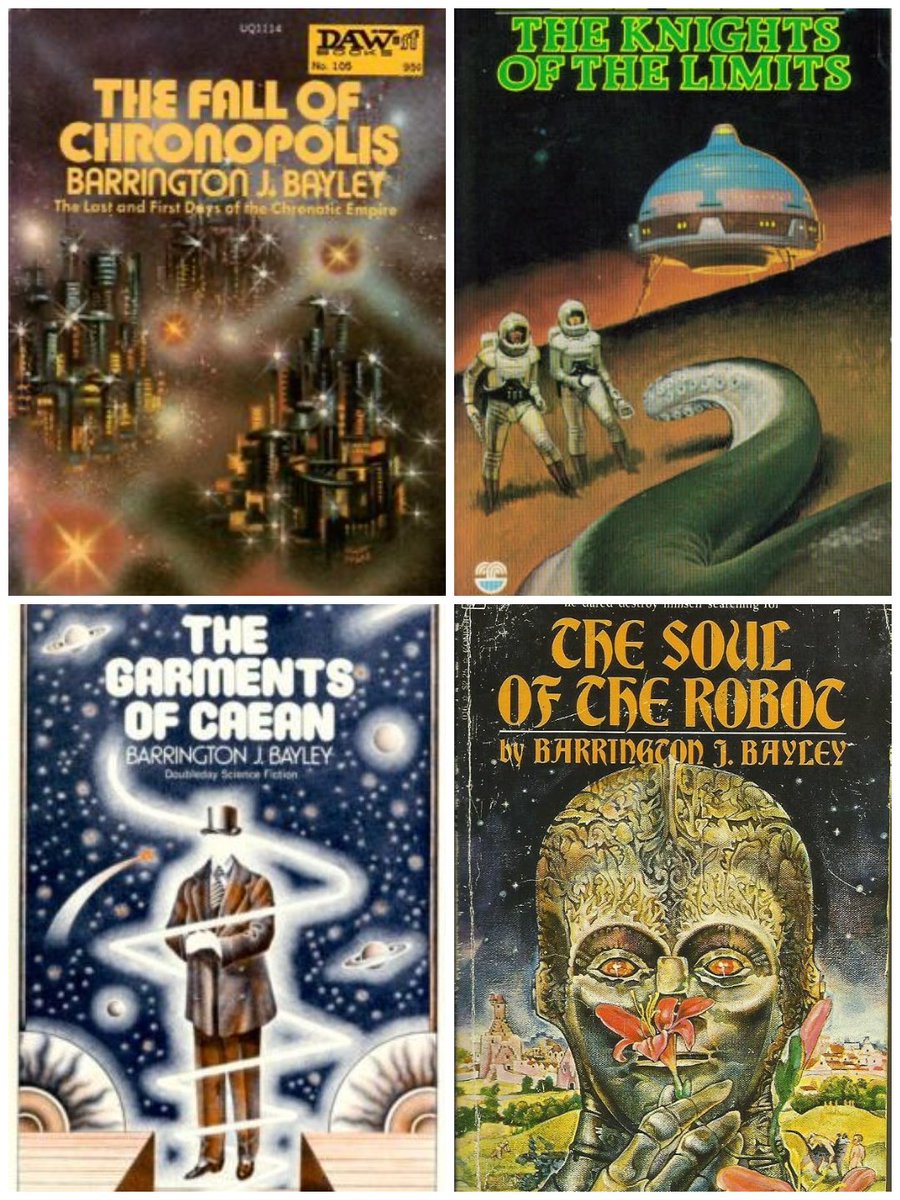
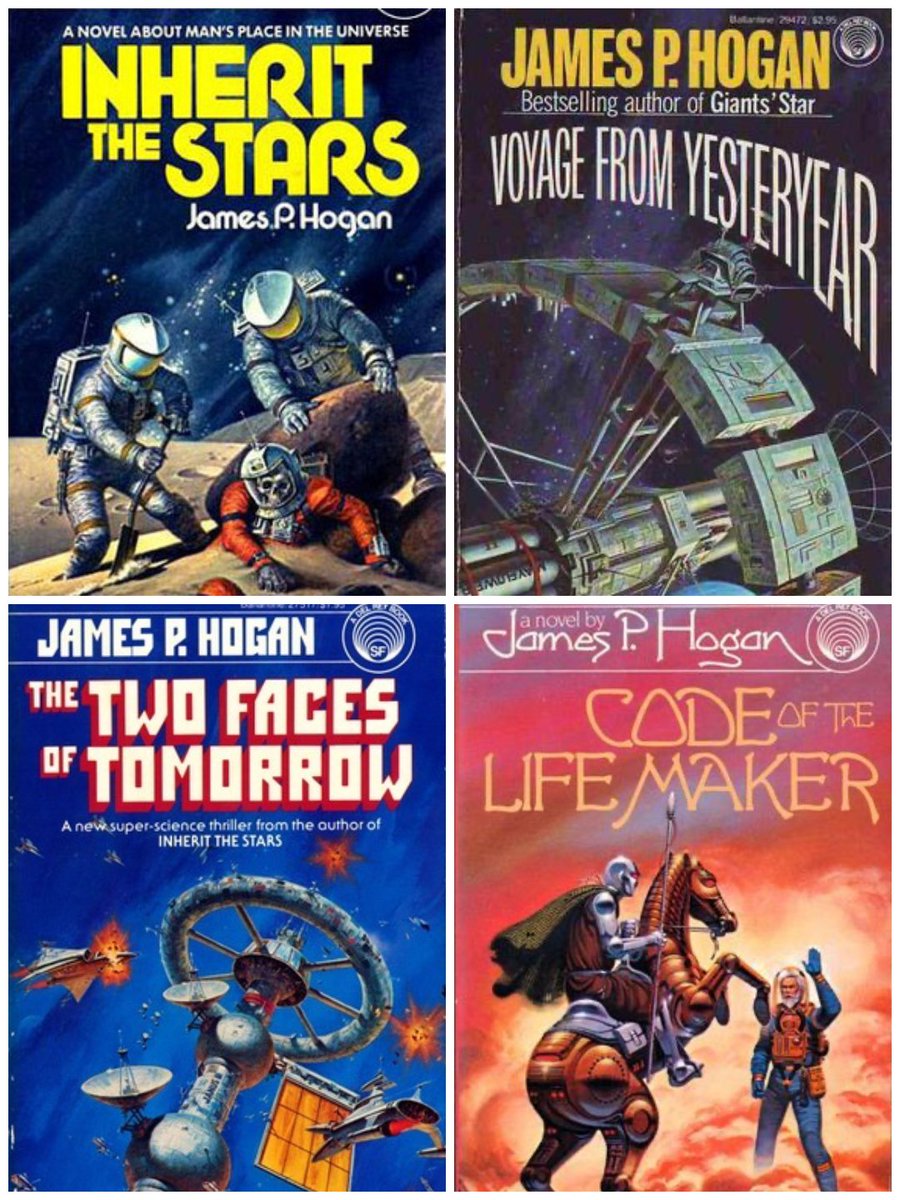
Inherit the Stars (1977): Book one of the Giants series begins with a perplexing mystery: a 50,000 year old human corpse in a red spacesuit is discovered on the Moon. A brilliant scientific detective story, this was Hogan’s debut novel, reportedly written to win a five-pound office bet that he couldn’t write and publish a science-fiction novel, after he’d complained that the ending of 2001: A Space Odyssey made no sense.
Voyage from Yesteryear (1982): On the planet Chiron, a generation grown from digitally encoded genetic data and raised by robotic tutors has built an advanced, post-scarcity anarchist utopia. When an authoritarian Earth government arrives to reclaim the colony, it sparks a massive clash of cultures. Thematically ambitious, it remains a touchstone of libertarian SF.
The Two Faces of Tomorrow (1979): To test the survival instincts and safety limits of the AI running a vast orbital station, scientists isolate it and stage a series of attacks. The machine adapts all too well, turning the station into an engineering battleground. It brilliantly anticipates the modern AI control problem while remaining grounded in hard science.
Code of the Lifemaker (1983): Human explorers encounter a civilization of intelligent, self-replicating robots, the Taloids, that independently evolved on Titan after a radiation-damaged alien factory ship, its software corrupted, began churning out imperfect copies roughly a million years earlier. This witty, highly satirical novel explores machine evolution, culture, and human greed.


Leave a Reply