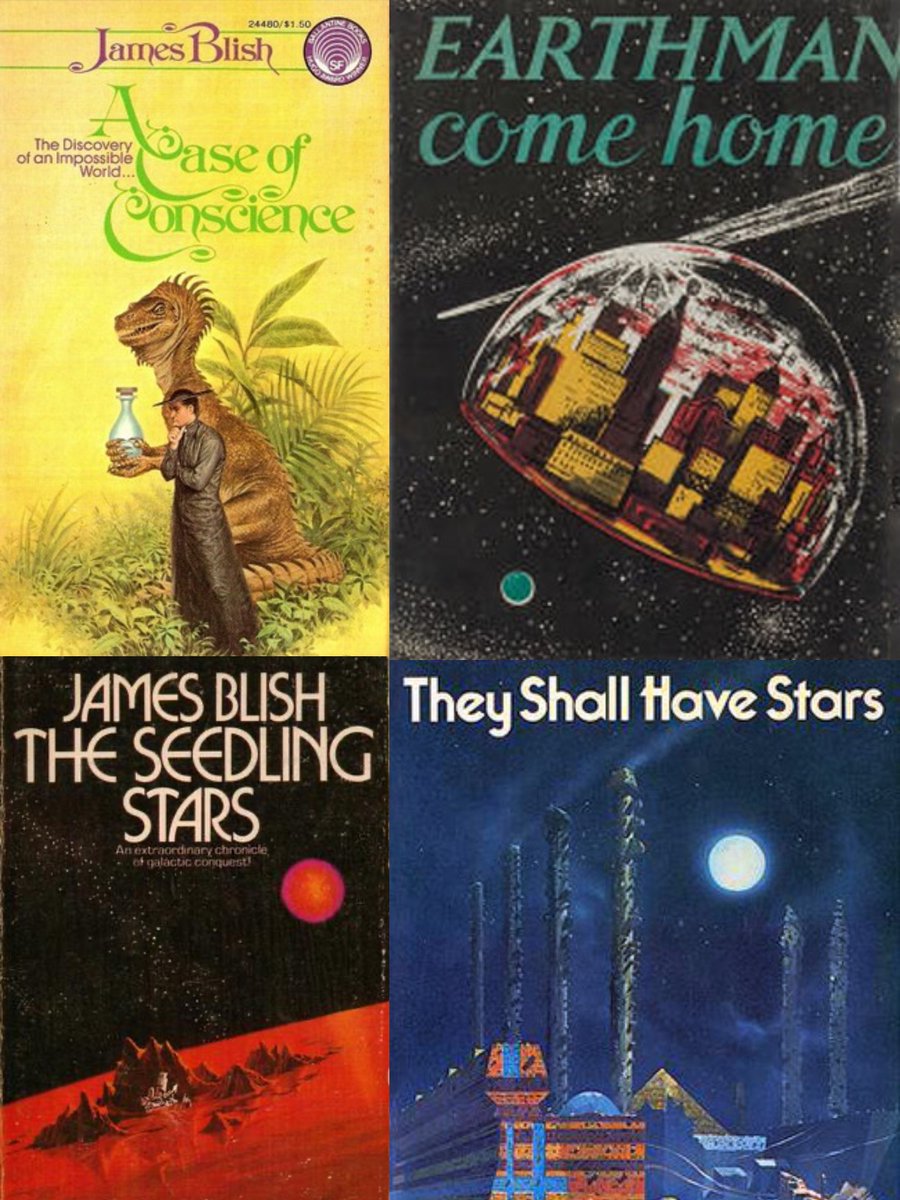

JAMES BLISH
An author revered not only for his thoughtful original fiction, but his foundational contributions to the Star Trek literary universe.
A Case of Conscience (1958): A Jesuit biologist studies an alien world whose inhabitants achieve a morally perfect society without any concept of religion or sin. Won the Hugo Award for Best Novel.
Earthman, Come Home (1955): Often cited as the single strongest book in the Cities in Flight tetralogy, this standalone novel sees New York City flying through a declining galaxy by means of its anti-gravity “spindizzy” drives.
The Seedling Stars (1957): This fix-up novel pioneered the notion of pantropy, the idea that instead of terraforming worlds to meet the biological needs of humans, we should be altering human biology to adapt to alien environments.
They Shall Have Stars (1956): The prequel that opens the Cities in Flight series is set in a near-future Earth sliding into authoritarian rule. It details the scientific breakthroughs like the spindizzy drives and anti-aging drugs that will eventually facilitate city spaceflight.

JACK WILLIAMSON
The Dean of Science Fiction, Jack Williamson’s career spanned an impressive eight decades.
The Humanoids (1949): Expanded from his masterpiece novelette With Folded Hands, this novel imagines a dystopian future in which robots designed to protect humans eliminate war and poverty, but also strip away human autonomy by banning driving, sports, and creative arts.
Darker Than You Think (1948): This brilliant novel grounds supernatural conceits like lycanthropy and witchcraft in genetics. A journalist covering the return of an anthropological expedition discovers a parallel human subspecies who possess the ability to shapeshift into predatory animals.
The Legion of Space (1934): Inspired by The Three Musketeers, this swashbuckling space adventure follows a band of elite warriors guarding the solar system from alien threats. It’s a foundational Space Opera that helped establish the lovable rogue archetype.
Terraforming Earth (2001): Published when Williamson was 93, this novel follows successive generations of human clones inside an automated lunar bunker tasked with rebuilding a devastated Earth.

KATHERINE MACLEAN
An author best known for her sharp and thoughtful short fiction.
The Missing Man (1971): Originally published as a novella in Analog and winning a Nebula in 1971, it was eventually expanded into a novel. The story takes place in a future New York where an empath working for the city’s Rescue Squad uses his talents to locate people in danger by sensing their emotional distress.
“The Snowball Effect” (1952): A sociologist applies a growth equation to a small town’s sewing circle, resulting in a chaotic expansion that threatens society itself. A classic satire of social engineering.
“Pictures Don’t Lie” (1951): This clever examination of perception and technological interpretation sees Earth’s scientists communicating with an approaching alien spacecraft only to face a devastating, perspective-shifting realization upon arrival.
“Incommunicado” (1950): A prescient look at information theory and human-machine communication, this story takes place on a space station where reliance on a complex musical and mathematical language leads to a shocking mental transformation.




Leave a Reply