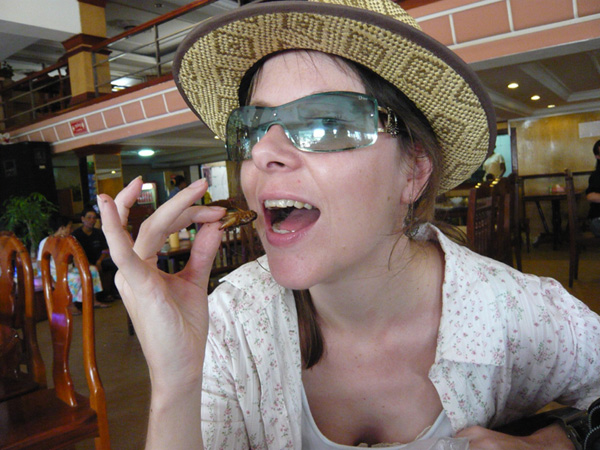
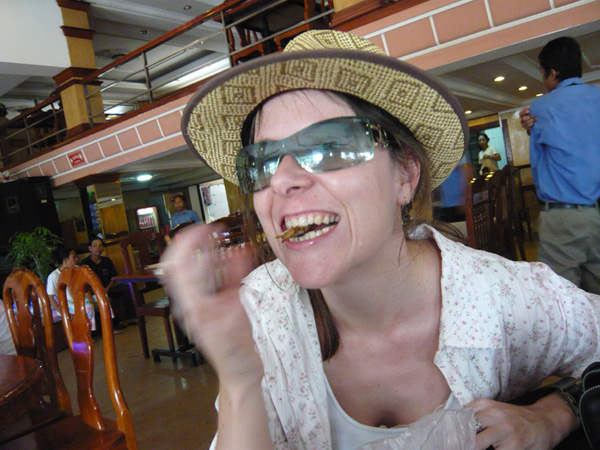
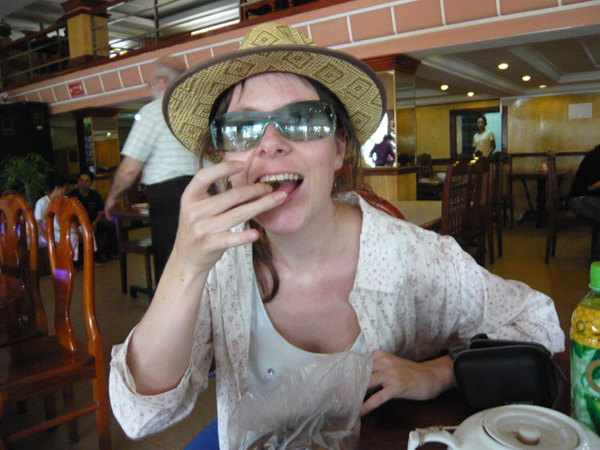
Today’s special guest author joins us all the way from her home in Bangkok, Thailand. As a result of your interest in her novel, her willingness to make time for us, and, of course, the magic that is the internet, K.J. Bishop is here to address a slew of your questions and comments. A huge thank you to Kirsten for offering some wonderful insight into The Etched City, her writing process, and the craft of writing in general.
Today’s pics: I asked Kirsten to send me a picture of herself to accompany the entry and she directed me to these three photos that document her first taste of fried grasshopper during a bus trip to the tourist town of Siem Reap (for the full account, go here: http://kjbishop.net/2008/07/06/an-entertaining-companion.html ). She writes “would any of the photos halfway down the page […] be suitable or would you like something normal?” Something normal? Puleeze! I’ve decided to use all three along with the accompanying descriptions.
For those of you who simply won’t be satisfied with this lone guest blog entry (and I‘m sure there will be plenty), head on over to http://kjbishop.net/ for your K.J. Bishop fix. Over to you, Kirsten…
To Joe and everyone, thanks for your thoughtful comments and your questions. I’ve answered them all except a couple that were the same.
Joe writes: “In your mind, what happens to Gwynn at novel’s end? I assumed his departing spirit was borne away by Beth/the Sphinx, but in your mind was this final act intended to suggest some sort of final redemption? Yes? No? Wait for the sequel?”
In my mind at the time, his spirit and most of his physical substance were borne away. If Beth hadn’t saved him, the Coldrake would have got him, I think. I don’t know about redemption—redemption isn’t really in Gwynn’s idiom, as Sir Lancelot would say; the idea would be foreign to him, and to Beth too—but rescue, certainly. I have a scenario for what happens next, but I don’t know that it would be wise to write it, as after initial strangeness it heads into more conventional fantasy territory.
Sylvia writes:
“1. Loved the “general look” of the book cover the design and colors. Not sure of what the centerpiece is or depicts, as it had elements of possibly being one of the discoveries Raule had in her laboratory. Ignoring that, the colors and framing was—well, I liked it. Are you able to share the spark or impulse to its design?”
I can’t speak for the designer, but the publisher wanted it to look decadent and Art Nouveau-ish and to have crossover appeal between mainstream literature and fantasy. . That’s a pomegranate in the middle.
“2. For the courtroom portion, who and/or what is the significance of Madam L____ C___?”
I was so tired by then that I couldn’t think of a name, probably! Actually, it’s meant to imply that no one knows her full name, or that it would be indiscreet to reveal it. They used to use dashes like that in old books, so I might have been trying to hint that the whole epilogue was apocryphal, but I don’t seem able to remember, sorry.
“3. Gwynn’s never ending supply of cigarettes was intriguing. Initially, I was going to say he must have magic abilities too. Only at the end does he make a comment about packing choices to ensure he has enough cigarettes.”
Packing choices aside, every character is allocated a certain amount of hammerspace—it’s union rules J .
“4. Please elaborate on the lighter that Gwynn uses. The use of a “lighter”—of course that word strikes me as something more modern like a zappo/bic. So it seemed out of place instead of matches.”
The level of technology in the book is roughly 19th century, but I didn’t want it to be a facsimile of our own 19th century. The lighter was invented in the 1820s and the technology improved a lot during the First World War—so, close enough. You mentioned newspapers, too—they had those in the Old West. I wanted to include a few items that would be feasible with the industrial development they’ve got in the book, but also ordinary to a modern reader, so that the ordinary becomes the exotic element.
“5. The story seemed to be set up whereby Gwynn and Raule might continue the “adventure” together. But that did not happen. What were your thoughts? Did you intend to give Gwynn a love interest from the beginning? Did this just evolve?”
I always knew he would fall in love. I’d already written a rough version of his affair with Beth. I didn’t know Raule was going to basically disown him, but she was adamant about that.
“6. It seemed that the etchings on Gwynn’s sword and/or Beth’s art might be linked to the title—the Etched City. Is this thought on the right track?”
Beth’s art, definitely. I hadn’t thought about the sword—but sure, why not? The inspiration for the book’s title—and the first inspiration for Ashamoil itself—came from this image by Sidney Sime for Lord Dunsany’s story How One Came As Foretold to the City of Never, which I think is an aquatint, though it might be pen and ink.
“7. Did you have any experience that led you to write this book?”
Different experiences contributed to different scenes. Driving across the Australian outback, a godawful holiday in Morocco… and, particularly, a story I was told that provided the basis for the murder of Hart’s wife. This guy was an ex-kickboxer turned kickboxing promoter. He must have got on the wrong side of the wrong people, because his wife was murdered in her bed. Their baby son was left alive. For years, I assumed the killers hadn’t been able to shoot the child. Then I realised it must have been for insurance. They needed to leave the guy something to protect and live for, or he would have come after them—he was pretty tough. The idea of a violent world with completely different laws colliding with your own safe world wouldn’t let me go, and that in turn led me to think about magical and supernatural worlds infecting or colonising ordinary ones. Richard Calder’s Dead trilogy inspired me in that direction, too.
“8. What was the basis for the character Gwynn? I found him interesting and intriguing.”
He comes from a lot of places. He’s named after the Welsh god of the hunt and the otherworld, Gwynn ap Nudd—so he’s that kind of dark hunter, except that he’s also a comparatively modern man—a dandy in the Baudelairean sense. Baudelaire wrote that “dandyism is the last flicker of heroism in decadent ages.” That captured my imagination. I like to think that the mythic and the ordinary mingle in him. Sometimes heroes become gods; then gods dwindle into fairies and folkloric amusements—or just mere mortals. He’s somewhere at the bottom of that trajectory; he is descended from myths and legends, but he’s human. However, he has the vanity of Lucifer and he tries to be the most interesting human he can be. He’s been in my head for a long time, since I was a kid. He’s picked up a lot of influences over the years—the violence came earlier, the dandyism later. Various figures and characters stuck their own influences on him, from Adam Ant to Maldoror .
Narelle form Aus writes: “What was your motivation for moving to Thailand from Australia?
Was it for inspiration, job opportunities, change in lifestyle?”
My husband Stu and I had been to Thailand twice and knew we could have a good life here. It was financially advantageous. I’m also allergic to something in the air in Australia—grass or pollen or something that’s everywhere. I don’t have that problem here.
“My reason for asking…
Our long term goal (in around 5 years to get everything in place) is to sell up most items here in Australia and live in Thailand for a much simpler life as opposed the crazy, materialistic world that surrounds us here.
My ultimate goal is to open an education centre for women in the hope they do not have to resort to prostitution but that will come down to whether I will be beating my head against a brick wall due to a pre-existing culture that won’t budge. Even if I can help just a few girls get the required skills to give them a well paying job and break the cycle then I’ll be happy.
We are heading over to Thailand in a few weeks to spend a bit more time trying to work out if it is something that is realistic or just a dream.
I always get told I’m crazy for even thinking of doing something like this. Oh well, so be it. Thank you for coming to visit here and your blog is great!”
If you want to leave the crazy, materialistic life behind, Bangkok isn’t the place to move to. However, other parts of Thailand offer an opportunity for a great simple life—renting a bungalow on an island, for instance, though you’ll need a source of income, and it can be hard to find a good job in those idyllic locations. Bear in mind, though, that the visa situation is problematic. Thailand doesn’t bend over backwards to encourage foreigners to stay and work or do business here, so best to do your research carefully before you commit to anything.
Regarding your idea for an education centre, there’s an organisation called Empower that you should definitely check out:
If you look at the website, you’ll see that Empower has education centres. Sex workers may want to remain in the job for as long as they can for the sake of the money, but in the meantime academic education, money management and business skills can make a huge difference to their lives afterwards. A sex worker can set herself up very well if she is astute. If she lifts herself out of the poverty cycle she may well lift others in time. Education can also help a woman get a better job in a better bar—if she speaks English, for instance.
A little bit more about the money. The problem is basically that the gap between rich and poor in Thailand is immense. Most of the women who become prostitutes or bar girls are poor, usually from rural areas. An uneducated girl can earn 3-4000 baht a month in a factory, maybe 5000 as a maid in Bangkok. As an unskilled dancer (shuffling around a pole) in a bar, she can earn 14,000 if she doesn’t go with customers. If she goes with customers, the pay goes up a long way. A pretty girl can make 100,000 a month. To make that kind of money outside the sex industry she would need a professional education and a very good job. Check on this, but I think you’re looking at jobs like heart surgeon and high level executive.
Another important fact is that nearly all sex workers send a large portion of their income home to their families. They may be supporting their parents or enabling their siblings to stay at school. They can’t afford to take time off for university, and on a shop worker’s or clerical salary that they might be able to obtain with lesser qualifications they couldn’t do nearly as much for their families. Sex work is one of the very few channels through which significant capital flows from rich to poor in Thailand. Regarding “a pre-existing culture that won’t budge,” really, what isn’t budging is poverty and a culture of inept, corrupt governance that lets poverty continue.
I really urge you to talk to Empower, if you’re comfortable with the idea of sex workers remaining sex workers while they’re young enough to be paid well for it and to find work in clean, comparatively safe establishments. If you’re not comfortable with that, I honestly think you’ll end up wasting your energy and goodwill. But re that and all of the above, don’t take my word for it. A lot of misconceptions about Thailand arise from people believing what someone else says. It’s great that you’re going to come and investigate for yourself.
N.B. The western media is not always careful to differentiate between regular sex work and sex slavery. The girls who end up as indentured prostitutes generally come from other, poorer countries in the region. They are not the majority of sex workers in Thailand and you’re unlikely to find them in areas that foreigners have access to. Also, consider that prostitution exists all over the world. Conditions for sex workers in Thailand, at least those in establishments catering to foreigners, compare favourably with many other countries in terms of safety, safe sex, and the right to refuse clients. You might find you can do more good elsewhere, such as Cambodia, which you could check out while you’re in Thailand, or by joining an organisation that fights child prostitution and sex slavery.
AMZ writes: “Did you set out to create the city as a character in its own right?”
Nope, not really. It’s meant to be a stage set for the action. I come from a visual arts background, so it seemed natural to me to “draw” the background around the characters. I’ve travelled a bit and seen some fascinating cities, so I used impressions of those. To some extent Ashamoil is a collection of my holiday snaps. I looked at some of my favourite writers who have created vivid places—M. John Harrison, Pierre Loti, Lawrence Durrell—and tried to study their techniques, but I still only thought I was designing a set. I hadn’t come across the concept of a city as a character at that time, I don’t think.
AMZ writes: “When/where did you intend the setting of the book to be? Was it a post-apocalyptic world or a pre-technological one?”
I intended it to be roughly 19th century in terms of technology, and postwar—any war, take your pick—in terms of zeitgeist. I didn’t set out to make it post-apocalyptic.
“A lot of books which include a journey start in a city, town etc, and then go into the physical journey. But with The Etched City you started with the physical journey and then looked at city life. It seemed to emphasise the psychological journeys of the characters in the city, but I wanted to ask: why did you structure the story like that?”
It was gut instinct to start with, I think. Back in Melbourne I lived in an area where there were a lot of refugees, people from places like Sudan who’d come to a city in a foreign country in hope of a better life. As usual there were doctors working as taxi drivers because their qualifications weren’t recognised, people who’d been through horrifying traumas being expected to just get on with life in an alien culture, some doing okay, others falling into despondency. Their stories influenced the book’s structure. I also wanted to show what Gwynn had been before he reinvented himself as a dandy and an urban criminal.
“Were there any myths and historical events/places that influenced the world you created in The Etched City?”
The wasteland motif, the journey to the promised land, the myth of the femme fatale. Civil wars, but I don’t think you could single out one in particular.
Charlie’s Angel writes: “What made you decide to move away from the character of Raule and concentrate on Gwynn? Did you plan that from the beginning, or did the story just grow that way?”
What happened was that I lost contact with Raule’s voice in my head. I had only written a couple of short stories before I wrote the book and didn’t know much about writing. I relied a lot on my unconscious mind to produce the story, and it was as if Raule slipped out of the dream I was having. I knew it was a problem; I just couldn’t find a solution at the time. Raule is probably the most mature person in the book, and perhaps at the time I wasn’t enough of a grownup to slip into her shoes.
McWraith writes: “1. Do you feel being Australian gives your writing a unique flavour?”
That’s hard to answer. Australia is a pretty diverse place. There might be a style of speech, secular attitudes, perhaps an appreciation of platonic friendships between men and women—I don’t seem to see so much of that in American culture. Although I’m an urban Aussie and only a tourist in the outback, the immense age of the land, they way it is worn down by time, and the way our cities cling to the coasts, gives me a sense of civilisation as a young, fragile thing that we have to tend carefully. There’s a sense of strangeness about Australia —one was born there, one lived there, but one hardly inhabited the place, because it is largely uninhabitable. In a place like Rome or London, the psychogeography is rich. In Australian cities it’s flimsy. The European history only goes back to the 19th century in most places, and the Aboriginal history is mostly invisible. These factors probably influence my writing.
“2. Could you share about your journey to getting published? Did you have to persevere through a lot of knock backs or did it come easy?”
Two knockbacks, then I published through Prime, a small press in the US, on a friend’s recommendation. Through Prime, I met authors who recommended me to an agent. He sold the book to major publishers in the US and UK—the latter being one of the two who turned it down at first, although by then it had been heavily revised and was a better book. In short, I was incredibly lucky.
“3. Have you earned a degree or doctorate in creative writing? Or have there been any courses or workshops that have been helpful in developing your gift?”
I have a BA in English, so I studied books. I don’t have a doctorate in anything—I have little Latin and less Greek (though my Japanese is ok). I did one creative writing course in poetry, with Chris Wallace-Crabbe, which gave me an interest in the word-by-word details of writing. I consider books my best teachers. I study the techniques of writers I like—that is, I study them now. I didn’t decide to try being a writer until after I’d written that first book. At the moment I’m reading Frederick Forsyth, as I’m trying to learn some tricks of plotting. I have an aversion to workshops. I prefer to get the opinions of a few people who I know are honest and perceptive.
Thornyrose writes: “When writing Etched City, was it a case of the book writing itself, where you simply started with your characters, or did you outline the novel, including some of the more fantastical aspects of the tale?”
Initially it wrote itself. At some point I had to try and plan and order it a bit. Then it did some more of its own thing. Mainly, I just tried to follow the characters without interfering too much.
“Are you planning other stories or novels in the “Etched City” universe, examining other parts of the world you’ve portrayed so vividly?”
Not especially. I’m not a fanatical worldbuilder. Those environments were stage sets, and they’re packed away now. I’m not interested in creating a secondary world that you could draw on a map or write an encyclopedia about. But the characters, yes. I can’t resist writing about Gwynn from time to time, but so far I haven’t been able to manage more than vignettes, which I wouldn’t even try to publish (see answer to next question).
“Was the epilogue planned from the start to wrap up the story of Gwynn and Raule, or did you decide to add it after finishing the main story? I thought it was admirable and gutsy to close out their stories that way. Though there is still room for sequels involving them, the epilogue seems to seriously restrict such opportunities.”
It wasn’t planned from the start, but I’d written a story several years before, The Art of Dying, featuring Gwynn. The Etched City is set sometime prior to that story. I decided to link the two together. I also deliberately made it hard for myself to write a sequel. I wanted to force myself to write different things, so I put that obstacle there.
“Finally, what conditions do you normally write in? Do you prefer music or other distractions in the background, do you set down to write at certain times each day, or do you write when the Muse strikes, so to speak?”
I write in the mornings. I live in two rooms in Bangkok. My husband’s a night owl, so the mornings are mine. I used to write late at night. I usually write the afternoons, too, when I’m not at work. I sometimes write with music in the background. My number one composer to listen to when I write is Harold Budd. Coincidentally Jeff Ford, one of my favourite writers, listens to him too. When I was writing battle scenes for The Etched City I listed to the Ennio Morricone’s film scores (A Fistful of Dollars, et al) and Basil Poledouris’s score for Conan the Barbarian. If I only wrote when the muse struck I would never write at all, but the muse lurks, and by writing he or she can be encouraged to come out and bop me on the head with a sparkler. I wrote some of The Etched City in the atrium of the Crown Casino in Melbourne, which is a psychedelic sort of environment.
Airelle writes: “What/why were the ghosts in Raules dreams?
Old comrades long gone, probably.
“Was the story/characters from an experience or a dream? A lot of dream reference in the story is why I ask.”
Only one line in the book comes from a dream—“You don’t know how dead you are.” On the whole, my dreams don’t furnish material for writing. (The other night I dreamt about a Pacman robot with Darth Vader’s head. I don’t want to touch that stuff with a 10-foot pole…)
“How do you try to think of ideas for a story?”
Sometimes ideas come serendipitously. Sometimes I have to put screws on my brain and hope something seeps out. As a last resort, I summon devils and get them to give me ideas. What seems to happen to me is that a character comes into my head, and then I spend a long time trying to understand that character. It can be like tuning a short wave radio. I have to be patient. I listen to the character while they tell me what they want to do, and we have a conversation about how we could collaborate. Sometimes other people give me ideas. Because my own process is so slow, it’s good when someone says, “Write a story about this.” I’ve done that a few times, not counting commercial work where I wrote short fiction for real money. It’s amazing how the muse will hop to it for a dollar a word.
“Is a lot of research involved once you get an idea?”
It depends on the idea. I try to get away with as little research as possible, but sometimes you have to read a lot of background material to get the one or two details that will end up in the work.
Anti-Social Butterflie writes: “Dear Ms. Bishop –
How did you come up with the character, Beth? Was she based on a real life person or was she an extension of yourself?
It seems as though you have a casual ease with the character that, in my experience, tends to come from an intimate clarity about that person.”
There’s a book called Idols of Perversity by Bram Dijkstra that looks at the femme fatale, often iconised as the sphinx, in fin-de-siécle culture. I was fascinated by the neurotic attitudes of men towards women that the book discusses. Prevalent was the idea that man must be the creator, woman the passive muse. I decided to make the sphinx the creator and give her a male muse. In that sense, Beth is like me. I have male muses. I studied printmaking, so I knew what the process of her work involved, which is always helpful in being familiar with a character. She has a mythic dimension, too. She isn’t an extension of myself so much as an embodiment of something I care about, namely the right of a woman to be what she wants to be. I still don’t think we’re anywhere near achieving that. She’s my feminist icon, my Kali. That’s why the world of dangerous men can’t touch her. She’s my wishful thought.
“Also do you relate more to Raule or Gwynn or are they two sides of your own personality?”
I relate to them both. They both have aspects of my personality, but I’m not as brave as either of them or as determined as Raule to do good in the world. I have Gwynn’s skepticism and Raule’s waspishness (sometimes).
Michelle writes: “My questions for K.J. Bishop would be, what inspired the desert descriptions — have you spent time in deserts?
In the arid outback of Australia—two long roadtrips there, and an impromptu excursion to the edge of the Sahara in Morocco. Those, plus the Spaghetti Westerns that Joe mentioned, were the main inspiration, along with Mad Max and Pierre Loti’s book The Desert. Since then I’ve been to Jordan and Egypt. Deserts used to fascinate me but I feel I’ve seen enough of them now. The desert was partly inspired by the Wasteland myth that you have in Grail legends and T.S. Eliot’s poem. There’s an awesome Wong Kar Wai film, Ashes of Time, set in a desert. It gave me some inspiration too. I could probably also say Tatooine. Maybe my inner six-year-old told me that stories start in deserts and then go someplace else entirely.
“Second, what do you have in the works now?”
Secret—can’t tell, sorry! I get superstitious about WIPs. Sometimes when you talk about them it seems to have an adverse effect.
Sparrow Hawk writes: “1. What is the significance of the red thread/Beth’s red hair? It seems to attain the significance of a religious relic to Gwynn.”
That’s something that I think is open to interpretation, but my take on it would be that, atheist that he is, he doesn’t realise it, but some part of him has a devotional relationship to her. Red thread is used in Hindu ritual; it also figures as a protective charm in Jewish culture. Red has various esoteric meanings that I thought were appropriate for Beth. It’s the colour of the left hand path of tantra, and Lilith supposedly had red hair.
“2. Is Beth human?”
There’s no definite answer to that question. Is a caterpillar a butterfly? J There are multiple possibilities—and within the book, multiple subjective realities in which she might be different things.
“3. The book gave me the feeling of wandering through an art gallery — from the clean, stark desert paintings of Georgia O’Keefe (Copper Country) into Salvador Dali then on to Aubrey Beardsley, Hieronymus Bosch and M.C. Escher with touches of Paul Gauguin. What was your inspiration for the book?”
There were many influences from different places. As for artistic inspiration, there was the Sidney Sime illustration I mentioned above, Beardsley definitely, the Australian painter Russell Drysdale for the Copper Country, old prints of India in the Raj days; architecturally, the cityscapes of Rome and Fez; and I think some things that go back to childhood, like Dr Seuss and Maurice Sendak—the boy who dreams of becoming a Wild Thing in the jungle, if he were a girl, might be Beth.
“It made me wonder whether, in Bishop’s fantastic world, perhaps Beth is a goddess who took on a human body and eventually, after experiencing all she could in this world, ultimately shed her mortal form. Maybe Gwynn, her demon and muse, both inspired her art and enabled her to complete that transformation.”
I think that’s a very plausible reading. While the text really doesn’t tell you, something a lot like that was in my mind.
A few of responses to points raised:
The religious discussions—if I were writing the book again now, I would try to knock some verbiage off those. I wanted to give Gwynn an equal adversary in the Rev. Looking back, instead of talking so much about abstract theology, perhaps the Rev should have nagged him more about actual crimes he committed.
Can you write without an inborn “It” —Somerset Maugham and George Orwell both worked hard to improve their writing. I don’t know if they had “it” or if they grew “it” through diligence. As for structuring things properly, the word “properly” smells bad to me. Writing, done “properly”, is in danger of reaching the condition of Tupperware. I’d like to improve my control over structure and other aspects of craft, sure, but I think you have to beware of formulas that smooth off all the rough corners and eliminate oddnesses and asymmetries.
The battle on the bridge—I might have overdone the amount of luck the Horn Fan had. I wanted the reader to be pretty sure something supernatural was at work, perhaps Beth’s imperviousness to danger rubbing off on Gwynn and his mates. But I think I could have either been more subtle or provided more explanation.
Beverly writes: “Even Raule was morally corrupt in her own way—she never protested when Gwynne tortured a young boy to death. She just stood there and felt nothing.”
I think Raule was exhausted. I’m interested in the fragility of civilisation and morals. We seem to slide rather easily when we’re hungry, tired and frightened, or when our own friends/family/comrades are threatened or harmed. That was a nadir for her, but perhaps most of us, under similar stresses, would have reacted the same way.
Terry writes: “I am curious how KJ Bishop categorizes her story.”
I don’t categorise it, lol. I don’t have a taxonomic mind. It’s fiction. Fantasy, if you really push me. Beyond that, I run shrieking from the label monster. I don’t think it really matters, except for marketing, which isn’t my job, thank goodness.
Phew! Joe said I could talk about anything I liked, but I feel all talked out. So instead of talking, I’ll ask some questions. We’re all readers here, and I’m interested in what makes us readers. What do we look for in books; why do we give them hours and days of our time? Given the length of time it takes to read a book, is there something you as a reader expect in return that you wouldn’t expect from, say, a painting? Do you read novels for insight into the human condition, to immerse yourself in another world, to live out fantasies vicariously? Other reasons? Could you read a book that took abstract expressionism or cubism as its inspiration? Is there anything you’d like to say about your relationship with these strange long lies called novels?



Leave a Reply