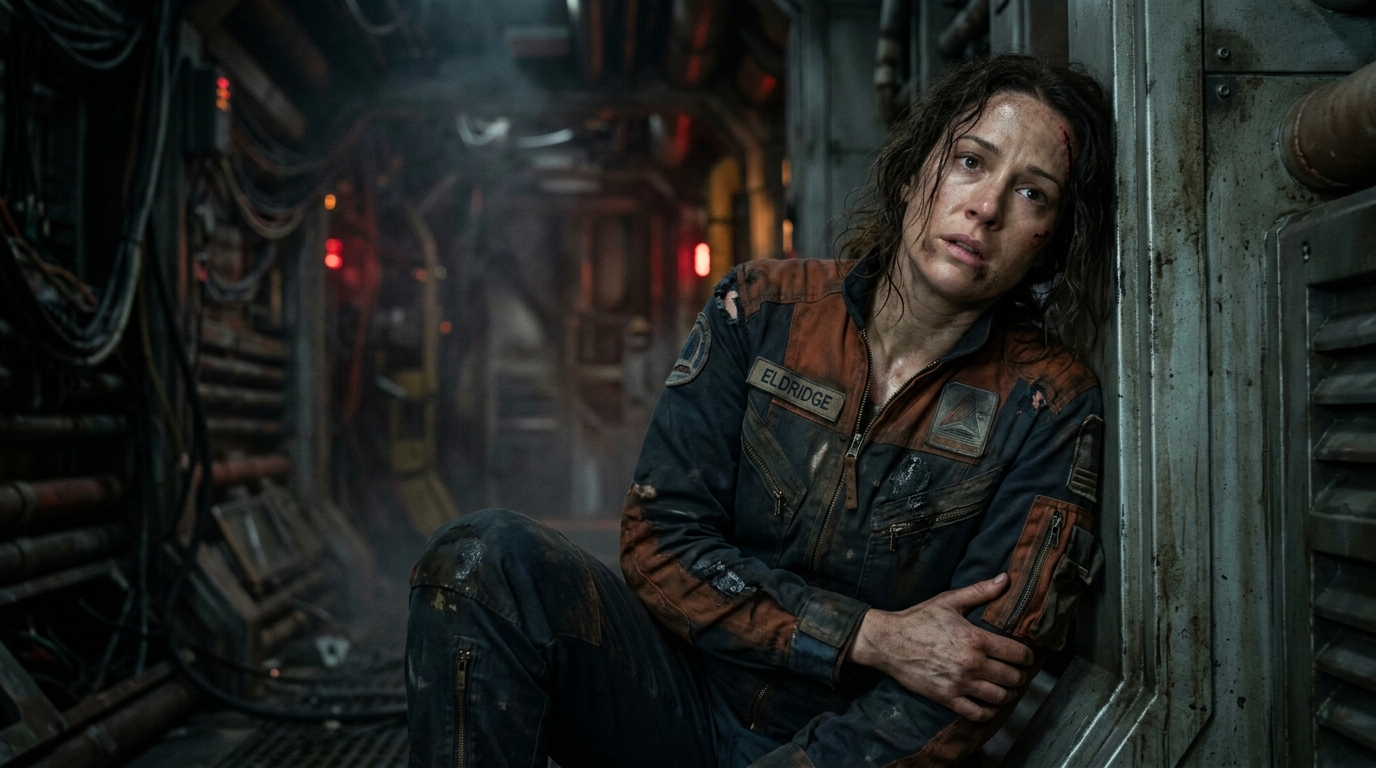
Jack and Daniel head down the corridor, the light on Jack’s P-90 cutting through the shadows while Daniel checks the sensor tracking the fading life sign. They move in silence. The far-off hiss of venting steam somewhere deep in the ship, the clack of their mag boots on the grille, and little else.
Then Daniel is hit with a realization. “Lam,”he says, an answer to a question only he was asking.
“What was that?”asks Jack.
“I was trying to figure out who Rommie reminded me. Just got it. Dr. Lam, back at the SGC.”
He waits for Jack to make the connection. O’Neill considers a beat, then shrugs. “I don’t see it.”
Suddenly, Daniel pulls up short. The signal is getting stronger. He motions to Jack. They approach a bend in the corridor, raise their weapons, then swing quickly around it to find –
A young woman, cowering under their lights. She’s in a crew uniform, clearly injured, and she flinches at the sight of them. “Please, don’t!”she cries. And then, as Jack and Daniel lower their weapons, she takes them in and a wave of relief washes over her. “How did you get aboard? Are you the rescue team?”
“We answered a distress beacon,”explains Daniel, hunkering down beside her. “Are you alright? What happened?”
Her name is Rhea, and she tells them that she was a member of the ship’s 7-person crew. They were on a long-haul run when they struck some kind of anomaly that knocked them out of FTL and crippled the ship. While they were effecting repairs, the anomaly somehow got onboard and infected their service android, Maia. She turned on them. They fought back and ran for the shuttle. Maia opened the bay doors while they were still crossing, venting the hangar and blowing them out into space. Rhea only survived because she had fallen behind the airlock when it sealed, trapping her on the pressurized side. She watched her friends die through the glass.
She’s been hiding ever since, waiting for rescue. And now that it’s here, she has one warning for them: “Don’t trust the android!”
What do you do?
A) Request transport. Ask Scotty to lock onto Rhea and beam her straight to sick bay, if the pulses allows it.
B) Bring Rhea along and confront Maia. Put them both in the same room and get the true story.
C) Keep Rhea hidden and regroup with the rest of the team first, then get to the bottom of it.
CHOOSE!
Previously On Amalgaverse…
You and 19 others have been stranded in an amalgam universe of myriad SF realities. All 19 are sci-fi’s Best of the Best. And then there’s you, uniquely qualified given your encyclopedic knowledge garnered from your world where these characters, their technologies, and their stories are fiction, beloved TV shows you have watched time and again. Together, all 20 of you have set off on the Enterprise-D, tasked with finding a way home.
For your first mission, you’ve decided to investigate a seemingly derelict freighter broadcasting an emergency beacon. An away team and puddle jumper have been dispatched to the ghost ship, anomalous energy pulses making beaming and communications a challenge.
After parking and cloaking the puddle jumper in the freighter’s hangar, the team crosses the airless bay into the ship proper. There, they make the decision to check out the waning energy signature of a containment field en route to the bridge. But they immediately encounter a utility unit that advances on them menacingly. Rommie connects to it and relays a shut down command that causes the robot to collapse.
Further along, they encounter a sealed door and Rommie informs them that the compartment beyond is exposed to space. She suggests locking down their current section and then unsealing the door since it’s the most direct route to the bridge – and that ebbing containment field. They do so. The door slides open to reveal an immense hull breach complicating their progress. Rommie leaps over the chasm and secures a tether to the other side, allowing the rest of the team to pull themselves over. But when they attempt to open the door to the next section, they hit an impasse. The door remains locked and will not respond to their commands.
O’Neill blows the lock with C4, allowing them entry into the adjoining compartment where they discover an android in a containment field, completing its regenerative cycle. When the android awakens, it informs them it is the caretaker of this freighter, the Waldorf Astoria, and warns them off pillaging its contents. Daniel assures the android, Maia, that they harbor no ill intent and asks for her assistance in accessing the bridge and restoring ship’s systems. But Maia remains suspicious. She requests a peer-to-peer interface with Rommie to confirm that your presence on the freighter is, in fact, benign. Rommie agrees.. Maia explains that her memory stores and parts of the ship were damaged after the freighter encountered an atemporal force during FTL transit. She offers to help the team access the ship’s systems in exchange for their assistance in tracking down and eradicating a mysterious entity that has boarded the freighter.
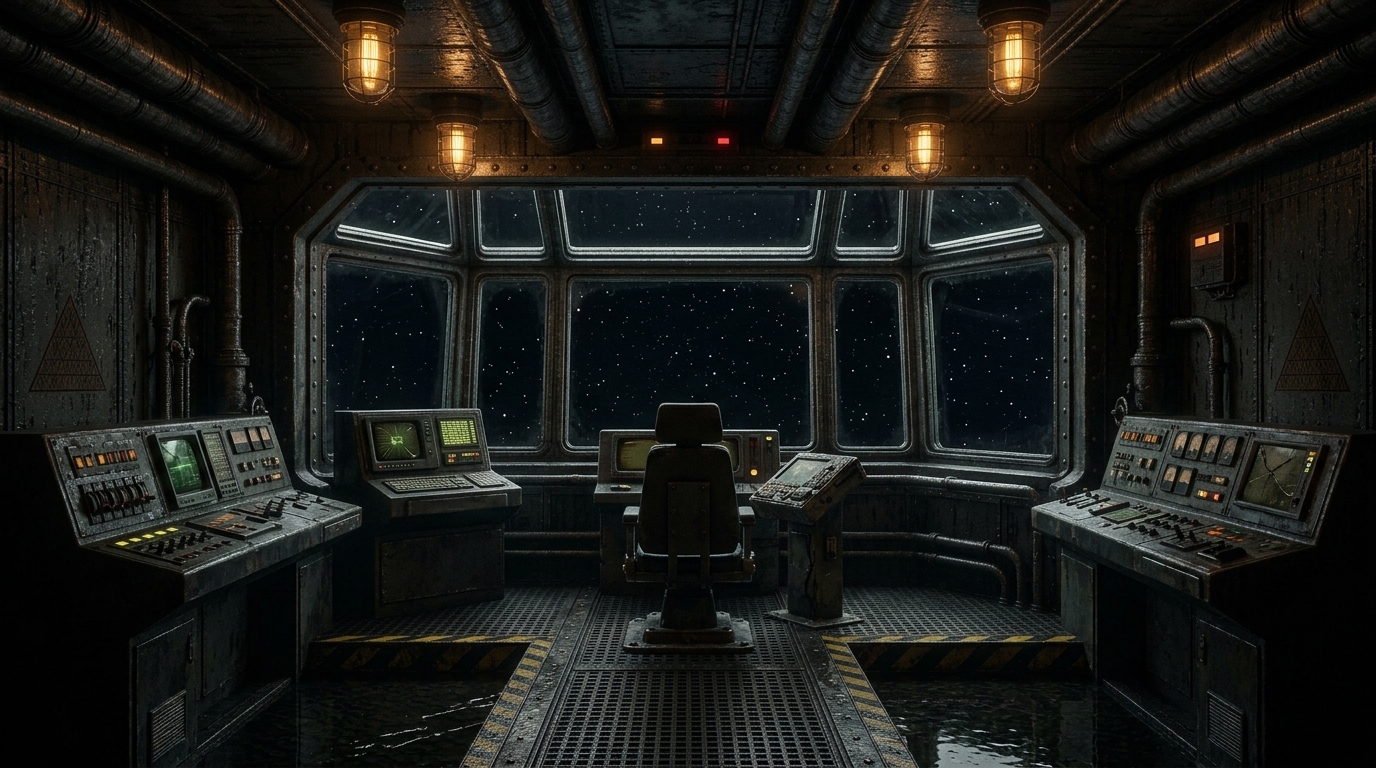
Maia helps the team access the bridge where they discover the freighter’s analysis of its encounter with the atemporal entity has yielded harmonics very similar to residual energy signatures from their crossings into this reality. This could hold the key to their return home, but the data is corrupted and Rommie needs time to decipher it. Daniel, meanwhile, notes that the life sign he detected earlier is fading, and he wants to check it before it’s too late. But Maia flags a more immediate concern – the likelihood that the ship’s core is in danger of going critical unless they vent the drive.
The decision is made to split the team.
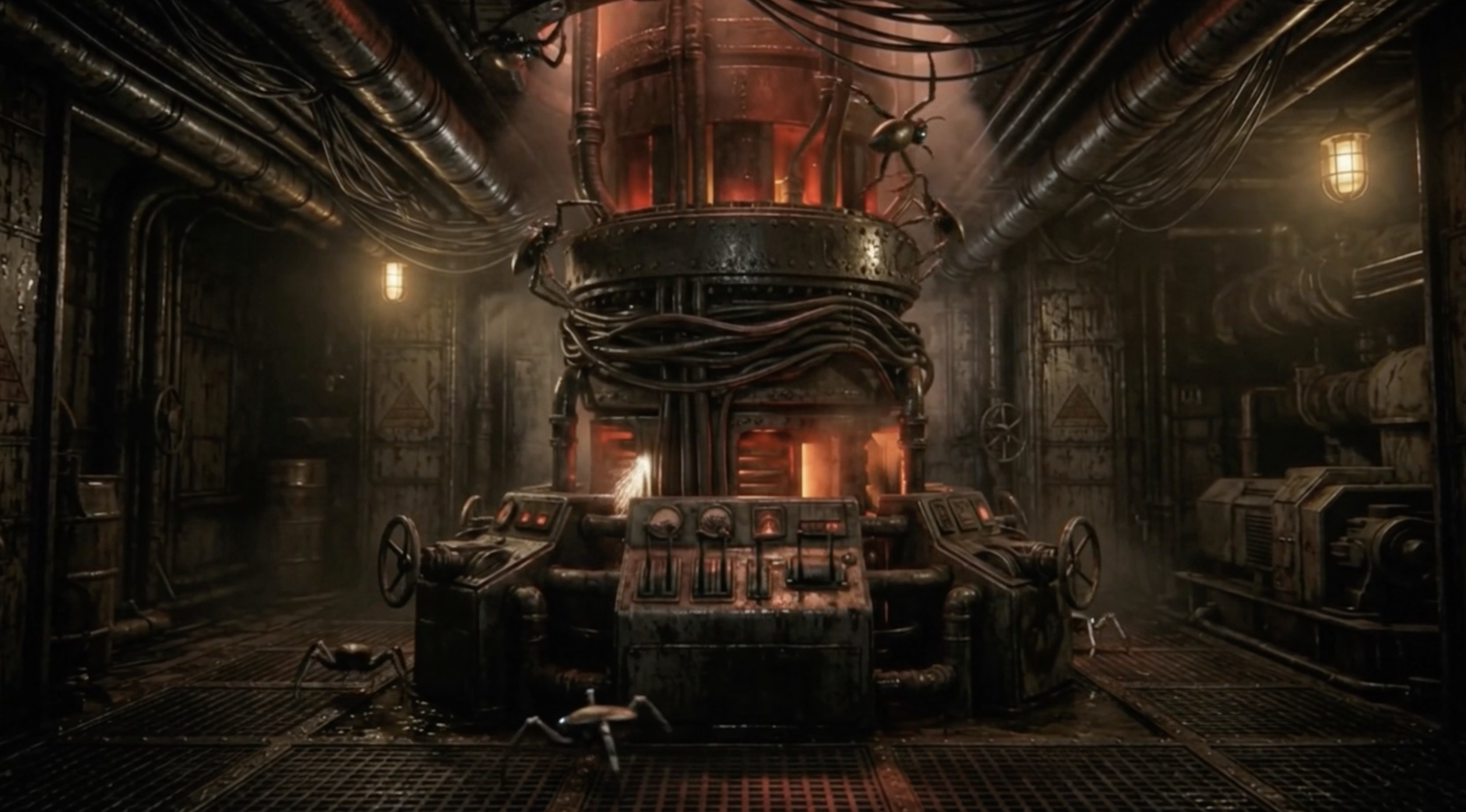
McKay and Maia head to engineering where Rodney is startled by a half-dozen mechanical spiders that he, at first, assumes to be replicators. But Maia assures him they are simply the ship’s repair bots. Maia vents the drive but McKay’s reading of the data confirms they have only delayed the inevitable. In approximately 42 minutes, the core will go critical and the ship – and everyone on board – will be destroyed.
***

George S. Schuyler
A provocative SF satirist and journalist.
Black No More (1931): A Black scientist perfects a process that turns Black Americans white in this foundational Afrofuturist satire that takes aim at everyone from white supremacists to Black political leaders.
The Black Internationale (1936-37): The first of two linked novels follows a scientific genius who organizes a technology-powered conspiracy to liberate Africa from European imperial powers.
Black Empire (1937-38): The sequel sees Dr. Henry Belsidus establish a Black empire in Africa, only to face European attempts to retake the continent.
The Ethiopian Murder Mystery (1935-36): When an Ethiopian prince is found dead in a Sugar Hill apartment, the ensuing investigation uncovers an international plot to stop Ethiopia from acquiring a death ray.

Damon Knight
SFWA founder, editor, and critic.
“The Country of the Kind” (1956): The world’s last violent man roams a future utopia, lashing out while going ignored by a pacifist society. An unsettling examination of isolation, freedom, and social control.
“To Serve Man” (1950): The source for one of the most beloved episodes of the classic Twilight Zone sees aliens arrive on Earth with promises of peace, prosperity…and an innocuously titled book.
“Masks” (1968): This Nebula-nominated short story follows a man whose body is almost entirely replaced by cybernetic components after a tragic accident, leading to a disturbing exploration of identity and humanity.
Stranger Station (1956): An intense and claustrophobic first-contact story about a man who is sent to an isolated space station, where he must endure psychologically harrowing encounters with an alien species.

Nancy Kress
Six-time Nebula and two-time Hugo Award-winning author
Beggars in Spain (1991): This Hugo and Nebula award-winner explores genetic inequality and social responsibility through the Sleepless, a genetically engineered elite who require no sleep and quietly outcompete the rest of a resentful humanity. It was expanded into a full novel published in 1993.
The Flowers of Aulit Prison (1996): Winner of the Nebula and the Theodore Sturgeon Memorial Award, this novelette follows an alien whose perception of reality is dramatically unlike ours as she is forced to become a prison informant.
Yesterday’s Kin (2014): Later expanded into a trilogy, this Nebula and Locus Award-winner sees an alien species arrive on Earth to warn it about an approaching biological spore cloud.
After the Fall, Before the Fall, During the Fall (2012): Another Nebula and Locus Award-winner, this one told across three time periods, tracking the cause and consequences of a catastrophic ecological event.

Leave a Reply