I mean, they do to me otherwise I wouldn’t be updating this blog on the daily, interacting with them here and on other social media platforms, uploading behind-the-scenes pics, videos, and insights into the shows I have helped produce over the years.  But, increasingly, it seems that in the eyes of many execs, they do not.  And I honestly don’t get it.

zBqT-1
Modern “Fan Outreach”

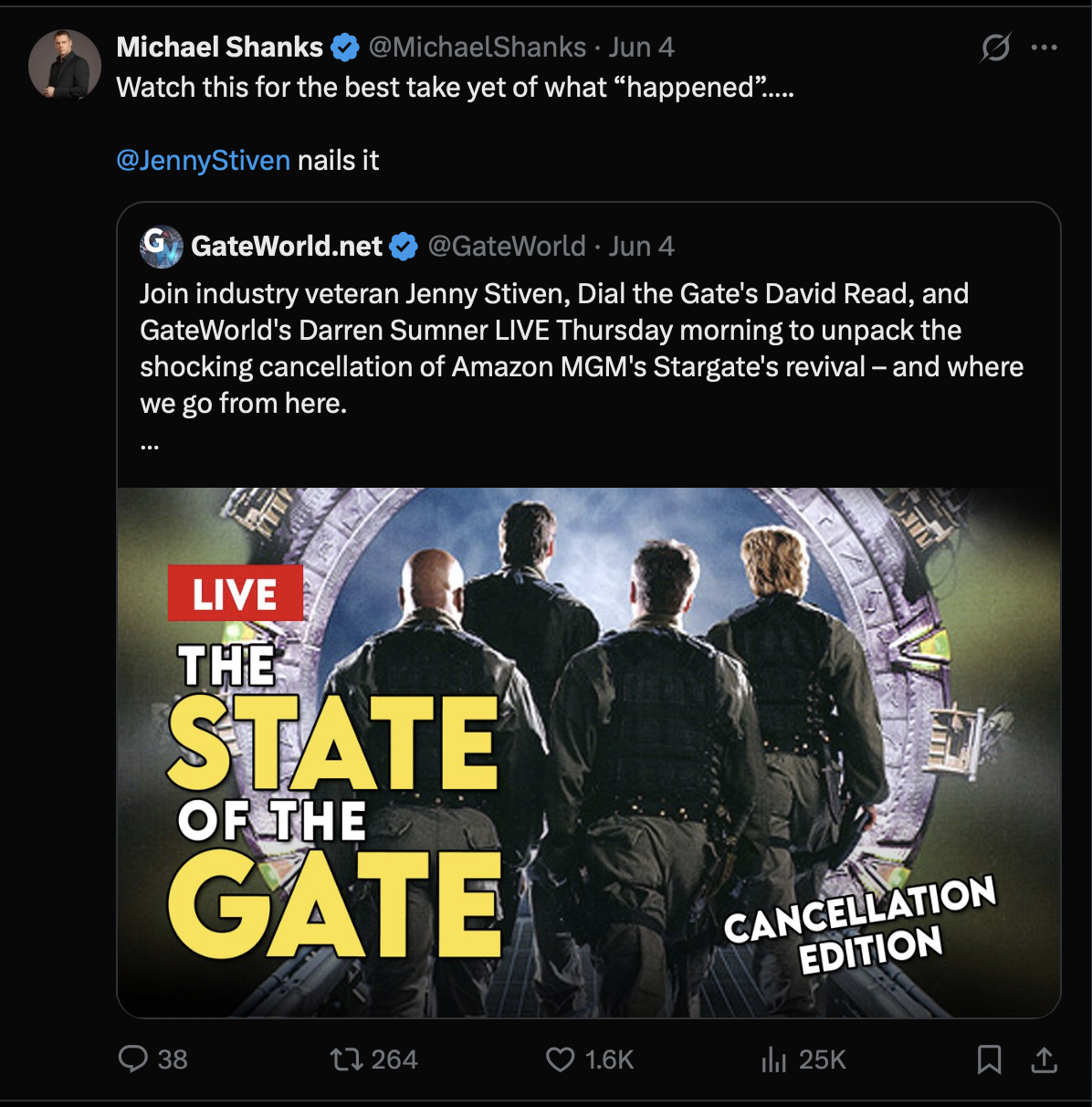
My friend Jenny Stivens is an industry insider and she addresses this baffling strategy (and much much more) in her latest chat with David and Darren on Dial the Gate: CLICK TO WATCH

Screenshot 2026-06-06 at 11.25.20 AM

I’m bound by an NDA that prohibits me from being transparent about the new Stargate series we were developing.  I’m a guy with opinions – and a desire to clarify and set the record straight.  But, for now, I’m just going to have to sit on my hands and let others lead the battle.  Like, Michael Shanks…

Screenshot 2026-06-06 at 11.26.05 AM

And so many countless fans.

Screenshot 2026-06-06 at 11.30.18 AM Screenshot 2026-06-06 at 11.30.32 AM Screenshot 2026-06-06 at 11.30.43 AM Screenshot 2026-06-06 at 11.31.00 AM Screenshot 2026-06-06 at 11.31.14 AM

Screenshot 2026-06-06 at 11.45.49 AM

There are a few petitions out there as well as addresses, email addresses, and phone numbers to direct your thoughts.

Screenshot 2026-06-06 at 11.29.47 AM

I’ve come across – and responded to – a few lazy articles and video takes that really do little more than regurgitate the Variety announcement, but there are sooooooo many other great responses out there.

“Why Amazon canceling the new Stargate series is a mistake – and fans are trying to tell them” by John Trent

“The new Stargate show is cancelled and I will never be okay” by John Summers


Discover more from Joseph Mallozzi's Weblog

Subscribe to get the latest posts sent to your email.

Podcast also available on PocketCasts, SoundCloud, Spotify, Google Podcasts, Apple Podcasts, and RSS.

26 responses

  1. Amazon, “got the band back together”… bit then said, “Ah, no. We wanted hyperpop, not blues.”

    So much of this fiasco, on Amazon’s side, doesn’t make sense. With NDA epidemic we live with these days, I don’t expect we’ll ever know the whole story. We’ll just live with the heartbreak of what should have been.

    What are the odds Apple/WB/Neftflix/Sony would take it on 🤷‍♂️ and, at least, pay off Amazon’s pre preproduction costs and a slice of revenue.

    1. Joseph Mallozzi Avatar
      Joseph Mallozzi

      I think the chances of that are zero. Amazon will hold on to the rights and do with it what they will.

  2. Joe, so long as an NDA does not prohibit you from rallying the troops, whatever mobilisation order is put out there, the troops will rally to defend the gate. Only be thou strong and of good courage!

  3. Cristina Graziella Avatar
    Cristina Graziella

    Of course fans count. And they count a lot! Even economically and financially speaking they are very important audience. Fans and all other people in contact with fans mean a huge reliable audience! I estimate that Stargate might have tens millions of fan. A massive fanbase. Isn’it it a big deal? I’m really waiting for your answer and comments…

  4. Richard Benedetto Avatar
    Richard Benedetto

    In my opinion, Amazon’s decision doesn’t really make a lot of sense for many reasons. They spent 8 billion dollars to buy the MGM IP’s and, apparently, have not done anything with them. Musical chairs and the inability to make decisions at the highest levels probably has had a lot to do with it. Stargate was green lit 7 months ago with Gero as showrunner and well into production. According to reports, two executives that supported that decision left and their replacements apparently orchestrated the cancellation, costing who knows how much and the delay of any new Stargate who knows how long. If Amazon’s goal is to create a Stargate franchise to rival the others, they seem to be doing everything in their power to fail. Gero’s show was a safe place to start and they could have explored “broadening” the franchise’s appeal with a future iteration. The Stargate universe is vast enough to accommodate almost any story and still remain in canon. Amazon just needs to get out of the way and let the people that know Stargate do their jobs and stop second guessing themselves.

  5. paulazimmerman38 Avatar
    paulazimmerman38

    Your interaction with fans is greatly appreciated. Thank you.

  6. Ttandc Borderlinereality Avatar
    Ttandc Borderlinereality

    Thanks mate, appreciate your words 🙂

  7. It really was the highlight of this year to hear more about this project. No more 😞

  8. I’m a fan from the first days. I’ve been for countless twitter storms, I’ve asked for Michael Shanks to be saved, I’ve sent kleenex to MGM, I’m carrying the symbols on my skin, I’ve been ready to carry what I can to give others the chance to experience what I had the chance to feel.
    But now I’m tired. I’m tired to learn about TPTB and IPs, I’m tired to connect, to meet and greet and explain. I’m tired to beg.
    You made me a f**king amazing person. My family did not. With all this power, how can we still be dependable from something so insignificant as a simple decision?
    Why can’t we go beyond? Why not take the next step? What other fandom is as willing as this to try out something new? Where is our creativity?
    So many revolutionaries, but no revolution to fight for.

  9. The Fanbase Is the Floor: An Open Letter to Amazon MGM Studios Leadership

    Dear Amazon MGM Studios Leadership,

    I am writing as a lifelong fan of the Stargate franchise and as a Amazon consumer who believes Amazon MGM is undervaluing two of the most important assets it acquired through MGM: an established and fiercely loyal audience, and the creative minds who spent decades earning that audience’s trust.

    What concerns me most is the belief that a revival centered on the existing fanbase would somehow limit the franchise’s broader appeal. Respectfully, I believe that reflects a fundamental misunderstanding of what makes a long-running franchise valuable in the first place.

    Amazon did not acquire MGM simply to own intellectual property. It acquired one of the deepest libraries in entertainment history, including franchises that had already demonstrated their ability to cultivate passionate, multigenerational audiences. That goodwill is not a liability to overcome—it is one of the acquisition’s most valuable assets.

    Every successful franchise is built on trust. For nearly thirty years, Stargate has cultivated one of the most loyal communities in science fiction. Those fans are not an obstacle to growth—they are the foundation upon which growth is built. They generate excitement, recommend the series to new viewers, drive online discussion, purchase merchandise, attend conventions, and return to rewatch the franchise for decades. Their enthusiasm is free marketing that no advertising budget can replicate.

    The entertainment industry has repeatedly made the same strategic mistake: viewing passionate fans as a niche to move beyond rather than as advocates to empower. Yet history shows that enduring franchises expand not by abandoning their foundation, but by building upon it. The audience that has sustained a franchise for decades is not evidence of limited appeal—it is evidence of extraordinary staying power.

    Every franchise begins with a niche audience. The path to mainstream success has never been to abandon that audience, but to create something so authentic that its existing fans enthusiastically invite others to join them. New audiences do not appear because a franchise distances itself from its identity—they appear because passionate fans create excitement around a product worthy of sharing.

    Recent Star Trek projects illustrate this principle perfectly. Star Trek: Strange New Worlds has been successful because it respects the existing fanbase while remaining highly accessible to newcomers. It embraces the optimism, exploration, humor, and character-driven storytelling that longtime fans love while serving as an easy entry point for viewers unfamiliar with decades of continuity. Rather than treating its legacy as baggage, it uses that legacy as a competitive advantage.

    By contrast, Star Trek: Starfleet Academy demonstrates the risks of pursuing a hypothetical broader audience at the expense of the established one. Instead of delivering the era and style of storytelling many longtime fans had hoped to revisit, it shifted toward a teen drama format that many compared to “Beverly Hills 90210 in space.” Despite carrying one of the most recognizable names in science fiction, the series failed to generate significant audience momentum, did not break into the Nielsen Top 10 streaming rankings, was cancelled after only two seasons, and its production sets were dismantled. The lesson is not that new ideas should be avoided, but that a franchise’s greatest asset is the audience that has already proven its willingness to invest emotionally in its universe.

    More broadly, when studios attempt to reinvent established franchises for an imagined future audience while sidelining the audience that already exists, the result is often a product that satisfies neither group. Existing fans feel disconnected from the property they helped build, while new viewers have no emotional investment in the brand and countless alternatives competing for their attention. A recognizable title alone cannot create loyalty.

    Authenticity can.

    The proposed creative team behind the Stargate revival was itself one of the project’s greatest strengths. Amazon had assembled an extraordinary combination of talent representing both the origins and the evolution of the franchise.

    Brad Wright and Jonathan Glassner transformed the original film into one of television’s longest-running and most beloved science fiction universes, defining the tone, mythology, humor, and character-driven storytelling that millions of fans came to love.

    Martin Gero demonstrated through his work on Stargate Atlantis and his vision for the revival that he understands how to honor established continuity while introducing fresh ideas capable of attracting new audiences without alienating existing ones.

    Joseph Mallozzi spent nearly two decades helping shape the mythology, characters, and world-building that gave Stargate its remarkable depth and internal consistency. His continued engagement with the fan community has helped preserve enthusiasm for the franchise long after its departure from television.

    Roland Emmerich and Dean Devlin created the original 1994 film that introduced the Stargate concept to audiences around the world, establishing the foundation upon which every subsequent television series was built.

    Taken together, these individuals represent decades of institutional knowledge and creative stewardship that cannot simply be replaced. Their involvement sends a powerful message that Amazon understands what made Stargate special and intends to build upon that foundation rather than reinvent it from scratch.

    One of the greatest strengths of any legacy franchise is the opportunity to combine experienced creators with new voices. The original architects provide continuity, authenticity, and trust, while emerging talent brings fresh perspectives and innovation. That balance has produced some of the most successful franchise revivals in modern entertainment.

    Amazon acquired more than a library of intellectual property when it purchased MGM. It inherited decades of creative expertise and audience goodwill. Preserving both is not an act of nostalgia—it is sound business.

    Fans do not expect every creative decision to align perfectly with their preferences. What they do expect is that the people entrusted with stewarding a franchise understand why they loved it in the first place. Respecting the core identity of a franchise is not the same as pandering to nostalgia—it is preserving the qualities that made the property valuable enough to revive.

    No marketing campaign is more effective than millions of passionate fans enthusiastically recommending a show to their friends, families, coworkers, and online communities. A loyal fanbase creates organic promotion that cannot be purchased. Alienating that audience means losing your most effective marketing department.

    From a business perspective, continuing an established franchise represents substantially less risk than launching an entirely original property. The audience already exists, the mythology is established, and the brand recognition has been earned over decades rather than purchased through marketing. Few studios would willingly discard such an advantage.

    Unlike disposable streaming content, legacy franchises generate recurring value through repeat viewing, subscriber retention, merchandising, licensing, conventions, games, physical media, future spin-offs, and long-term library engagement. Their value compounds over time because audiences return to them again and again. The lifetime value of an enduring franchise often exceeds the value of its initial release.

    Amazon is uniquely positioned to benefit from this model. Success on a streaming platform should not be measured solely by opening-week headlines or the pursuit of the broadest possible demographic. A beloved franchise that subscribers revisit for decades strengthens retention, engagement, and long-term platform value in ways that disposable content rarely can. Stargate has already demonstrated this extraordinary longevity.

    The fanbase is not the ceiling for Stargate’s success—it is the floor.

    Every successful revival begins by earning the enthusiasm of the audience that kept the franchise alive during years of dormancy. Those fans become ambassadors who introduce friends, family, and an entirely new generation of viewers to the universe they love. Ignoring that audience in pursuit of a hypothetical larger one is not expansion—it is abandoning the very foundation upon which future success must be built.

    Like hundreds of thousands of fans around the world, I have signed the global petition supporting this revival. The continued passion surrounding Stargate nearly twenty years after its last television series is itself evidence that this franchise retains extraordinary untapped potential. Communities this dedicated cannot be manufactured—they are earned.

    The question facing Amazon MGM is not whether Stargate can attract new viewers. It has done so for nearly three decades. The question is whether the studio will trust the audience that has already demonstrated its loyalty or chase a hypothetical audience at the expense of the real one. History consistently suggests that the former builds enduring franchises, while the latter too often diminishes them.

    The existing fanbase is not a limitation to overcome. It is one of the most valuable assets Amazon inherited when it acquired MGM.

    Likewise, the creative team assembled for this revival should not be viewed simply as a collection of writers and producers. They are the architects and caretakers of a universe that has inspired millions of people across generations. Their experience, institutional knowledge, and credibility with the audience dramatically increase the probability of creating a series that both honors the past and earns the future.

    Respect the audience. Trust the creators who built that audience. Build upon the foundation they established rather than replacing it.

    If Amazon embraces that philosophy, it will not simply produce another streaming series. It will demonstrate that enduring franchises are grown through stewardship, authenticity, and trust—not by chasing hypothetical audiences at the expense of real ones.

    The future of Stargate does not depend on reinventing what made it successful. It depends on recognizing that the very qualities which sustained the franchise for three decades remain its greatest competitive advantage.

    Thank you for your time and for considering the perspective of one fan among the millions who continue to believe that the best days of Stargate are still ahead.

    1. Joseph Mallozzi Avatar
      Joseph Mallozzi

      Wow. Great letter.

  10. I don’t believe so, no. And I don’t think it’s limited to just the entertainment industry. Once shareholders become the main constituent that a company is trying to please, at the expense of its customers, it’s headed for doom, in my opinion. The definition of enshittification, I suppose. You see it with tech companies, car companies.. everywhere. I’m not sure where it all ends up, but you can rest assured that the richest people, the people directing the whole mess, will end up just fine.

    I wish I felt more confident that there was a hope that the series could be saved. It certainly deserves every chance to succeed. But I just.. I don’t know, everything seems to be terrible now other than my immediate world that I have control over. I guess I’m just getting to the point where I assume the worst unless things prove otherwise. Sad, I know.

  11. We, TheFans, all hope that the spirit of David (the one who slammed that rock at Goliath) is alive in us. The defeat of the brutes (AKA “The Suits” in the bureaucracies that run TheNetworks) does occasionally work, but I have been crushed by show cancellations as far back as 1995, Space: Above and Beyond with Firefly coming right after in 2002. We sometimes get a final episode or film to work out our frustration, but after so many years of anger and frustration, I hold little hope that TheFans are heard. “Hope, I live on it” Now my weekend is turned gloomy!

  12. “WE HATE YOUR STARGATE SHOW” – Amazon CANCELS New Stargate Series Over ‘Modern Audience’ Concerns

  13. The New Stargate Series Is Officially Dead?

    Stargate Producer LASHES OUT At Amazon!

  14. Stargate Reboot Cancelled – Fans Vow to Save the Franchise

    THE END

    Stargate CANCELLED By Amazon Because Fans LIKED IT

  15. I don’t know if any of this will work.
    I would just like to take the opportunity to thank you for really trying.
    You and the guys never let us down so thank you for all the work.

    1. Joseph Mallozzi Avatar
      Joseph Mallozzi

      Thanks!

  16. I’m not even sure I can count the number of times streamers and networks have gotten me really invested in a show and its characters and then unceremoniously pulled the plug.

    One of the worst was The Peripheral. Based on a great SF novel, unlike anything on TV, had a stellar first season and a magnificent cast, got greenlit…and then Amazon canceled it.

    Shadow and Bone? Fun new fantasy world, also based on books, with some unique worldbuilding twists that differentiated it from other fantasy series. Netflix took 2 1/2 years between seasons, then acted surprised when the second season didn’t do as well and canceled it.

    Consider Phlebas based on Iain Banks’ Culture novel of the same name. They were developing it, then they canceled it, then they were moving forward again, and now it’s been radio silence.

    Wheel of Time? The showrunners and writers kind of made their own bed on that one since they deviated so far from the books, but still. The third season showed much improvement, then Amazon canceled it.

    SGU, obviously.

    And then the one that left the most bitter taste in my mouth: Kingdom, the Joseon-era zombie action/political intrigue thriller on Netflix. Maybe someone can explain how you take a show with universal acclaim from critics and fans, the first massive crossover hit from South Korea to gain loyal fans from the west, insanely good cinematography, writing and cast, a setting unlike anything we get in western TV…and then not say a single word after two seasons. Nothing! Not even the courtesy of telling us it was canceled, no responses to fans, just silence.

    Yes, obviously the money men do not see beyond the business side, but TV is a medium that by necessity depends on resonating emotionally with viewers. When you build something up like that, get people invested in a new world with new characters and a great story, then pull the plug, it’s tantamount to driving customers out of a store or restaurant with abominable service. Worse, in many ways.

    I think the people behind the streamers have turned themselves into the original TV networks. Now that they have the audience and network TV is dead, they’ve largely abandoned good scripted dramas in favor of endless reality and quasi-game show garbage. Cheap? Profitable? Sure. But it cannot be good for the long run.

    1. Joseph Mallozzi Avatar
      Joseph Mallozzi

      Haven’t watched Kingdom but it’s on my to-watch list. According to the writer, Kim Eun=hee, there were plans to explore the origins of the plague in season 3 but a combination of actor availability, the terms of their contract with Netflix, and the poor performance of the standalone movie, Ashin of the North, worked against a pick-up.

  17. I’m no expert in the economics of new-media in this late stage capitalism reality we live in. But my gut feeling is that while fans matter, we’re not numerous enough to make a difference to the bottom line. We’re fans, so we’re gonna pay for whatever slop the studio produces. It may piss us off and we may stop watching after the first season (I’m looking at you Star Trek: Discovery, Rings of Power, etc) but the studio is likely to cancel the show after two seasons anyway so the small loss of revenue after the first season is no big deal. The reality is that the fans’ money is guaranteed no matter what they produce. It worked, and continues to work, for Star Wars and Marvel. Fan money is baked in but business is all about growth, not status quo.

    So, looking at it from a purely financial point of view, any show must cater for the non-fans. The 18-30 year old demographic that has most likely never watched an episode of Stargate in their life. A lot of them may have never even heard of Stargate! Amazon needs a show that will make people want to fork out for their monthly Amazon Prime subscription. People that wouldn’t normally subscribe. That’s a hard ask for a cable TV show that achieved modest ratings and has been off the air for 15 years.

    I trust Martin, you, and the rest of the team would have created something that caters for both fans and non-fans. I’m sad I won’t get to see it. But maybe it was not accessible enough to new fans in the eyes of whoever makes these decisions at Amazon. They want a showcase franchise the way Disney has Star Wars and Marvel and Paramount has Star Trek. Is that Stargate? Maybe not. Perhaps they’ll funnel the money into James Bond?

    I’m disappointed. I’m sure I would have stuck around for more than one season of a Martin Gero produced Stargate series. But whatever crap the studio pumps out in 10 years’ time with a completely new team? . . . probably not. I’ll be one of those fans who will give it one season to grab me and will probably not shed a tear when it’s cancelled after one or two seasons.

  18. Nah, fans don’t matter because people don’t matter. They can create AI fans to watch their AI-generated entertainment. It’s all about the profit – and the stock market – and Jeffy now needs money to build a new rocket. 😉

    das

  19. StarTrekIsBetterThanStarWars Avatar
    StarTrekIsBetterThanStarWars

    That really sucks that on top of it all, you guys can’t even share what you worked so hard on. Even if the new series wouldn’t have brought any new audience members in on its own, the dedicated fanbase they seem to despise would have brought new people in. I have personally gotten many people to give Stargate a try, and they all love it. Now… Anything that isn’t made by you guys AND comes with an apology, regardless of how good it is(which it won’t be obviously), I will ensure that those same people, and whoever else will listen, not only don’t watch it, but cancel their subscription. I was actually going to pay to watch your show for once, instead of “acquiring” it as I have all my other shows for years now. Do you know if the fan response is making a difference? Even though the fans are unusually united on this, even across politics(which has been really cool to see!), I know it’s hard with all the social media algorithms to maintain an effort like this after the first day or so. Have you or anyone else on the team heard anything?

  20. NarellefromAus Avatar
    NarellefromAus

    It feels like any show that has a premise of bringing humanity together, not using violence to resolve everything and gives the people hope that we can do better as humans, doesn’t suit the current narrative of division and absolute brutality to win at all costs. The media buy-outs are only entrenching this further.
    Buffy was another one that seemed like a great idea to kick-off again, but you can’t go having women empowered in this day and age. We’re meant to be in the kitchen, serving our husbands, and not worrying our pretty little heads.
    The powerful need us divided so we fight each other rather than standing up against those that are trying to make sure the people stay down, while they continue to take more and more.

    This is why my British TV viewing continues to grow.
    Apologies Joe if this sounds a bit political!

  21. I tend to see the business model of the streaming studios as favoring more short-term forgettable content than the kind of slow-burn of a traditional series. After all, they (especially Netflix and Amazon) are really just content delivery platforms and their numbers say the subscribers need a steady firehose of new content to show up in their recommendations. It’s much better for them to have large numbers of people binge on something, then forget about it completely and move on to the next thing. For executives with this school of thought, the degree an existing fanbase enters into the process at all probably is as a negative. I was pleasantly suprised with the initial announcement of all of this where it seemed Amazon was not going in this direction, and made it clear that the existing Stargate fanbase was important to them by having Martin as show runner and letting him announce it via Gateworld, but now they seem to have reverted to what’s comfortable. I suppose that whiplash is why it feels like such a gut punch to everyone.

  22. I’ve watched some of the YouTube videos linked in the comments and it’s very unfortunate (to put it mildly) that the commentators are using the Stargate cancellation as a soapbox to air their free-floating and slightly paranoid bigotry (ableism, homophobia, etc.), which they somehow project as being Stargate-type values. They’re giving the fanbase a bad and unpleasant name, and I wish they’d put a sock in it.

Leave a Reply

This site uses Akismet to reduce spam. Learn how your comment data is processed.

Discover more from Joseph Mallozzi's Weblog

Subscribe now to keep reading and get access to the full archive.

Continue reading