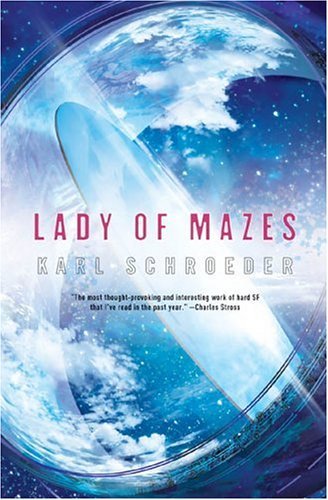
 In a far, far distant future, Teven Coronal is one of numerous space habitats orbiting a sun. Its inhabitants live within separate manifolds, virtual realities independent both physically and philosophically. One manifold may be a technologically-advanced culture where flying cars abound and individuals are able to project their consciousnesses into artificial constructs, duplicates called animas, while another may be primitive and technologically bereft. All of these societies are generated and maintained by AI’s through neural implants via a technology called inscape. Meanwhile, failsafes called tech-locks ensure technological purity (ie. developmental stagnation in the cases of those primitive manifolds) and that there is no bleed-thru between the the individual VR’s, making for a well-controlled system. But the occasional glitches do occur…
One such glitch proved an almost-transcendent experience for two young people, Livia Kodaly and Aaron Varese. Following the crash of a public transport, only they were able to handle the subsequent exposure to harsh reality, an ability that allowed them to lead many survivors to safety – and that, subsequently, set them apart from their fellow citizens of the Westerhaven manifold. And yet, their brief intimacy with reality those many years back does little to prepare them for more shocking truths when a large-scale disaster strikes, upending their very existence.
The tech locks have been disabled and the barriers between manifolds is breaking down. Livia discovers the source, a mysterious entity known as 3340, but it does little to save Westerhaven. It is attacked, descends into chaos and soon, she is forced to flee. With the entire solar system under threat, she and her allies journey to other coronals in search of answers. What she inevitably ends up with are answers to questions she never even thought to ask, surprises and revelations in the form of entities, cultures, and realities bigger, broader, and deeper than anything she could have imagined within the strict confines of Westerhaven. To say any more would risk spoiling the novel for those who’ve yet to discover its wonders.
Wow! Lady of Mazes was a head-spinner. The world-building is vast, the technology intricate, and the thematic core of the book both challenging and thought-provoking. I’ll admit to being slightly overwhelmed by its first fifty pages. Although the concepts introduced aren’t overly complicated, they do require a fair amount of exposition, resulting in a slow narrative build over those first fifteen chapters or so. The use of exotic terminology lends another confusing element, forcing one to progress at a very deliberate. Easy reading this aint. But highly-rewarding it is because a basic understanding of these worlds, technologies, and philosophies form the launch point to a brilliant exploration of knowledge and existence, the sort of big ideas that shouldn’t be confined to science fiction alone (but, honestly, no other genre does a better job). How does technology benefit our lives and what are the disadvantages of living in a technologically-advanced society? Is happiness always defined by reality or can happiness flourish in a state of artifice and ignorance? Should it? Do absolute truths exist, or are they as fluid and volatile as varied environments and social constructs? We are posed these questions through the experience and enlightened eyes of our protagonist, a woman who ventures beyond the comforts of her constructed reality to examine and understand people and places once beyond her comprehension. And, ultimately, we learn that the search for answers is just as important as the answers themselves.
Lady of Mazes isn’t the type of book I’d recommend to a friend looking for a fun SF summer read. It’s dense and demanding, yet smart, inventive, illuminating, and incredibly satisfying.
So, those are my preliminary thoughts. I’m very interested in hearing what everyone else thought. Let’s hear ’em! And start posting your questions for author Karl Schroeder!



Leave a Reply