
When he’s not editing or working on his deck, Mike Banas is answering YOUR questions! No doubt intimidated by the fact that I would be visiting him to start work on my producer’s cut of Resurgence today, Mike magically turned around that outstanding Q&A we’ve all been waiting for. And it’s a good one. As is Resurgence, is latest labor of love. But you can judge for yourselves when it airs in about ten months.
Over to Mike…
Well, hello everyone. First off I have to thank Joe for the invitation to participate and of course thanks to all of you for your thoughtful questions.
Also, I should apologize for taking so long in answering. I usually get a bit of a breather between episodes to get caught up on emails and what not, but this time I finished Joe’s latest and greatest: “Awakening” and instantly launched into Rob Cooper’s “Malice” with no down time.
Since I’m late, lets dive right in:
Chevron7 writes: “Questions for Mike Banas:1. What was the most challenging episode of SGU to edit?”
MB: I’d have to say, by far, the pilot – Air pts. 1 & 2. It was challenging to edit mainly because we were working with more of a clean slate in terms of ‘look’ for the show. Having no template to work from opened up a lot of possibilities. Since we were all on a learning curve it took a lot of work to find the show’s style. What made my job easier and still does today, is our incredible cast. The performances are consistently spot-on, which allows me to focus on other things while I’m putting the show together.
“2. How involved are the directors and writers in the editing process?”
MB: Very. During the shooting of an episode the editor cuts the raw footage, or ‘dailies’, alone. We do communicate quite regularly with the director and producers during the shoot but the editor produces the first cut of the show, which contains everything that was scripted. After the Editor’s Cut, the episode’s Director comes in and spends a few days reworking the cut. Often they remember things from the shoot that really grabbed them, like a particular camera angle or line reading. So when he / she is happy we release the Director’s Cut for the producers to watch and then the supervising producer (usually that episode’s writer) comes down to editing to work with me for a few days. After that it’s off to the network for their thoughts then the show gets ‘locked’, which means there will be no more picture changes, that’s when the sound and Vfx folk get busy. The whole process for the editor takes roughly a month for an hour-long episode.
“3. Is there a scene you’ve done in which you’d like a second go at it?”
MB: Yes, plenty of scenes. We have a saying: “you never really finish a show, you just stop working on it.”
“4. Any other job in the production you’d like a go at? Directing?”
MB: Sure. Directing sounds fun.
“5. What do you do for fun in your spare time?”
MB: I like to snowboard (winters off in British Columbia can be amazing).
I am also a T.V and Film addict (I’m watching “The Wrath of Khan” while I’m typing this – Kirstie Alley!).
“6. What music do you like?”
MB: I grew up in the eighties listening to and going to punk rock shows. My tastes have broadened, but I am still drawn to bands that exist more or less on the fringe. Current favs are “Future of the Left” from Wales and “Titus Andronicus” from N.J.
“7. I’m curious about the editing for the SGU ep Lost compared to Pain. The scenes going back and forth between the characters in Lost was more abrupt than in Pain…what was the reasoning behind this? While I liked Lost it felt a bit like a tennis match…Pain I loved! The transition between scenes was brilliant. Thanks for you hard work…you should get on twitter with is..”
MB: Unfortunately I can’t really speak to the editing of “Pain” or “Lost”. We have a three-editor rotation, so I cut every third show. Rick Martin and Brad Rines (two of the best editors in Canada) cut those shows respectively. What I can say is every episode is unique and the script and material more than anything dictates the style.
As far as joining Twitter.…maybe….perhaps….well….the thing is, the idea of spending more time on my computer or phone than I already do scares me.
Lou Zucaro writes: “How long have you been editing and have you worked in both traditional (analog) and digital and if so, is there anything you miss about working in analog?
Have you ever made an edit you really regret making? If so, what was it?
Have you ever edited an easter egg into something you’ve worked on without telling the rest of the production team beforehand?”
MB: I’ve been editing for about 12 years plus a few years working as an assistant editor. I began my career just as digital editing started, so I am among the first generation of editors that have never needed to handle actual film. So I have never seen anything literally hit the cutting room floor, it just vanishes out of my timeline on screen. I know editors who had to make that transition from film to digital and most feel that the new technology gives them the speed, options and freedom to experiment with a scene or show. It allows them to try more things.
Do I regret making an edit? Yes. (See answer to question #3 from ‘Chevron7’)
Elminster writes: “On the topic of Easter Eggs, are there any in Stargate that you’ve never told anyone about?”
MB: Secret Easter Eggs? I’ll go to my grave before I say.
Joseph writes: “What program is used to edit SGU?”
MB: We now use Apple’s Final Cut Pro 7 on Mac towers running OS X Snow Leopard.
Logan writes: “I see that you were the editor on two of my favorite episodes, “Time” and “Divided”. There were several scenes in both episodes that made me really appreciate the subtleties and challenges inherent in your craft.”
In “Time” for example, I really liked the scene where the main characters are gathered around the monitor viewing the time-shifted off-world kino footage and Eli says, “What the …!”, which sends the episode to commercial break. That to me was both a brilliant piece of script and editing. Can you take us through the process for how that scene was edited? How much creativity are you allowed vs. what’s in the script? How much collaboration is there with the writers and directors at the point where you have the material? Are the fx effects added before or after you edit the episode? Were there alternate choices that were devised for ending that scene?”
MB: Time is probably my favorite episode. Rob Cooper misled me, however, before I read the script saying it would be an easy one to edit. He said it would be a series of single shot scenes that I would just have to string together. Well, it turned out to be a bit more complicated than that.
He and I discussed while he was shooting the idea that the ‘fritzing’ Kino footage could jump in time as well as between performances with carefully chosen edit points within the glitches. An Idea I had was that the Kino should not only fritz forward but it should have small jumps in time backwards as well. If you watch the opening scene you can see the Kino image of our team walking down the ramp from the gate and small time jumps both forward and back as a subtle hint to what lays ahead in the episode.
The “What The….” act out was great. Robert wrote it to be cut off like that but he had David Blue actually say the real sentence “What The F@#%!” with the idea that it would feel more authentic than if David cut himself off. The fun part was sitting in the cutting room listening to and comparing the dozen or so takes trying to pick the funniest, most realistic one.
Also, it is probably the only episode I’ll ever work on that features footage shot with a camera stuck on top of a character’s head.
Jeremy writes: “Question: Has the idea been discussed of keeping a copy of any long cuts of the show which the director is happy with before it has to be cut down to fit the allotted running time and the DVD being those long versions and not the broadcast ones? Or what are your thoughts about that if it hasn’t?
Question: What are your thoughts about the lengths of current movies or Tarantino’s in particular?”
MB: Because we have to cut down to a specific format length the writers try to make the scripts a bit longer so we have some room to play with. Often they will write a deliberately redundant line or scene knowing full well that it will hit the floor in the cutting room (figuratively speaking of course). Every step of the process the episode is being improved. So when the show is done, putting some of those things back in wouldn’t really improve it. Longer isn’t necessarily better.
As an editor part of my job is to help figure out what parts of the show has to be removed to bring the episode down to the format length. When I watch movies I’m always thinking about what could be removed without adversely affecting the story. I believe audiences are more sophisticated than they were years ago. People can process story points with less visual information than in the past. So in answer to your question I do find quite a few films lately could lose a bit of weight.
Tarantino, hmm. A couple of years ago I was doing a Kung Fu film in China with David Carradine. And one night over a drink we started talking about “Kill Bill”. I told him it would have made one terrific film instead of two mediocre ones.
He called me an a**hole.
Cat4444 writes: “Have you ever had to convince a director that the cut he wants would be better if done a different way?”
MB: Yes, by getting them to think it’s their idea.
PoorOldEdgarDerby writes: “Questions for Mike Banas: 1. Where did you go to school and what did you study?
2. How much of a change has it been moving from Atlantis to Universe considering the marked difference in show tone and appearance?
3. I see from your IMDb page you worked on “Young People F#@king.” Seeing as how a lot of your work has been in TV, how was working on a movie different?
4. So, Snifty Snakes: What’s up with that?”
MB: 1) I went to the University of Toronto (where I’m from) and then transferred to Concordia U. in Montreal. Funny enough I was not film student. I was a History major. Friends of mine were in the film dept. and ultimately those friends were instrumental in me landing my first film job.
2) The transition from Atlantis to Universe has been a bit challenging. ATL was shot and cut in a more traditional style, which relied more on editing “rules”. Since SGU is shot in a handheld, documentary style it is very liberating. It allows the editor to be in any shot at any time regardless of size or angle. But with that freedom comes the expectation that we try more of those possibilities. So, it’s a bit more labour intensive.
3) Yes I cut YPF with the multi-talented Martin Gero. I had a blast doing it and I was proud to be involved in the film. Working on a movie is actually easier than a TV series for an editor. TV schedules can be pretty demanding and by the middle of the season we usually have multiple shows on the go in various stages of post. Features have a lighter shooting schedule. A television series will shoot on average 6-9 pages of the script each day, where as a feature is more like 3-5 pages (lead television actors are incredible in that respect. What they have to prepare themselves for on a daily basis is mind-boggling). There is also more time to massage the scenes because each stage of post is given more time.
4) I just assumed everyone played “Snifty Snakes” as a kid. I was on my high school varsity “Snifty Snakes” team. Maybe it’s just a Canadian thing.
Otros Ojos writes: “Logan asked the same questions about specific episodes that I would ask for all the episodes. I know very little about editing for TV or film, however. It’s clear that some eps are written and directed in a way that requires meticulous work from the editor, and it just kind of blows me away when I’ve watched some very intricate scenes play out without a hitch — from what little I know, that demonstrates excellence in editing. I’ve seen some high-budget shows on major networks that don’t do nearly as well in this area, so would just like to express appreciation for your talent and application of experience, and to say thanks for your very well-done work.”
MB: Thank you very much Otros.
Arctic Goddess writes: “Question for Mike Banas:
– How did you get into visual effects as a career?
– What courses did you take to learn your trade?
– What is the most interesting part of your job?”
MB: 1) Its actually a whole other department that creates the Visual Effects. The VFX are added after we finish editing the episode. The very talented Mark Savela leads the VFX artists. When the shots are partially done we cut them into the show so that the producers and Mark make adjustments before they are delivered as Final Effects that end up in the finished product.
2) I actually learned on the Job. I was lucky enough to start in on the ground floor in the editing department on another Brad Wright series called the Outer Limits. I was hired to work in the tape room and make vhs dubs of the shows and the raw dailies for everyone (I also made the coffee). But, the first time I sat and watched an editor work I thought to myself: I must learn to do this! So I stayed late, came in on weekends, did everything I could to get my first show to cut.
3) The best part of my job is the day the footage stops coming in for an episode and I get to see the show all fleshed out from start to finish for the first time. The editor is the first audience member and I try to watch it with that in mind. It’s a privilege to be the first one to see the end result of so much hard work from so many people. I like that and ‘snack time’.
Imadaman writes: “‘soup Mike! 1. What’s your favourite scene you’ve edited?
2. What’s your favourite episode you’ve edited?
3. What’s your favourite episode from a) SG1 b) ATL c) SGU?”
MB: Hello Imadaman.
1) My favourite would have to the opening sequence in Air Pt. 1. The scene where 100 or so Icarus Base personnel flying through into Destiny’s gate room. The stupendous Andy Mikita covered that with three cameras and shot it for several days. There are over 200 individual shots in that sequence and it took me about a week to cut.
2) My favourite episode to cut was Air but my favourite to watch is Time.
3) I unfortunately never worked as an editor on SG1. My favourite ATL show would have to be Vegas. That CSI style we paid tribute to can be a lot of fun for an editor.
Tanie writes: “Ooooohhhhhh, a Q&A… woohoo!! 1. Did you have to apply for this particular job or do you work through an ‘agent’ for want of a better word?
2. How long have you been doing this for and what training did you have to undergo?
3. What’s your favourite ice-cream flavour?
4. Is Joe good to work with or is he a pain in the gluteus maximus? (kidding Joe!)
5. Do you have any pets, and if so, are you able to take them to work with you?
6. How long are your working hours – we hear that the actors and production crew can work up to 14hr days. Are yours shorter or about the same?
Thanx very much Mike and have a good one!”
MB: 1) No, I don’t use an agent, although some editors do. I suppose Brad Wright and Robert Cooper liked my work and hired me based on my previous experience.
2) See answers to PoorOldEdgarDerby and Arctic Goddess above.
3) Anything blueberry.
4) Joe and I worked together for the first time on ATL’s “Whispers”. We both had fun on that one and this season we’ve got a few shows together. As you are all aware, Joe is a very entertaining fellow.
5) Yes. Ruby is our very sweet ½ Newfoundland – ½ Golden Retriever seen below with the beautiful and talented head of SGU Post Production – Jennifer Johnson (little known fact – she is also my wife of 15 years).
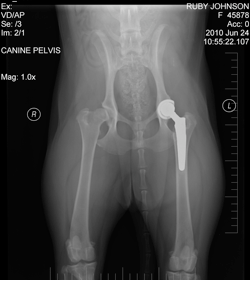
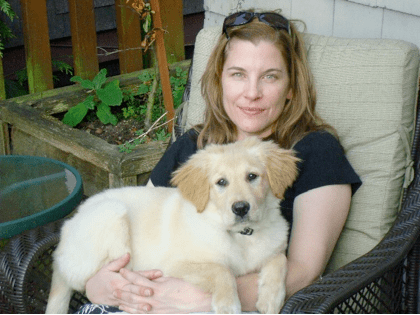 Unfortunately Ruby was born with bad joints. On her first birthday she got a new hip. This fall she’s going to get a second one. We are also going to try the stem cell procedure that was featured here recently. When it’s all said and done that dog will be more machine than beast.
 Ruby actually does a lot of my work for me:
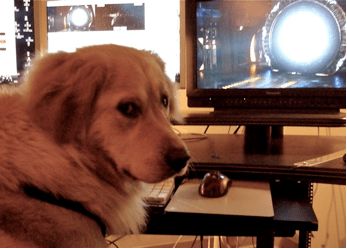 6) Post has shorter days than the shooting crew. Depending on the types of scenes, it takes about 8-10 hours to cut the previous day’s footage. Also, staring at computer monitor that intensely for more than 10 hours can be a real strain.
Zoomeister writes: “Hey, Mike. I just want to say I’m enjoying your SGU work so far. I have a couple of questions:
1.) You won a Leo Award for Best Editing (congrats BTW) for your work on the SGA episode ‘Vegas.’ What do you think you did differently compared to your other SGA and SGU eps that made you recognized for that specific episode and how do you feel your methods used for Vegas compare and contrast with recent Emmy winners for Best Editing, such as the pilot episodes Dexter and Breaking Bad and the ‘ABQ’ episode of Breaking Bad?
2.) How could you use the full methods/techniques and editing concepts used for Vegas in each episode of SGU that you do? How do you envision them being implemented in each episode?
Thanks for answering my questions and I hope to see you win more Leos in the future and maybe even an Emmy here or there.”
MB: Vegas was a really unique episode because it takes place in an alternate reality where John Sheppard was a CSI type detective and we paid homage to those kinds of detective shows. We used ramped (sped-up) establishing shots of the city, jump cut sequences, flashy flashbacks, etc. to create that look. So, Because Vegas was a one-off, a great deal of those techniques wouldn’t fit with the less stylized ‘documentary’ look of SGU. But we do incorporate some jump cutting and montage elements into the show. And thank you for the good wishes.
BoltBait writes: “Now a question (or seven) for Mike: 1. How close to air date do you typically finish your work on an episode?
2. How do you deliver your finished product?
3. Are you the one who sends the final product to the network?
4. After seeing your work on TV, have you ever wished you could go back and do it over again and fix something?
5. How much time are you usually given to do your work?
6. Do you typically work alone, or with lots of input?
7. If you get lots of input… from who?”
MB: 1) My work on an episode ends months before an air date. There is so much more that goes on once the picture is ‘locked’. The sound editors and mixers get to work, VFX starts putting their shots together, Joel begins composing the music, etc.
2) We send the network an HD master tape.
3) Jennifer Johnson and Kerry McDowell expertly handle every aspect of delivery.
4) See answer to question 2 from Lou Zucaro
5) The whole thing from the first day of ‘dailies’ to the ‘locking’ of picture takes about a month.
6) and 7) I cut the raw footage as it’s being shot alone but there is usually communication between the director and producers and myself.
Ponytail writes: “A question for Mike Banas: Joe wrote, “First, I snapped a pic of the creepy-looking game sitting on the top shelf of editor Mike Bananas’ shelf -”. “Bananas’ ”? Come on! Surely that is not how you make your name possessive is it? Wouldn’t that be Banas’ or Banas’es or Banas’s? And what was that creepy-looking game anyway?”
MB: You’re right Bananas is the plural not the possessive of Banas (That or Bani).
Hey, why is everyone so down on Snifty Snakes?
Actually it was a gift from one of our two assistant editors Ryan Malone. He and Steve McLeod are the best assistants in the whole world. (And now they both owe me a burger).
Andy Brindley writes: “I wanted to ask mike a really interesting question, but they all seem t have been asked, so am afraid that this is a bit of a boring one…
I’m a film and tv production student at university studying towards a bachelors degree. I’m particularly keen on being an editor, as well as writer, anyway, what system do you have a choice on what editing system you use to edit sgu?? I personally prefer avid but I’m working on getting to know final cut pro, which system is used on sgu if you don’t have the choice??”
MB: I too prefer Avid. We happen to use Final Cut on SGU for various reasons and there are definitely some advantages to using it. Any time that I’ve gone onto another show that uses Avid there are some elements of FCP that I miss. Any professional grade editing system gets the editor to the same place its just another tool.
Well I think that’s it for me. I thank you all for your awesome questions and I appreciate the interest in what we do. People tend to forget about postproduction because we work in dark little rooms by ourselves like trolls. So it’s nice to shed a bit of light on the process now and then.
Thanks go out to Joe for setting this up. I would also like to take this opportunity to thank the amazing editing department:
Jon Anctil who keeps the shows coming and going on time. Troy Mac Neill who manages to keep a very complicated system running well. Bob Dewald whose eagle eye catches every potential problem. Ryan Malone and Steve McLeod for having to deal with me every day. Kerry McDowall who keeps the train on the track. And, of course, Jen Johnson who keeps us all in line.


Leave a Reply