I’ve often said that I like SF, fantasy, and horror – but, in fact, that’s not entirely true. Yes, I’m more receptive to genre fiction, but that certainly doesn’t mean I enjoy every SF, Fantasy, and horror that crosses my plate. So what then makes certain works of fiction more enjoyable than other? Well, a number of things: an interesting premise, an engaging story, believable dialogue and, most important of all, characters I can care about. In fact, I’d say the latter is so important that it can excuse a lot of other narrative shortcomings. If an author can get me to care about his/her characters, then I’m along for the ride through good times and bad. This is true for film and television as well where audience members return time and again to touch base with characters who have become like a second family to them: James Bond, the doctors of Seattle Grace, the members of the Atlantis expedition.
For this reason, one of the sub-genres of horror that particularly appeals to me is the “small town horror” that Stephen King does so well. In short: a tiny isolated community is besieged by some unspeakable terror that brings out the very best and very worst in its citizens. Although it seems fairly straightforward enough storytelling, this particular sub-genre is the trickiest of all to pull off because it all rests on the characters. Not stalwart heroes or intrepid reporters in search of the truth, but ordinary people faced with extraordinary circumstances. If the characters are grounded and believable, then the audience connects with them. If the characters are small town clichés, then the audience may as well be reading the phone book.
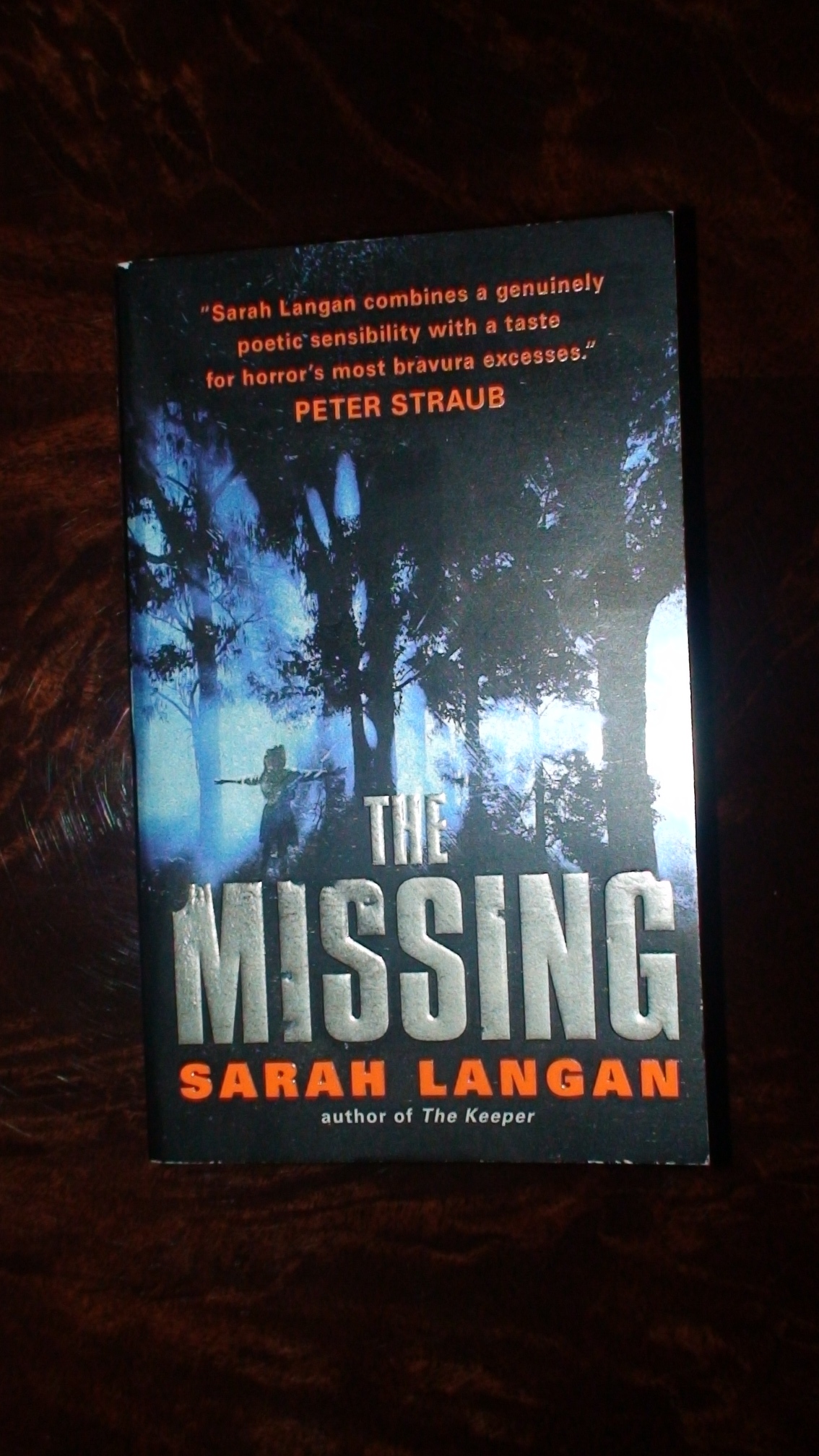
Which brings us to Sarah Langan’s The Missing…
Interesting premise: Check!
Engaging story: Check!
Believable dialogue: Check!
Characters I can care about: And check!
Langan does a wonderful job of setting up the town of Corpus Christi and its colorful denizens, from the grade school teacher bitterly disheartened by a relationship gone wrong to a town drunk who may not be as wacked-out as he appears. She takes her time setting them up, introducing their disordered lives, developing them over the course of the book’s first half and then, suddenly, upending their world. And, as events rapidly devolve around them, one can’t help but empathize with the likes of Meg, Fenstad, and Danny because they are as familiar as friends, neighbors, and co-workers we have known.
A field trip to an abandoned mill in the neighboring town of Bedford takes a horrific turn when a young boy goes missing. A search party is organized but its best efforts turn up no sign of James Walker. Well, no sign provided one discounts the report of Danny Walker who claims he spotted his brother in the dead of night, wide-eyed and bloodied, loping through the darkness on all fours. Soon, other inhabitants of Corpus Christi begin to disappear as the town is stricken by a mysterious illness. And when partially eaten corpses start turning up, the local authorities realize they’ve got a big problem. Unfortunately for everyone, by the time they mobilize, it’s already too late.
On the surface, The Missing would seem to be a well-executed zombie offering, but it’s much, much more. Beside the aforementioned depth of the characters, the narrative is lent further richness by the author’s decision to get inside the heads of the afflicted. These are no mindless zombies staggering stupidly around town in search of brains. They retain, at their core, the individuality that personified them before they were infected. They’re conflicted, confused, yet stricken by a ravenous hunger. Most unsettling of all – they’re smart, and organized.
Langan does a great job of building suspense, capping the slow, uneasy burn with terrifying finality. The horror is not overly graphic. She parcels it out in disquieting little bursts that leave the reader to imagine the worst. And they do.
I had two minor quibbles with the book. The first was the source of the entity that strikes the town. Its backstory is touched upon early on but never really pursued. As a reader, I don’t need all the answers and would have accepted the mysterious origin of the plague if a possible explanation hadn’t been teed up. Then again, since this novel is a follow-up to The Keeper, the answers may well lie in the first book (which I fully intend to check out). My second bump was Maddie’s willingness and ability to protect her mother at book’s end. Given that Albert Sanguine was made to pay for sympathizing with the survivors, I can’t imagine Lois and her horde would stand for Maddie doing much the same. In fact, with the emphasis placed on their hunger and the scarcity of meat, it seems to me that Lois and co. would set their sights on Meg much sooner than later.
Those issues aside, I very much enjoyed The Missing and found the bleak, open-ended conclusion very effective.
A smart horror novel.
Your thoughts?
Hey, I’ve received some emails from blog regulars who are wondering whether my failure to answer their questions suggests I harbor some sort of grudge against them. Well, I can assure you all that it’s nothing personal. If it was, I wouldn’t be approving your comments in the first place. Rather, when it comes to selecting which questions I’ll respond, I tend to apply a complicated and laborious Wiccan system that involves ground water, two teaspoons of cardamom, six inches of twine, and an eight-side die – in addition to whatever strikes my fancy on a given day. As for which questions I tend to avoid:
1. Questions that have already been asked. Since I’m working toward my 700th blog entry, one can assume I’ve answered more than a few questions. Sometimes, more than once. Take the “What’s the deal with Teyla naming her son Torren?” question. I believe I’ve answered that one three times already and, thus, have no intention of answering it a fourth time. So what if you missed my answer? Are you expected to wade through some 700 entries to find it? Nope. Just use the search function. Type in Torren and then check out the entries that pop up as results.
2. Technical questions. Only the art department knows the exact measurements of a goa’uld mother ship. I gathered questions for Production Designer James Robbins a couple of weeks ago. Hope you remembered to ask.
3. Questions that either contain spoilers or request spoilers. In the case of the former, I simply don’t approve the question. Nothing personal but many readers of this blog didn’t see the SciFi promo that – as is typical of most SciFi promos – completely ruins the surprise twist in an upcoming episode. Also, be assured I will not reveal whether we are wrapping up any specific storylines in future episodes or the movie.
4. Questions I don’t have the answer to. For instance, if someone asked me a year ago whether we would ever see the character of Kolya again, my instinct would have been to answer “No”. And yet, this is scifi and, as we’re so fond of pointing out, no one is ever really dead on scifi. Take Kolya for instance. In the past, I’ve answered such questions as they’ve come along but after being called a liar for saying we had no plans to revisit a certain storyline – only to revisit said storyline a year and a half later – I’ve decided to avoid these types of questions altogether.
5. Questions that don’t really interest me. Have I read Horatio Applebottom’s new book? Do I watch Celebrity Bathroom Break? Have I ever waxed my eyebrows? Feel free to ask away but if I don’t answer, chances are the response I’d offer wouldn’t be all that interesting.
6. Questions from people I’m secretly mad at. YOU KNOW WHO YOU ARE!!!
Well, that’s it for today. Start posting your questions for author Sarah Langan. What led her to the horror genre? Who were her literary influences? What are the exact measurements of the town of Corpus Christi? Does she watch Celebrity Bathroom Break? And, of course: Why did Teyla say her father’s name was Torren when it was suggested in the pilot that his name was Tagan?



Leave a Reply