


So check out the videos after Mark’s Q&A. And check out the mailbag after the videos.
Over to Mark…
I’d like to thank everyone out there for all of your well-wishes, your interest and compliments. It’s great to hear your thoughts. As for the recent nomination, thank you for the congrats and keep on thinking positive thoughts. I do believe it’s a testament to the show itself and a franchise that has been on the air for 12 years now. We’re always up against the latest/greatest/hip shows that are on any given year. Now, I’m a big fan of Heroes and the like. I think they do great work. But it really does show the strength of the franchise, and the life our writers and actors give to our series year after year, that the show gets nominated for awards (People’s choice, Emmys) throughout the run of the series.
But, on to the questions:
NZ Jackie writes: “Was it deliberate, in the Episode ‘Sunday’, to make it so the last thing that went through the gate was Zalenka/David N’s butt??lol”
– Hmmm……David’s butt? Can’t say I noticed that one, or saw that it was intentional. Have to check on the artist who did the shot. Maybe they were a fan. Pretty sure it’s the order they pass through and how they cross the event horizon though.
K8T writes: 1) How much of the final product is actually what you set out to accomplish in the planning stages?
– That’s a great question K8T. Every shot is different and every VFX shot we do is pretty unique in its’ planning and execution. Shots are often very organic and they will change from the planning stages. Sometimes a director will come to set and want to shoot a different way than what was planned. Sometimes I’ll propose different ideas than what was planned. And some shots stay very true to what we set out to do. A good example of this is the shot of McKay firing the drones in Adrift. We knew we wanted to do a shot that would start out as a complete 3-D (or CGI) created shot and then transform into a shot that incorporated the live action plate with McKay. I try and incorporate live action plates whenever I can. I think it just sells a shot that much more to see one of your actors in it. We went through a couple of different animatics here in the in-house department with 3-D animator Michael Lowes, finally nailed the shot that we wanted, and brought it to set when we were shooting McKay in the PJ. We always went in thinking that if the live action plate didn’t work out we could adapt and live with a complete CGI shot, but the crew on this show is amazing. Our dolly grip Simon Smith matched the speed and feel of the shot exactly. We composited the live action plates into the 3-D scene and the shot you see onscreen is pretty much exactly what we had planned.
Sometimes an artist will run with a sequence and bring back something completely different than what you had in your head but is still very cool. Check out the first 8 min of “Ghost In The Machine”. Except for some minor tweeks here and there, that was all Alec McClymont from Atmosphere VFX.
2) Can you describe the life cycle (planning, drafting, executing etc.) of an effect? Like the huge and long pull back from Rodney in the rubble, past all the planets and onto Todd’s ship in S&R.”
– Well, the life cycle of an effect is pretty much as described above. The Power of Ten shot in Adrift (the McKay pull-back) was one we really tried to plan out as best as we could. Martin Gero knew exactly what he wanted to see. We had a timing version out and shot a couple of different versions of the McKay live action plate. We did various low-rez animatics of the shot using the McKay footage. You have to really nail down the animation and timing because it is so long. (If you make changes later when you’re working with the shot at HD, it will cause a great deal of lost time due to how long it takes to process/render a shot like that.) When the timing was nailed down it was a matter of rendering and compositing until we got what you saw in S&R.
Pol writes: “My question for Mark is…what software does your team mainly use? I’m assuming Photoshop, Maya and RenderMan for a start. What else do you use (if not the above, then what)?”
– You’re right on the above assumption, Pol. The show does farm out work to five main vendors (Atmosphere VFX, Image Engine, CIS Vancouver, Darkroom Digital and Spin West), as well as our in-house department. So, in addition to the aforementioned, we would use Lightwave, Combustion, Fusion, Inferno and After Effects.
Muddpiddypop writes: “My question for Mark is: Are effects or the techniques you use or come up with trademarked or copyrighted in any way, or are they standard techniques that are only different based on a crews skill and creativity?”
– Trademarked or Copyrighted????? Mark Savela ™ visual effect. I like it.
Sadly no, I don’t think there would be any way to control that. I’m reminded of something that took place years ago. I was up for a job on a pretty big film. They had seen a sequence I did for small documentary and had a similar scene in their movie. They asked if they could use my finished effects as “animatics” or “placeholders”. I agreed. And then they ended up going with a larger company to do the effects. When I saw the finished film in the theaters, they matched the camera moves and timing of my shots almost exactly, with only slight changes in the look. People must have had a giggle when I yelled “those f@*kers” when the scene came up.
It’s a fine line because when interviewing for a job you want to present your best ideas/approaches/shooting techniques based on the script and the job you’re applying for. But it’s the nature of the business that sometimes people will take your ideas, run with them and not hire you after all.
I’ve read a few comments that say the effects in our show look like a certain other sci-fi show. Just wanted to state that I’ve never seen an episode of said other show. I’m sure it’s great. I saw a bit of what they won the Emmy for last year and it was pretty cool. But the thing is we are all flying around ships in space, and it’s a pretty hard thing to try to keep fresh and new. I consciously made an effort to gradually get away from the early “Parking Lot” in space feel and make shots more dynamic, faster paced and more “in the action” look. I think I’ve accomplished that over four years, but I don’t think there are any direct influences that led us to where we are now.
Patricia writes: “How long does it take to put together a seamless effect such as a space battle scene? Is your work more art oriented, or because you use computers, is it more math oriented? In other words, what ability do you find you rely on a great deal to do your job? And lastly, congratulations for the nomination. I have my fingers crossed for you.”
– Thanks Patricia, I hope your fingers are very lucky.
A space battle scene (hopefully seamless) takes about two to three months for a large one. We usually get the heads up from the writers that a show with a great volume of visual effects is coming down the pipe. We’ll get the script, prep the show in about a week, shoot for about a week and a half, and spot the show with the producers. The show will lock shortly afterwards. We usually have a month before temps and a month after that to complete the final shots.
In my work, I rely on my sense of esthetics. I hope/feel/pray that if something looks good to me, it will look good to the fans. A lot of the artists who work on the show are the math wizards. They’re incredible. With around 13-14 shows going on at different stages at any particular time, with an average of about 50 shots an episode, I tend to rely on my memory. If my memory fails, my amazing co-ordinators Shannon Gurney, James Rorick and Sonia Gilmore will be there to pick up the pieces.
Enzo Aquarius writes: “First of all, congratulations on the Emmy nomination. When creating a new ship for the series, what is the process in which it is created? IE – How is the design figured out, is a consensus to the design required, do interior sets come into play?”
– Thank you very much Enzo. A new ship usually starts off with a concept drawing done by the mega-talented James Robbins, our Production Designer. We take the concept art and build the ship in 3-D, then apply textures for weathering, etc. The ship usually goes through some slight modifications to help with scaling or overall continuity after which it is approved or critiqued by the producers. Interior sets totally come into play. We really try to match the look and feel of the sets with the exterior of our ships. The Travelers’ ships is one example.
MaggieMayDay writes: “Mr. Savela, are the ideas for effects sketched out? Would that be like a storyboard? How detailed would a drawing be before it transmuted into CGI? (Am I asking the right question even?)”
– Yes, it is a very good question MaggieMayDay. Every sequence is treated differently. Sometimes storyboards are used. James Robbins storyboarded my first sequence for Atlantis – “Intruder”. For BAMSR, I went down to Image Engine and we threw a bunch of toy space ships on their boardroom table. I was moving the little toys around saying “I want the camera here, I want the camera there”. When we work with Atmosphere or Darkroom Digital, usually Alec McClymont (for ATM) or Craig VandenBiggelar (for DD) will do initial animatics. So even sequences within the same show could have a very different approach.
Carol Z writes: “ What specific training, education, experience in your background prepared you to be the Visual Effects guru for SGA? Graphic design/arts, etc? Good job Mark!!”
– Prepared me most? Juggling class at clown college in ’91.
Chevron7 writes: “1. In the past few years we’ve seen films (Sky Captain) and shows (Sanctuary) with completely CGI backgrounds and live actors. What direction do you see the Visual Effects industry taking in the future? What is left to do?
– Hmmm…..the future of Visual Effects? You’re tempting me to soapbox here. I think Visual Effects is a huge, growing industry that is still very young. I really do like the style of films like Sky Captain, Sin City, and Sanctuary. The motion capture stuff people are doing like Polar Express show a lot of promise. I’m of the opinion though that story comes first. Visual Effects should be used to tell a story or move a plot forward, not become them. The future of the VFX industry should be directly tied in to how people want to tell stories. Hopefully it will not become all style and no substance. Take Pixar for example. They make great movies, movies that can exist in any medium. I really think that’s what should come first. The technology, style, flash should all come later. But having said that, I think anything is possible. The only limit is the imagination of the writers and the artists.
2. Can you please give us some insight into how you did the Shep/Zelenka space jump in Adrift? Congratulations btw.
– The space jump in Adrift was another example of a shot that was very well laid out at the script stage by Martin Gero. He really wanted to do a shot that showed the scale of the gap they were jumping tied into the scale of the city. We started out with a few versions – different speeds, different camera moves, etc. It was a little bit of a hard sell once we came up with a move that we liked because it was a little difficult to picture in the animatic stage since it’s such a subjective shot/move. But we stuck with it and really reassured people “No, this will turn out great”. Image Engine created this great 3-D matte painting of the gap with debris and rebar. We see it on the first reveal and I think it’s great. The camera move, city and destruction matte painting are all combined with the animation of our 3-D Sheppard and Zelenka. I have to say that it was when I saw some of the initial animation of the characters that I knew the shot would work. It was amazing and looked like really, really good mo-cap. The shot is composited blending all the elements together and color correcting the final product.
3. What Stargate visual effect exceeded all expectations and what didn’t work out so well?”
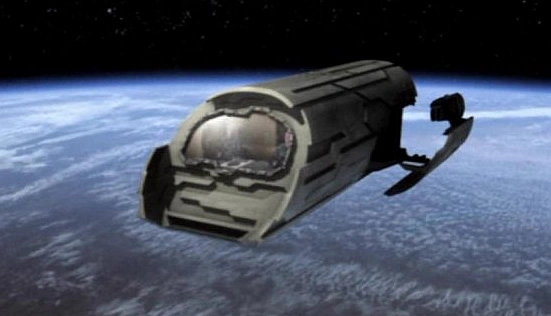
– Space walk in Adrift, described above. I think it’s just one of those shots that is so cool accompanied by Joel’s score. Pull back shot from our team in Progeny to reveal the city. This is one shot we were a little afraid of because we had never seen that city before. I remember working on the shot with our in-house artist Michael Lowes. I gave him the direction to “go over the top” of what he felt comfortable with, to push further than what he thought of as a normal shot. He came back with this amazing camera move that we made only small adjustments to. Erica Henderson then did a wonderful job of compositing that shot and I think the final product really is something.
I also really liked the reveal of Weir’s ship at the end of BASR.
I think all effects look so much better with the sound mix from Sharpe Sound and Joel’s score.
What didn’t work out so well……… Well, again with Progeny, there were some scenes in that episode that were a little sketchy. It was a tough show that was done almost entirely in-house on a very tight timeline. I think the team did a great job under the circumstances and the show is “huge”. We got into some problems shooting the “virtual tour” portion of the show as well. There is also a scene in “The Last Man” which has been a topic of discussion. The whole show was just amazing and I wish we could have had more time on that one. It‘s a very subjective industry. Some people really liked that shot; some people really didn’t. As a general rule I can’t really watch anything I’ve worked on after it’s been delivered. There is always something you want to change, always something you would do differently. The thing is, as soon as you deliver a show it becomes dated. It is one of the curses of working in this industry.
The Skypig writes: “When I listen to the episode commentaries, mention is often made of the expense involved in what on screen look to be a short, relatively simple special effects–the gate coming to life, for instance, or some whispy alien cloud drifting about. Tell me, please, what is it exactly that makes special effects so expensive? Give an example, if you have time. Thanks!”
– I think the best example of this is a puddle pass-through the event horizon. The franchise had been around for 12 years yet the puddle a pass-through hasn’t gotten any cheaper to do. Why? Because the manpower to do a shot like that remains relatively the same. The very same amount of work takes place to have a person step through the event horizon as it did 12 years ago. The processing power and speed is probably faster, wage increases and such evens that out. That’s why a lot of our pass-throughs may not show up on screen. Do we put money towards it? Or do we put money somewhere else to create something new and different? I think the producers do a great job of balancing – keeping the gate, the gate travel and using the money saved to create new shots.
Jon writes: “I know that to stay a “head of the game” for visual effects you have to have the latest stuff, 1) How many visual effect programs will you go through one season of atlantis? 2)what was the hardest visual effects sequence you have ever done?”
– You don’t really go through different programs or platforms over the course of a season of Atlantis. You do go through different versions of the same platform. We’re actually having a tough time right now on an episode with effects created on a previous version.
Mackenzie’s Momma writes: “Mark- What is the most challenging episode outside of Season 5 that you have worked on thus far in the Atlantis Realm?”
– I’m going to answer Mackenzie’s Momma’s question along with #2 from Jon. I think one of the hardest sequences/episodes I’ve worked on was the end sequence in BAMSR/opening sequence in Spoils of War. I think the most difficult part was planning those two episodes. They pretty much shot back-to-back last year. When we spotted the episodes (to spot means go through the cut with the producers and editor, going over and timing out VFX shots before the cut is locked), we spotted BAMSR and SOW about 10 minutes apart. After a heavy spotting session like BAMSR, your mind is a little fuzzy. There is so much to process. Shannon Gurney and I spotted the episode with Martin Gero and editor Mike Banas. We then spotted SOW 10 minutes later with James Rorick, Paul Mullie and Alan M, along with editor Rick Martin. As everyone knows, we use the back half of BAMSR for the opening of SOW (but from the wraith’s POV). The only constant in the two spotting sessions was me. We were using beats and timings from shots that were just discussed 15 min before. It was pretty confusing and pretty hard to keep straight, but I think both shows turned out all right in the end.
Michelle writes: “Questions for Mark Savela, regarding the nuts and bolts IT side of the VFX work: How do you keep records of what you’ve done in the past so you can re-use it when appropriate? Is it corporate knowledge or do you have a database or a wiki or…
– We do it very simply. We make a compilation reel each year of all the VFX shots in the show. Mostly, the four of us just use our memories (Shannon, James, Sonia and I). We can remember every effect, what episode, what season, etc.
2) Did you work on McKay and Mrs Miller, the one with 2 McKays? How hard was that to do, and can you outline what the process was? The result was amazing and seamless!”
– Thank you very much for the compliment. I’m glad you enjoyed it, Michelle. McKay and Mrs. Miller was a really fun episode to work on. There was a deliberate goal to make the show not look and feel like a traditional “twinning” episode. Martin Wood and I sat down and really tried to design shots where the camera was moving and inside the action, where the actors were moving around the camera. There is the “standard” way of doing twinning shots where the camera is usually outside the action looking in, even if the camera is moving. This works a lot of the time and a scene like the one in “This Mortal Coil”, where the two teams meet, calls for that. However, we tried to make McKay and Mrs Miller very non-traditional in that respect. Huge props have to go to Martin Wood. He has such a big brain when it comes to designing shots that feel very unique and fresh. I love the shot where McKay passes the laptop to McKay. I thought the moving camera interaction was great. David Hewlett deserves the other MVP star for that episode. We really put him through the ringer. If you can imagine the camera moving, both McKays converging to one spot, moving around the camera, around set pieces and delivering dialogue at the same time. At the end of the shot the two McKays have to end up facing each other, so David had marks on the floor for both passes that he had to hit so it would look like he ends up face to face with himself. And he had to hit those marks exactly, without looking down at them. He did such a great job. It’s always so much fun to see McKay play off of himself.
Another challenge to that episode presented itself when our normal “cheats” for a twinning episode didn’t work out. Usually in a twinning episode the close ups are “cheated” with a photo double. You see the actor delivering his lines and the head closest to camera is a photo double so that you don’t have to do as many shots in an episode. Our photo double did not look a lot like David Hewlett so we had to shoot David on both sides. We ended up with about 40 or so additional VFX shots. We didn’t have additional budget for the episode so my co-ordinators (Shannon Gurney and Geoff Anderson) and I ended up doing a lot of the extra shots in addition to our real jobs. Some turned out to be quite difficult. It was tough but pretty rewarding in the end so thank you.
Airelle writes: “Do you start out ideas on paper/head, and then to computer? Did you build your own software to do the VFX ? ? A lot of special training/school or just good at it? Is that your bulletin board in one of Joes picture, if so,who thought up- Dept of Waffle Headed Monkey Trumpets(tv division) ? CONGRATULATIONS on the Emmy award nomination. Awesome visual effects, thanks for stopping by.”
– Thank you very much Airelle. Thanks for stopping by? I thank everyone out here. I really do consider this a true honor to do and a lot of fun too. The bulletin board belongs to our set supervisor (Jon MacPherson). Department of Waffle Headed Monkey Trumpets (TV Division) was started by VFX co-ordinator James Rorick (there may have been booze involved) and we just ran with it. I think it’s a weirdly twisted Simpson’s reference mixed with something else. I would delve further into James’ twisted brain for further explanation but, to be honest, I don’t want to go there and am actually afraid.
Sari writes: “had some questions for Mark Savela, if it’s not too late. First of all, the special effects in this show are absolutely incredible and well-deserving of the Emmy nomination. Good luck with that!
– How long does it take from the time (the writer?) says “Can we do this?” to the final, delivered product?
Thank you very much for your opinion of the effects Sari. I think Patrica’s question above covered that. I do like the fact that, on this show, I will get calls exactly like that, where one of the writers is starting to write a show and will call and say “I’m thinking of writing this. Can we do it?” Hopefully we’ve never let them down.
2) Have you ever been asked about doing a special effects that just about made your heart stop, given the complexity of what was being asked?
The first thing that comes to mind is picking up the first draft script of “BAMSR” and seeing the line “The giant replicator blob has now grown to the size of a small city”. I think Fran the replicator blob was certainly challenging, just trying to imagine what the final product would look like from the one line. Martin Gero always has a great vision of what he wants something to look like. That line was just really hard to get your head around though.
Also, for very different reasons, the Ronon shot in “Doppleganger” from Season 4. This is a steadi-cam shot where Ronon is running through the hallways of Atlantis and comes to a door that leads to a forest – no cuts, no way to do any greenscreen. That shot had me wracking my brain on how to approach it. But Robert Cooper has such a clear vision in his head about what he wanted. Robert is such a great director and really amazing to work with. I remember we were shooting the fight scene with Sheppard and we were discussing how to shoot it. Robert was willing to make some compromises because he knew how hard the shot was. I was arguing against it and at one point he said “You do realize I’m arguing to make your life easier, right?” But I really didn’t want to compromise his vision or his episode. I assured him it would work out. I really like that shot because no one really knows how complex it was to pull off.
I do love challenges and sometimes they work, sometimes they work to a lesser degree than what you’d hoped. There is a saying among the VFX industry that “you never actually finish a VFX shot. You abandon it”. It’s the point at which you feel most comfortable abandoning it that is your job. But without challenging yourself and challenging others it would all get pretty bland and stale. It’s really a risk/reward job and hopefully the reward pays off a lot of the time.
I get scared just thinking about episode 100. Nah, it’ll be amazing.
3) How many people work on any one visual effects sequence?
If I started to go through all the people who would work on a visual sequence I could end up clogging up Joseph’s blog. I’ll try anyway. How do you start? Well, first off, there’s Brad and Robert who created such a wonderful world for us to play in. I’m not sure I know too many people in our industry in Vancouver who haven’t worked for the franchise in one form or another. Our city would not be the same without Stargate. All of our writers and producers who challenge us each episode and give us such great material to work with. Our directors are amazing. I think our DPs (Jim Menard and Michael Blundell) can never get enough praise. They set the look and tone of the entire show. All of my team – Shannon, James, Sonia and Jon. They are not just my right hand, they are both left and right arms and legs. Krista McLean who is our wonderful Matte Painter. Our wonderful in-house department. Christopher Stewart who was the CG supervisor and head of the department for the last three seasons and Shawn Tilling who is doing it this season. All the artists at Atmosphere, Image Engine, CIS, Darkroom Digital, Spin West. Our great cast (acting on a sci-fi isn’t easy). James Robbins for his amazing concept art and great plans all around. Jen and Kerry in post for everything they do for us. The editors and assistant editors. Everyone in the playback department (they never get enough credit for what they do). Terry and Amanda the script supervisors. Camera Department, Evil Kenny, Val. Grips Johnny Z and Ken Young who help us out so much. Wray Douglas and his gang for their special effects magic. Joel Goldsmith and the folk at Sharpe Sound for putting such a polish on our sequences. Lawren, Scott, Matt. Who could forget Pappas, Mizel and their crew? Hmmm…..I smell acceptance speech…..Nah……never happen.
Or did you just want a number?
4) Do you ever reuse elements from previous visual effects to create one that looks totally new?
We do at times use elements from previous shots to varying degrees of success. We do use a few “stock shots” that you will see in different episodes. The shot of the Deadalus flying through hyperspace springs to mind. I seem to recall people writing a lot about the sequence in season 4’s “The Seer”. We used a sequence from “The Hive” where two hive ships were fighting each other. We removed the darts from the shot at minimal cost. A lot of people took offence to that, thought it was a pretty big cheat. I think Alan mentions it in the DVD commentary. The episode did not have a big budget and our only other option was to do the hive battle off screen. How big a cheat would that have been?
5) Do you enjoy working on a sci-fi show? How does doing sci-fi effects compare to doing effects on non-sci-fi shows?
I really love working on a sci-fi series. It gives you the opportunity to play in a giant sandbox that the writers create. There are no rules or limitations of any kind. I’m always thankful of the world that Brad and Robert created. Doing VFX shots for sci-fi is very different from doing VFX shots for a non-sci-fi show. More often than not you are adding something to an environment that has to seamlessly blend with what is shot on set. In the sci-fi world, more often than not you call identify a VFX shot (a space battle for example). We know it and our main focus is to make it as esthetically pleasing as possible. A lot of the time, in the non-sci-fi world, the effects have to be what we would call “invisible effects”, meaning that if you’ve done a good job no one will notice that you worked on the show. There is a great deal of satisfaction that goes along with that as well. When “Trio” and “Midway” aired last year I recall people on the boards talking about what small VFX episodes they were. Trio was one of our biggest episodes last year in terms of volume and Midway was right up there as well. So, it was a great compliment to hear that people thought they were small.
So, long answer short: I love working on a sci-fi show, especially Atlantis. We get a really big sandbox and the writers give us all sorts of toys to play with. It’s an amazing job. When I did series work before, I usually wanted to look for another job after the first season. I’ve always wanted to push myself to do something new. On Atlantis I get new exciting challenges every season, great scripts, and amazing people to work with. It’s my fourth season and I’m still here. I’ve got the best of both worlds.
Wow, that’s a lot of questions. I’d be happy with whatever Mr. Savela is willing to answer. And tell him and his team thanks for all of their hard work. It makes watching Stargate that much more enjoyable.”
Linda Gagne writes: “What is the most challenging of request when it comes to visual effects?”
– Faster, cheaper, better………do all three.
Thornyrose writes: “1) How did you first get into the business? 2) What aspect of your job do you enjoy the most?
– I really, really do enjoy the people I work with everyday. That’s the best aspect of the job. We work minimum 12 hours a day with a group of people. We see more of each other than we do of our own families. If you didn’t like the people you work with in this job you would be one miserable SOB. And I don’t think I am. I love the material, and the producers and directors on the show are all amazing.
3) In the future, do you see yourself moving on to working on movie Fx, or do you prefer television? Or is it a bit like acting, where you have to seriously consider any offers, due to the inherent instability of the profession? thank you for your time and participation.”
– At this point in my life I’m pretty happy doing VFX for television. Maybe not even VFX for television, but VFX for Stargate: Atlantis. I find it very creative, very challenging. It’s like doing a mini-movie once a week. The industry is at times very unstable and you do take jobs where you can get them. But, as I said, I’m still here and very happy.
Strivaria writes: “1 – What drew you to this line of work anyway?
– The story of how I got into my line of work is a very long and sordid tale. It involves a car accident, a documentary, a guitar. Too long to explain here. Next time everyone is in Vancouver, let me know and I’ll tell you over a couple of drinks.
2 – How does one get into visual effects work?
– Like any profession, it takes hard work, luck, a strong work ethic, dedication and training. The right combination of those things will get you there. Look at me. I’m a kid from a very small town in Ontario, Canada (Kirkland Lake) and I’m working on the best science fiction show on television.
I’m really curious about #2. After seeing a behind the scenes special on Star Wars and their model shop, I wanted to work at ILM or the like and build all these neat things, but South Mississippi back then wasn’t exactly a hot bed for movie magic and I never did figure out how to make that dream come true. These days I take my electrical engineering schooling and a little Googled knowledge and content myself with seeing how well I can replicate things like the turtle brooch from “Hide and Seek”.”
Thanks to Joe for letting me do this. Again, thanks to all for your great questions. And keep watching Season 5. I think the front ten of what I’ve seen so far is the series at its best.
Mailbag:
Note: I’m working my way backwards, so if you posted a question over the past few days, I’ll get around to it. Well, I’ll get around to re-reading it anyway.
Muddypiddypop writes: “If an actor wants to go a certain way with a line or how he or she presents themselves in a scene, and it is not how the director sees it, how is that worked out.”
Answer: We try to be as accommodating as possible and will discuss any concerns anyone may have with the script. Just recently, Bob Picardo phoned me up and asked if he could make three slight alterations to some Woolsey scenes. He pitched them out and I thought they were great. It’s very rare that we arrive at a situation where there is strong disagreement. If someone wants something changed for a good reason, there’s no reason why he/she couldn’t make the change. If, on the other hand, there is a good reason why the change shouldn’t be made, the producer or director will explain why. Hopefully, at the end of the day, reason prevails.
Narelle from Aus writes: “Do you feel like you have reverted back to your childhood when you have a milk shake?”
Answer: No, but I do whenever I eat Nutella.
Sue writes: “So when does Prodigal start shooting?”
Answer: Prodigal started shooting last week.
Trish writes: “Allie really wants to know a) when will Whispers air? and b) Will it be up there with Stephen King type suspence?”
Answer: Sorry, I don’t have a schedule handy, but I believe it will be airing sometime in mid-August. As for whether it will be up there with Stephen King – Hey, I don’t think anyone gets close to the master of suspense. That’s why he’s the King.
Ganymede writes: “After that “meal”, two words, Big J : arterial plaque!”
Answer: And I’ve got two words for you, Medium G: tase tee!
Andy writes: “If I may, why hasn’t #20 been named yet? Is the story so complex you’re still considering the name, or is it you just don’t want to release it yet for drama?”
Answer: Nothing quite so intriguing. We just haven’t come up with one yet.
Davidd writes: “I want to know what is the one thing you like the LEAST about the Stargate franchise?”
Answer: The wait to find out about next year.
Anais33 a ecrit: “1)Quel est votre moment préféré de la journée?Pourquoi?
2)Le casting est difinitivement terminer ou il réste des rôles à pourvoir?”
Reponses: 1) Entre 22:00 heures et minuit quand je lis. 2) Ils en restent des roles.
Sort of translation: My favorite time of day is between 10:00 p.m. and midnight when I read. And we still have some roles to cast between now and the end of the season.
Chevron7 writes: “What’s your fave part of the shooting week? First day, last day, on location, when things go boom?”
Answer: How about when things go exactly as scripted?
Jess writes: “Just wondering, who’s idea was it to put a photo of Daniel in Sam and Jack’s “imaginary” wedding in Sam’s office in Atlantis? Because I’m just thinking, how can you have a picture from a wedding that never took place?”
Answer: Presumably Daniel wore that tux to at least one other event in his life. That photo was snapped at that event.
TBA writes: “Why is Sheppard always the one to save the day? It has annoyed me over the past seasons. Can’t he, just for one time, NOT save the day and be saved by someone else?”
Answer: Just last season, fans were complaining that it was McKay who was always saving the day.
MrsB108 writes: “Will Teyla’s new situation force the other team members to look at their own lives and ponder what else life can hold for them?”
Answer: Not really.
Dalene writes: “I usually don’t comment, but I read this article (linked above) & wanted to share it with you. I think this research, at the University where I work, sounded like it could make for an interesting medical drama, should Atlantis go to a season 6 (which I hope & pray it does, of course!).”
Answer: Very interesting article about nanotechnology and its medical applications. Yes, it would make for very interesting SF story fodder.




Leave a Reply