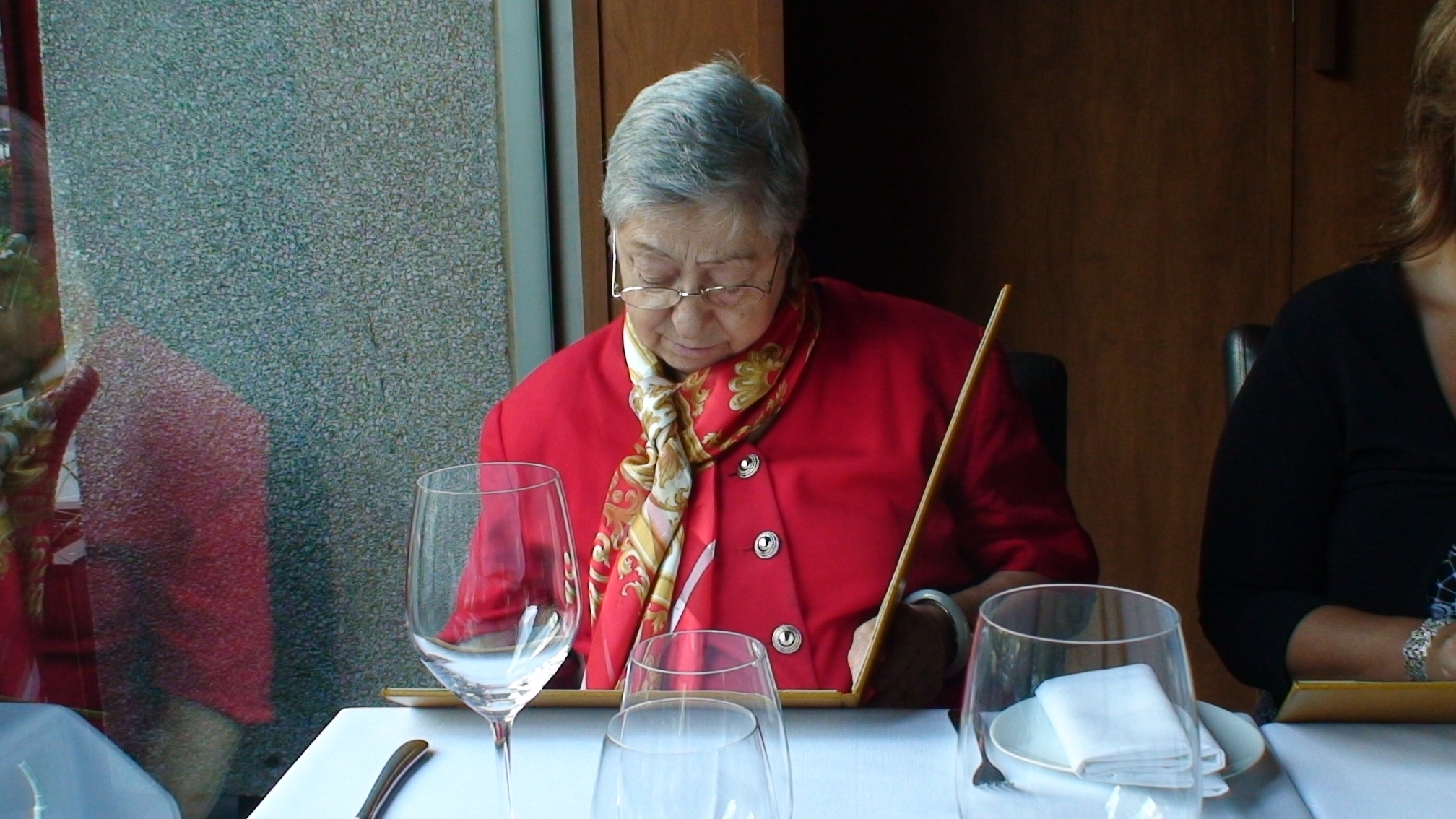








I took my eyes off the menu to glance outside. On the other side of the big bay window, one of the restaurant musicians was emptying his spit valve. I redirected my gaze back across the table to my mother who was weighing her choices. By the look on her face, I knew exactly what she was thinking: “Thirty dollars for rabbit! I could’ve made rabbit at home and I guarantee it would be ten times better than what we’re going to eat here!” My mom is not one for fine dining but, alas, she was along for the ride on this night as we checked out Garcon, pegged by many as one of Montreal’s best.
Maybe so, but beside our table and the three musicians cleaning their instruments out on the patio, the place was dead. In all fairness, however, it was early, only a little after 6:00 p.m. Of course, by the time we left at a little after 8:30 p.m., the place was still dead. Again, it could have been timing. On the other hand, it could have been the quality of the dishes served. In retrospect, I’d lean toward the latter.
The menu offered some enticing alternatives and, after much thought, my sister and I both opted for the same bone marrow ravioli with escargot and confit shallot roasted in marrow bone with lettuce and lardons. My mother, however, wasn’t having any of it, skipping the appetizers and even passing on the simple garden salad suggested by our waiter. To make up for mom’s unwillingness to play ball, I ordered a third appy “for the table”, the squash tortellini with truffle oil, boletus mushrooms, baby peas, and sage butter.
The bone marrow ravioi was a huge disappointment, served dry-baked and devoid of any saucing, while the escargot and confit shallot roasted in bone marrow proved surprisingly bland, accompanied by shredded beef that seemed to have been boiled into submission.
The squash tortellini was relatively inoffensive in comparison. The actual tortellini was thin and nicely al dente, its squash interior devoid of any of the vegetable’s subtle sweetness. They may have well been potato tortellini and I wouldn’t have noticed a difference. The accompanying sauce (the baby peas and sage butter) was very good however, as were the roasted boletus.
For my mother’s main course, she had the rabbit stuffed with lobster and mango, served with rosemary polenta, rabbit shoulder ravioli, brussel sprouts and almonds. It was a bold but ultimately ill-advised attempt at marrying three ingredients that had no business being together, much less hanging around on the same neighborhood plate. It wasn’t terrible but by no means was it good either. My mother complained about the partially-cooked brussel sprouts, but did some to not mind her polenta. I thought the rabbit shoulder ravioli were nicely executed though.
Mom declared my sister’s roasted lamb the best of the three mains, which was a little like crowning Moe the smartest of the Three Stooges. Served medium-rare, the meat was tender but bland, accompanied by some very nice potato gnocchi with avocado butter, vegetables, and a pretty good lamb belly.
I went with the roasted veal filet that, I later informed our waiter when he inquired about our meals, was overdone and cold. “Overdone AND cold?”he asked. Yes. No easy feat. But I wasn’t too broken up over the veal since I actually ordered the dish for the accompanying sweetbread lasagne. It turned out to be a few morsels of lukewarm and fairly tasteless sweetbread and equal-sized morsels of fat layered beneath some sheets of spinach pasta. No sauce. No discernible spicing. I imagine that if the staff of my high school cafeteria had ever attempted this dish, they would have been more than equal to the task. The accompanying chanterelle mushrooms were inedible. Hilariously so. They were the type of food item you’d convince a friend to try just so you could see the look on their face when they actually tasted the damn things. I had half a mind to play this gag on my mother but given that she had already spat up a good half-dozen mouthfuls over the course of the meal, I gave her a break.
We didn’t dare risk dessert.
Service was actually quite good, the only low-point coming at the end of our meal when the waiter whisked my mother’s side plate away, sending its partially masticated contents sailing across the table and into my lap.
If this is truly the best fine-dining that Montreal has to offer, then I’m sticking with Smoked Meat Pete’s.
Some thoughts on your thoughts on In the Garden of Iden:
Whovian writes: “The characters seemed very real to me, whether I liked them or not. At first I was put off by Mendoza calling us all mortal monkeys.”
Answer: I too loved her from the get-go. Baker does a great job of introducing Mendoza as a precocious but incredibly charming child, then fast-forwarding her to adulthood over the course of a chapter. In my mind, those childlike elements we were introduced to early on remained with her throughout the book and, in my opinion, made her that much more sympathetic. Which is why I really wasn’t put off by her opinion of mortals. It was an innocent, child-like perspective. Besides, as this novel proves, she was right all along. We ARE monkeys!
Whovian writes: “I thought it was clearly shown how these immortals can suffer, fear, want, etc., when they cannot die. I truly believed and understood that life for the immortals is difficult, to say the least.”
Answer: True. That point was really driven home for me when Joseph gives her the lowdown on mortal-immortal relationships. He does so in a matter-of-fact way as someone who has experienced love and loss so many times that he has risen above its effects. Mendoza, however, is new to this game, and it’s her innocent belief that she COULD make it work that makes her falling in love with Nicholas so tragic. As someone else pointed out – you sympathize with the character and you desperately want her relationship to work but, in the back your mind, you can foresee it is doomed to end tragically.
Whovian also writes: “Mendoza may be immortal and highly intelligent, yet she is painfully young. Her lack of experience allows me to forgive her for her mistakes and harsh outlook on the rest of human kind. And when she wonders, “Are we really good for people?” I wondered along with her. It’s something that, for me, doesn’t really get answered.”
Answer: Yes, this is something else I wondered about. In the long run, are they doing more harm than good? In the big picture, I would guess yes, their work will better humankind in the long run so it is obviously worthwhile. But in the small picture, specifically as it relates to the players both mortals and immortals who are involved in the retrieval, one could argue that they are far worse off for their experiences.
Mercie writes: “I enjoyed Mendoza’s youthful take on all the goings-on during the story, and especially thought her initial aversion to humans and their “violent” nature was a very teen-feeling viewpoint.”
Agreed. I agree. If she had grown up in our contemporary society, I’d imagine her as a nihilist goth chick. Tres Lenore.
Nebula writes: “But once I read _In the Garden of Iden_, I went on to read all her Company novels and although her first is still my favorite, they are all a wonderful mixture of humor, adventure, poignant romance and historical facts.”
Answer: It’s great to hear the rest of the series lives up to this first book. Like I said, I really enjoyed In the Garden of Iden and do intend to pick up the rest of The Company titles.
Itsme writes: “ I liked her whole time travel theory but found the process to make them immortal unexplained, like I had missed something? – what were they doing to them??”
Answer: True. This is hinted at very early on but never fully explained. To be honest, I didn’t think it was that important to the story given that this is the first book in a series, and I assumed this subject would be covered in future entries.
Itsme writes: “In the beginning, the author gives us so much information about the Company that is really very interesting but really irrelevant because you never hear anything about it after that (but I assume this would be covered in the following books?? but after this one, there is no chance i’m going to find out) – but I found that I was more interested in The Company and its policies than I was about Mendoza’s individual story.”
Answer: What I found interesting was learning about The Company’s policies via Medoza’s experiences in the field. It was through the sometimes unforeseen circumstances that developed over the course of her first mission that we got to learn about this unique entity. Like you, by book’s end I was wanting to know more.
Bar Stool Babe writes: “I also must applaud the way you show the inevitable progression of “political correctness” in the future. Yech!”
Answer: Ha! Agreed.
Narelle from Aus writes: “The premise that you cannot change history was interesting. However, I did move onto Sky Coyote after finishing In the Garden of Iden and I think the motivations behind this philosophy is explored in more detail and it isn’t as cut and dry as it first appears.”
Answer: Ah, I’m intrigued. Perhaps my theory on history’s immutable nature in this series may be up for debate.
Narelle from Aus writes: “When you have an immortal as old as Joseph, when he speaks you wonder what multitude of experiences he is drawing from. So as well as reading the story on the page, his character allowed me to take my mind to what else he had seen considering his age.”
Answer: Yes. I could just imagine him reprimanding: “You kids who grew up during this Inquisition had it easy. In my day, they didn’t torture you with nice clean instruments. In my day, the instruments of torture were filthy and you’d die of infection long before you bled out…”
Narelle from Aus writes: “It would be difficult to watch humans make the same mistakes over and over and you not be able to do anything about it.”
Answer: And yet, throughout this novel, I kept thinking “how very topical!”. Those who do not learn from history…
Thornyrose writes: “ The one thing that seriously jarred me at the beginning of the novel, and that I couldn’t shake, was the early explanation of time travel. Ok, I can buy into the “you can’t change history” approach. But the caveat “But this law can only be observed to apply to recorded history”. My first thought was, if someone writes a journal noting something, but the journal is lost 200 years later, does that mean that its not really recorded history? If the Company wants to change history, do they in fact simply send agents to remove documentation so they can modify history in the way they want?”
Answer: In my interpretation of the laws of time travel set forth in this book, the removal of a historical document would not allow them to change history. Even though that journal was lost, it is still recorded history. The fact that The Company doesn’t have access to this document (and, thus isn’t privy to the way this specific aspect of history played out) gives the illusion that one can change the past. Of course, after reading Narelle form Aus’s post, it seems that I may have to revise this theory once I read the ensuing books in the series.
Thornyrose writes: “I enjoyed the time frame that Ms. Kage elected to set the story in. And the news reports picked up by radio to keep the agents informed of (relatively) local happenings. “
Answer: Yeah, I wasn’t sure what to make of those news reports at first. I didn’t know what the heck was going on and then, when I realized they were clandestine reports being filed by representatives of The Company, I thought them a clever way to update both the characters and the audience in highly entertaining fashion.
Thornyrose writes: “While I wasnt suprised at the physical relationship that developed between Nicholas and Mendoza, I was a bit curious as why the Company didn’t deal with that matter before putting people out in the field. I half expected that sexual training would have been part and parcel of the schooling, rather than letting a new agent out in the world, to have their hormones kick in in an uncontrolled environment.”
Answer: That’s a good point and one I didn‘t consider until you brought it up. It was strange that their orientation didn‘t cover this subject. Maybe past experience proved that no amount of orientation or theoretical grounding could prepare individuals for the inevitable heartbreak and loss. Perhaps the only way to learn the lesson is to experience it firsthand.
Thornyrose writes: “Loved Sir Walter, and his “modifications”. It felt right that the poor man would end up running off to take a second chance at grabbing for the brass ring.”
Answer: I too loved Sir Walter’s metamorphosis from a doddering old codger to frisky not-so-senior.
Sanura writes: “The first, since it was at the beginning, is her amazingly convincing portrayal of the thought processes and reactions of a five-year-old, without resorting to oversimplicity or mere obtuseness.”
Answer: I couldn’t agree with you more. It was this deftness that so thoroughly won me over. Those first few chapters detailing Mendoza’s childhood were among my favorites.
Sanura writes: “Admittedly, her characters were superhuman, but there’s still a certain self-identifiability with them, they’re characterized so well.”
Answer: Exactly. Even though they may have been physically changed they essentially remain true to who they were before the process. This is why I felt such sympathy for all of them – Mendoza, Joseph, and even goat-loving Nef.
Anti-Social Butterfly writes: “Both Nicholas and Mendoza had been deeply indoctrinated which should have built a unbreachable wall between them, but they were able to look past that for a while, and yet it was that dogma that eventually drove them apart. They had deluded themselves into believing the other would come around making it impossible for them to move beyond that romping sexual stage of their relationship.”
Answer: And therein lay the tragedy, the fact that both felt they would be able to overcome their differences and change the other, thereby attaining true happiness. What they hadn’t counted on was the fact that the person they fell in love with would prove as obstinate as they were.
A Honshuu writes: “Nicholas and his religious fervor would only have destroyed Mendoza in the end, making her doubt her life and her purpose.”
Answer: I think that Mendoza would have been destroyed by the relationship regardless of Nicholas’s religious convictions. In fact, I think that had she succeeded in saving him and changing his mind, the end would have been equally tragic. Regardless of how it worked out, he was a mere mortal and would have left her eventually.
Charlie’s Angel writes: “Joe, I can’t believe you didn’t mention that the immortals get buzzed from chocolate! I can just imagine them crashing your chocolate party.”
Answer: Yes! I loved the fact that Joseph dispensed those Theobromos bars as rewards of sorts. Took a page out of my book.
Sylvia writes: “There was also the temptation in the garden as she became entranced by Nicholas.”
Answer: A neat little reverse there. Nicholas hesitates taking the apple she offers him because he sees the symbolic parallels when, in truth, she is the one venturing to take the bite of the forbidden fruit in this case.
Sylvia writes: “At first my reaction to the “end” was – oh man, there is so much left “untold.” It is great there is a series of books…now to get them.”
Answer: That‘s exactly how I felt. I’m very much looking forward to the next book in the series.
Drldeboer writes: “Once she was rescued I just could not get any sympathy for Mendoza’s personal issues, and little sympathy for Nicholas and the actions of the people therein as it has all been unpleasantly hashed before.”
Answer: Really? I thought Baker realized some wonderfully sympathetic characters here.
Aboleyn24 writes: “The way that time travel is approached is great fun. Even though time travel is possible people from the future find it distaceful. So instead they make immortals to do the dirty work for them.”
Answer: Interesting. That’s a point I glossed over and never gave much thought to until you brought it up. Did I miss something? Why ARE The Company’s time-traveling employees strictly made up of immortals? Maybe this is something that will be explored in future books?
Anyway, great discussion. I’d love to hear more of your thoughts and please get the last of your questions for author Kage Baker in by tomorrow as I’ll be sending the rest her way by day’s end.
To Susan W. and her request that a Gene Wolfe title be considered as a book of the month club selection. Susan, I’m a huge fan of his and list Wolfe’s mammoth Book of the New Sun teratology among my very favorites. Definitely something to consider.
Finally, thank you for all your thoughts on Don. It’s really wonderful to see how well-loved the man was.






Leave a Reply