So, in yesterday’s blog entry, I offered up a short but sweet summary of my rise from humble animation freelancer to landing a gig on the biggest television production in Canada. I had uprooted, wife and dog in tow, and joined my writing partner, Paul, on a west coast adventure that – at the time, was planned to run two years, culminating in a no-doubt fantastic fifth and final season that would then see us all go our separate ways. Of course, whether Paul and I would be around to witness that fifth season was up in the air. Our first season deal was a composed of two parts: the first, a ten episode guarantee that came with co-producer titles; the second, an option to pick us up for the fourth season’s back twelve episodes (remember the days of the 22 episode season?) and a bump up to producer titles. And so, Paul and I settled in and got to work.
I remember spending a lot of time in our offices that first season, writing. There was talk of a past writer who had spent much of their time hanging around set in an attempt to ingratiate themselves to the actors, neglecting their script work much to Brad and Robert’s chagrin – and I vowed I would not be that guy. Every day Paul and I would gather in an office (either his or mine) and write. Back in those days, we were a true writing team. We would bounce dialogue back and forth between us, essentially giving life to the scene by acting it out in the room. One of us would pace, the other would write it all down, then we’d switch. At day’s end we’d head home and, whoever happened to have the updated version of our latest script (usually the last one writing) would spent the evening going over the scenes. The next day, we’d read what we had and pick up where we left off. In retrospect, it’s a wonder we were able to get anything done at all using this collaborative method – yet we managed to write 7 of season four’s 22 episode run.
That’s not to say we didn’t spend time on set. Occasionally, we’d swing by to say hi to the cast and crew, especially when our episodes were being shot, but, for the most part, we tried to stay out of everybody’s hair and get those scripts written. On any other show, we probably should have spent more time on set to ensure things ran smoothly but, we quickly learned, after three years, the Stargate production was a well-oiled machine. Executive Producer Michael Greenburg was our dedicated onset producer and we could take comfort in the knowledge that he would put out any potential fires. Also providing back-up were Co-Executive Producer N. John Smith and Unit Manager John G. Lenic who made sure the ship ran smoothly.
I remember the first big dinner we went to soon after our arrival. All of the producers gathered for a meal at what was then one of Vancouver’s top restaurants. John Smith, who has been in the business so long I’m actually more surprised if he DOESN’T know someone, chatted away with the affable owner. It was a magnificent meal. The following week, I drove by and was shocked to find the place shuttered. I had been planning a return visit but, clearly, enjoying another meal there would be out of the question. What happened? Well, eventually I learned that the restaurant owner had a little tax disagreement with the government. You can probably guess who won. For years, the other producers wondered what had happened to the affable owner and then, some time later (I think it was SG-1’s sixth season) ,Michael Greenburg told us he’d seen him working in a mall sandwich shop. The story amazed and horrified, branding itself into the back of my mind as a cautionary tale. The lesson: Work hard, save your money, and PAY YOUR TAXES!
And, in SG-1’s fourth season, I did just that. I spent my days in the office writing then returned home where I spent much of my free time writing. As any writer will tell you, ours is not a 9 to 5 job. It’s not like we can simply switch off our brains in mid-script. Even if we’re not sitting behind our computer or pacing the corridors of the production offices running dialogue with our writing partners, we’re writing. Sometimes in the shower. Often in bed. Occasionally, during dinner when your wife is talking to you. It can be a lonely business. For all involved.
I also found time to reach out to the fans, hitting some of the forums in a desire to interact with our audience. It was a lot of fun and very enlightening, then, eventually, baffling, hurtful, and irritating. But always entertaining. Most of those I met online were very nice. A few, not so much. And, as that fourth season of SG-1 developed, I was introduced to the wild and wacky world of fandom wars! But I’ll save the discussion on that topic for a later entry.
Anyway, like I said – we worked hard that fourth season, completing seven scripts. AND also finding the time to come up with lyrics for the SG-1 opening theme – which we sang, at Peter Deluise’s behest – during the recording of our season four commentary:
Looking back on SG-1’s fourth season:

SMALL VICTORIES (401)
I remember sitting in Brad’s office when we first came to Vancouver and having Brad ask Robert how he planned to conclude the season three finale, Nemesis. Well, Rob knew exactly where he wanted to go with the story and broke it down for us. I remember thinking “There is no way they’re going to be able to pull this off.”. And yet, he did. WE did. Again and again. The high point of this episode isn’t the Rick Moranis lookalike taking a face full of acid in the teaser, or the Russian dialogue that, when translated, reads: “What’s that noise” “Maybe it’s that bug from the last episode.”, but the outtakes – specifically, one depicting a seated Thor requesting a Mokochino and another with the Asgard reaching up to goose Carter and getting his face slapped as a result. This was also the first episode I saw Director Martin (“AND CUUUUUUUT!”) Wood in action and he was a sight to behold.

THE OTHER SIDE (402)
I remember coming away from this episode impressed by Brad and Robert’s willingness to take chances, especially with regard to our characters. O’Neill kills someone at episode’s end – and I’m not talking in the heat of battle. He gives the order to close the iris and then, seconds later, the Eurondan leader apparently steps through and ends up pasted on the other side. Granted, Jack did warn him not to follow but still – it was a calculated move on the part of the usually happy-go-lucky team leader. Actor Rene Auberjonois, who played the doomed leader Alar, was a pleasure to work with. Soon after wrapping production on the episode, he swung by Brad’s office to tell him Alar had a twin brother who’d be more than happy to make an appearance in a future episode. Two other things stand out for me about this episode. The first was being on set and discovering how they pulled off the chamber-rattling off-screen concussive bursts of the bombings. Director Peter DeLuise would yell: “Boom! Shake-shake-shake!” The actors would feign being rocked while members of the crew would rain dust and sand down on them, unseen overhead. The second aspect of this episode that will forever stand out for me were those crazy alien glasses that are SO alien that they’re completely counter-intuitive. In fact, I believe Rick made a gag of it in the episode by going to take a sip, giving the glass a curious look, then turning it around and drinking from the backside. This was Peter DeLuise at his best and his desire for alien props (from rounded hammers to red spray-painted kiwis) would be a source of endless amusement for Paul and I.
UPGRADES (403)
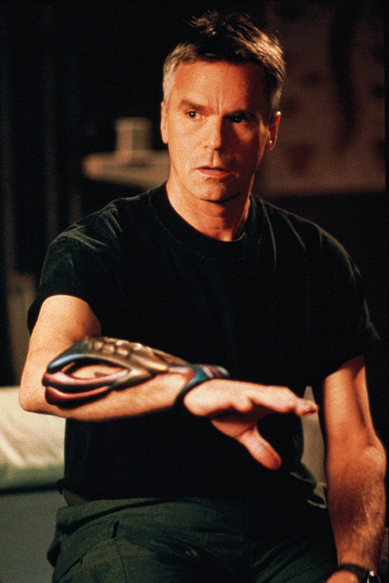
This was the episode that introduced me to the realities of the scriptwriting process. The fact is, as a show’s Executive Producer, it’s your job to make sure the episode is as good as it can be. As a result, you’ll be asked to cast the best actors, choose the best costumes and props, approve the best visual effects, sign off on the best cut and, most important of all, see to it that the script is as good as it can be. Often, this involves providing a writer with detailed notes for a rewrite. Occasionally (but a hell of a lot more than you, dear viewers, will ever know), it involves doing a pass on a script not your own – anything from a dialogue polish to a full script rewrite. But even in cases where a script is thoroughly rewritten, the original writer will retain sole credit. And so, more times than I can count, I’ve perused the boards and had to bite my tongue (or cross my typing fingers) as I read posts lauding Writer X, knowing full well that while Writer X’s name may have been the credited writer, the person who should’ve been lauded was Brad or Robert or Paul. I remember Paul sitting in our offices at one point in our Stargate run, amused because he had two scripts nominated for an award: one, on which he’d been co-credited on that I actually wrote, the other on which he’d received no credit but which he’d actually written. It’s a strange, strange business. Anyway, in the case of Upgrades, it was simply a case of a script that was tonally very different from first draft to shooting script. The original version had actually been very serious but, after Robert Cooper did his pass, it was transformed into a hilarious entry and one of my very favorites. The highlights of this episode for me was the memorable saran wrap force field (augmented with visual effects, but saran wrap nevertheless – I loved watching the dailies of our hero getting their face smooshed as they ran into the damn thing).
CROSSROADS (404)
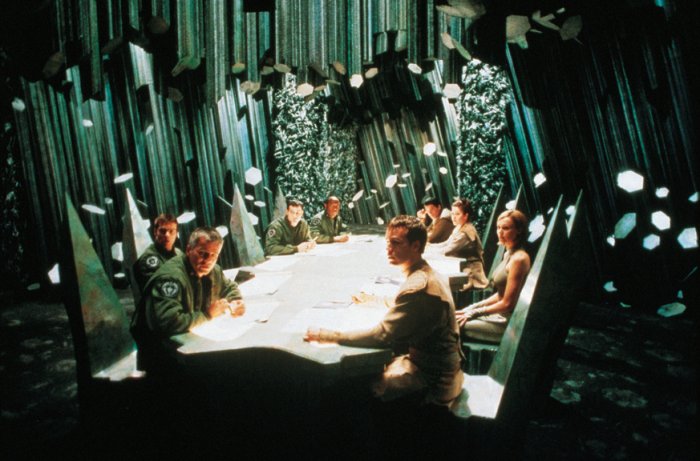
In the original version of this script, Teal’c exacts his revenge on Tanith and the episode concludes with, if not exactly a happy ending, then sure a satisfying one. But Brad suggested that, instead, we end the episode with Teal’c restraining himself and Tanith getting away with Shau’nac’s murder – at least temporarily. “That’s pretty dark,”I recall Paul saying. “I like dark,”countered Brad. And so did I. The original version of the script also contained a reference to the fact that Teal’c had gotten a (Jaffa) divorce from his wife, freeing him up to pursue that amorous rendezvous with his long lost love. Unfortunately, for some reason, it didn’t make the final draft and, as a result, Teal’c ended up looking like a big slut to many fans. All that being said, the high point of this episode for me was that damn pointy Tok’ra digs, everything from the porcupine walls to the lethal high-backed chairs. It’s a wonder they weren’t impaling themselves all the time.

DIVIDE AND CONQUER (405)
Some point to this episode as the genesis of the grand shipper vs. anti-shipper debate as O’Neill and Carter finally admit their feelings for one another – and I suppose it was, except it didn’t come as much of a surprise. Shippers rejoiced as, after after three years of unspoken mutual attraction, “Sam and Jack” became canon. Anti-shippers, on the other hand, were less than enthused. And the forums lit up! And it wasn’t just the ship they were referring to. It was also the death of their beloved Martouf and the continuing presence of the Anise character, introduced in response to then President of MGM Television’s Hank Cohen’s request for “a sexy female alien” (A suggestion he got to repeat onscreen when he played himself in Wormhole Extreme).
In my next entry, I’ll tackle a few more episodes (including our version of Groundhog Day), the hiring of Ivon Bartok, and “the ship” sails on (at least in the early drafts of Beneath the Surface it did).


Leave a Reply